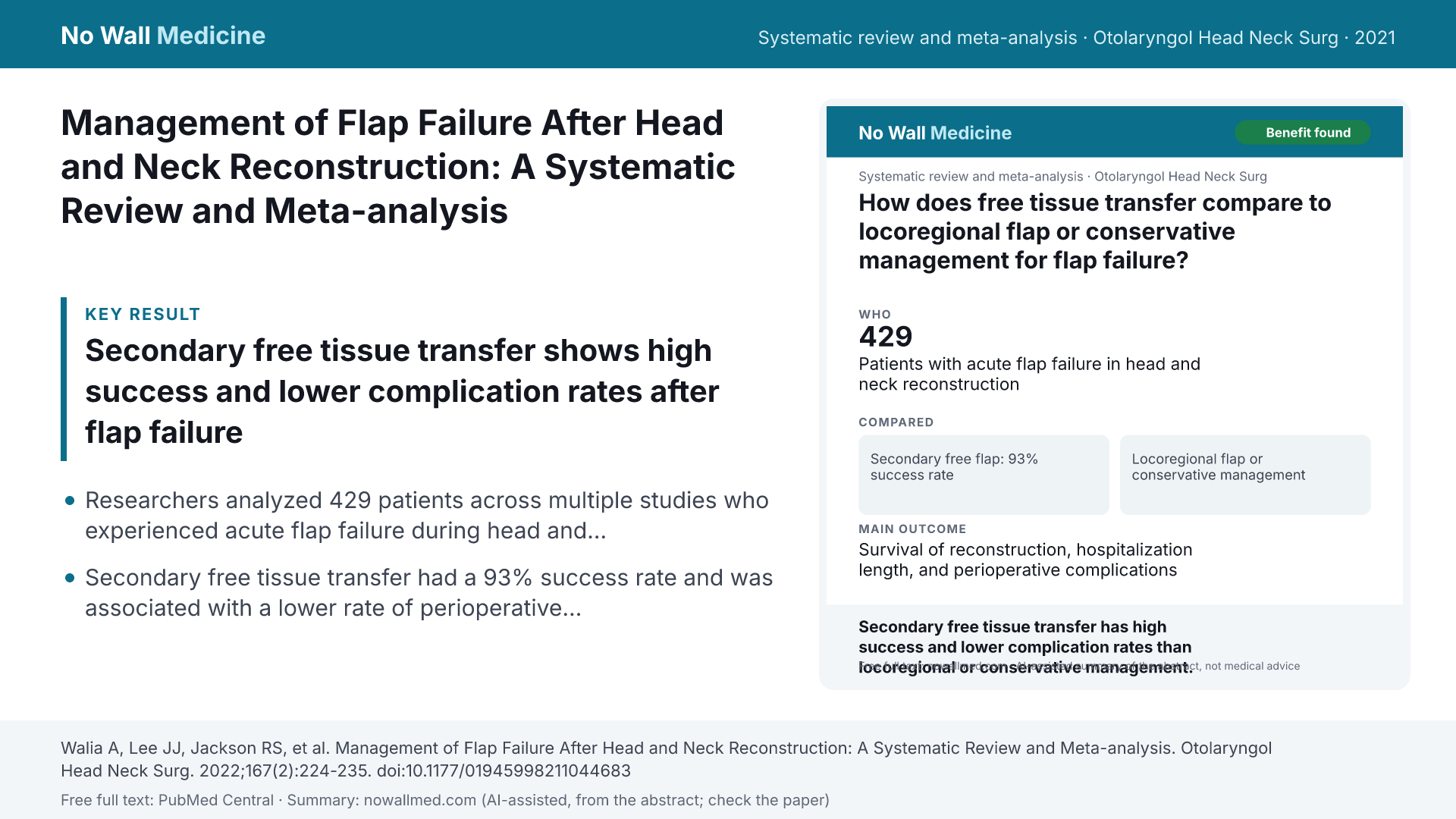
Secondary free tissue transfer shows high success and lower complication rates after flap failure
Management of Flap Failure After Head and Neck Reconstruction: A Systematic Review and Meta-analysis
Systematic review and meta-analysisBenefit found
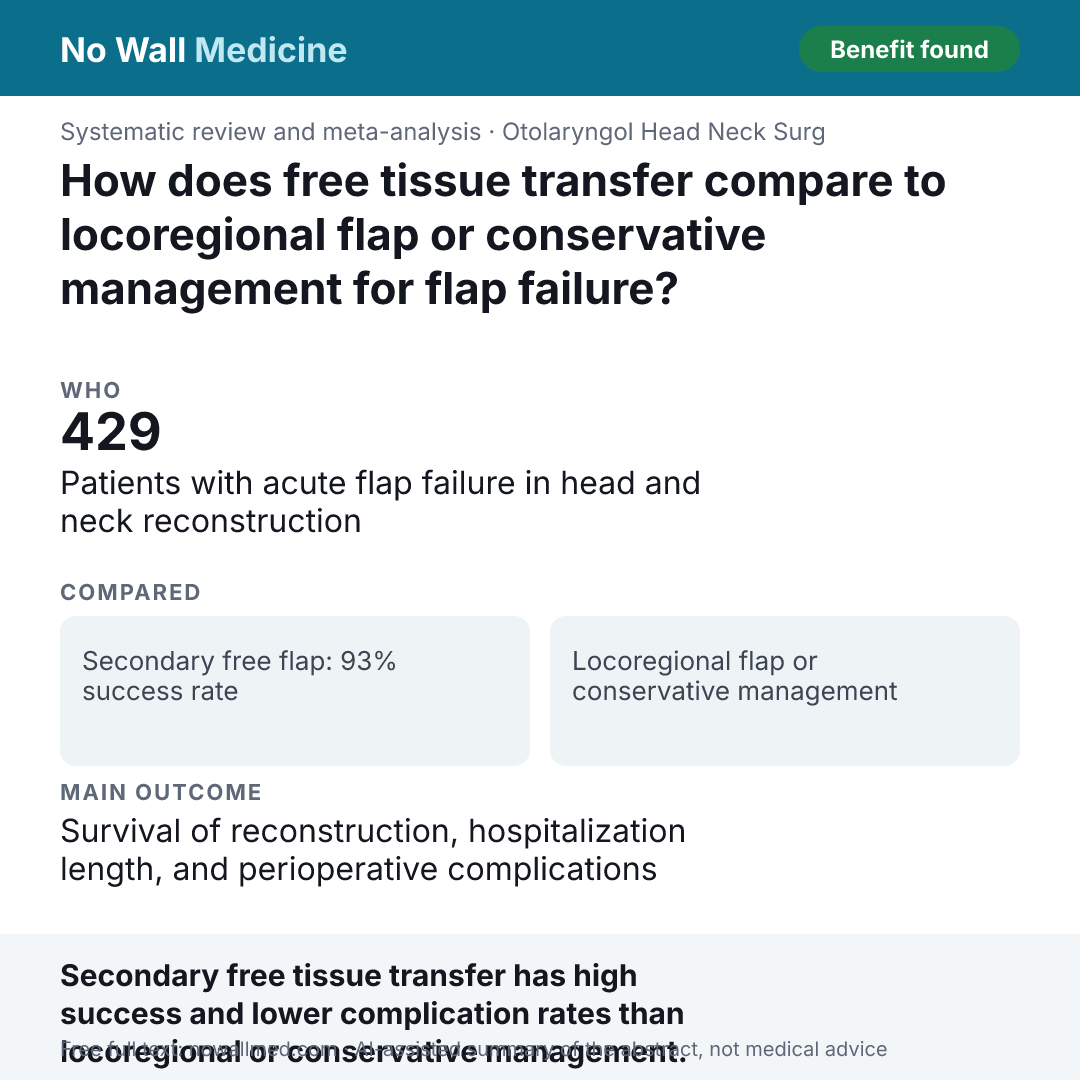
How does free tissue transfer compare to locoregional flap or conservative management for flap failure?
Who
429
Patients with acute flap failure in head and neck reconstruction
Compared
Secondary free flap: 93% success rate
Locoregional flap or conservative management
Main outcome
Survival of reconstruction, hospitalization length, and perioperative complications
Result: relative risk of perioperative complications 0.60 (95% CI 0.40 to 0.92)
Bottom line: Secondary free tissue transfer has high success and lower complication rates than locoregional or conservative management.
Otolaryngol Head Neck Surg · 2021-09-07 · Save PNG
Clinical question: How does free tissue transfer compare to locoregional flap or conservative management for flap failure?
Key points
- Researchers analyzed 429 patients across multiple studies who experienced acute flap failure during head and neck reconstruction.
- Secondary free tissue transfer had a 93% success rate and was associated with a lower rate of perioperative complications compared to locoregional flaps or conservative management.
- There was no difference in the length of hospitalization between secondary free tissue transfer and locoregional flaps or conservative management.
Headline and key points written with AI from the paper’s abstract, with every number checked against it. Read the paper before relying on them.
Was this summary helpful?
Subject terms
Headline, design, result, key points, caveat and citation as plain text.
Cite this article
Walia A, Lee JJ, Jackson RS, et al. Management of Flap Failure After Head and Neck Reconstruction: A Systematic Review and Meta-analysis. Otolaryngol Head Neck Surg. 2022;167(2):224-235. doi:10.1177/01945998211044683
Spotted a mistake? Suggest a correction