Follow-up screening strategies for tuberculosis in migrants show varying coverage and disease detection rates
Mandatory, voluntary, repetitive, or one-off post-migration follow-up for tuberculosis prevention and control: A systematic review
Systematic review and meta-analysisNo clear difference
How do post-migration follow-up strategies affect tuberculosis coverage and yields?
Who
International migrants at risk of tuberculosis · 7 countries
Compared
Mandatory programmes
Voluntary programmes
One-off screening
Repetitive screening
Main outcome
Coverage and tuberculosis yields
Bottom line: Voluntary programmes have similar yields to mandatory ones, and repetitive screening does not increase yields compared to one-off screening.
Limitation: High heterogeneity in programme design and underreported factors like baseline incidence and reactivation rates.
PLOS Med · 2023-01-31Download image
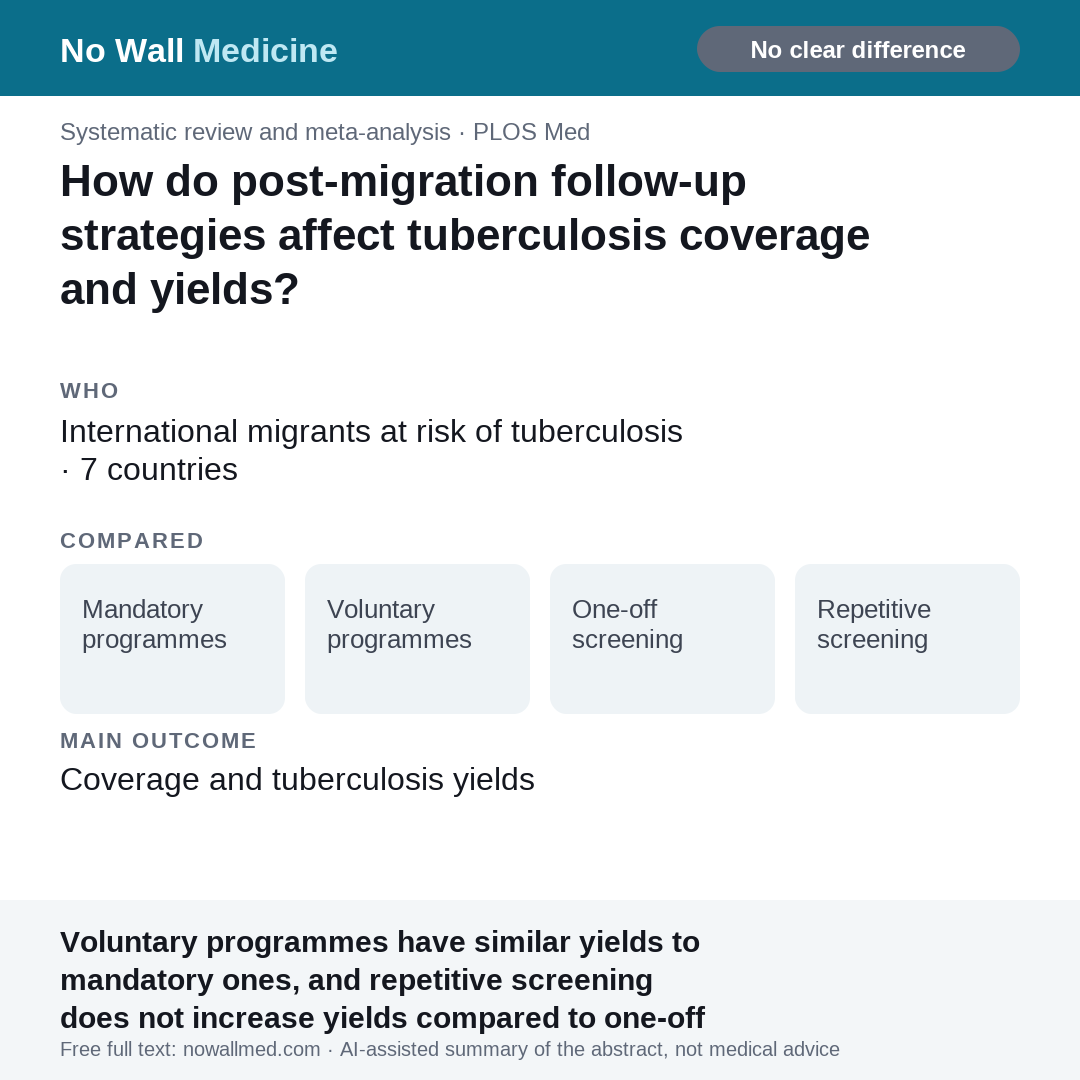
Clinical question: How do post-migration follow-up strategies affect tuberculosis coverage and yields?
Why it matters: It is unknown how different follow-up screening designs, such as mandatory versus voluntary or repetitive versus one-off, affect the coverage and detection of tuberculosis in migrants.
Key points
- Researchers reviewed 24 reports from 7 countries to analyze how different follow-up screening strategies for tuberculosis affect coverage and disease detection yields.
- Disease detection yields ranged from 53.05 (31.94 to 82.84) in a Dutch study to 5,927.05 (4,248.29 to 8,013.71) in a United States study.
- Repetitive screening was not associated with higher yields compared to one-off screening, and voluntary programs showed similar yields to mandatory programs.
Limitation the authors note: The study is limited by the heterogeneity in the design of the identified screening programmes and factors that are often underreported or not known.
Headline and key points written with AI from the paper’s abstract, with every number checked against it. Read the paper before relying on them.
Was this summary helpful?
Subject terms
Cite this article
Wahedi K, Zenner D, Flores S, Bozorgmehr K. Mandatory, voluntary, repetitive, or one-off post-migration follow-up for tuberculosis prevention and control: A systematic review. PLOS Med. 2023. doi:10.1371/journal.pmed.1004030
Spotted a mistake? Suggest a correction
Top studies every Monday
The week’s key trials and guidelines in your specialties, plus any topics you follow. By email, free.
Get the weekly digest