Mandibular Advancement vs Combined Airway and Positional Therapy for Snoring: A Randomized Clinical Trial
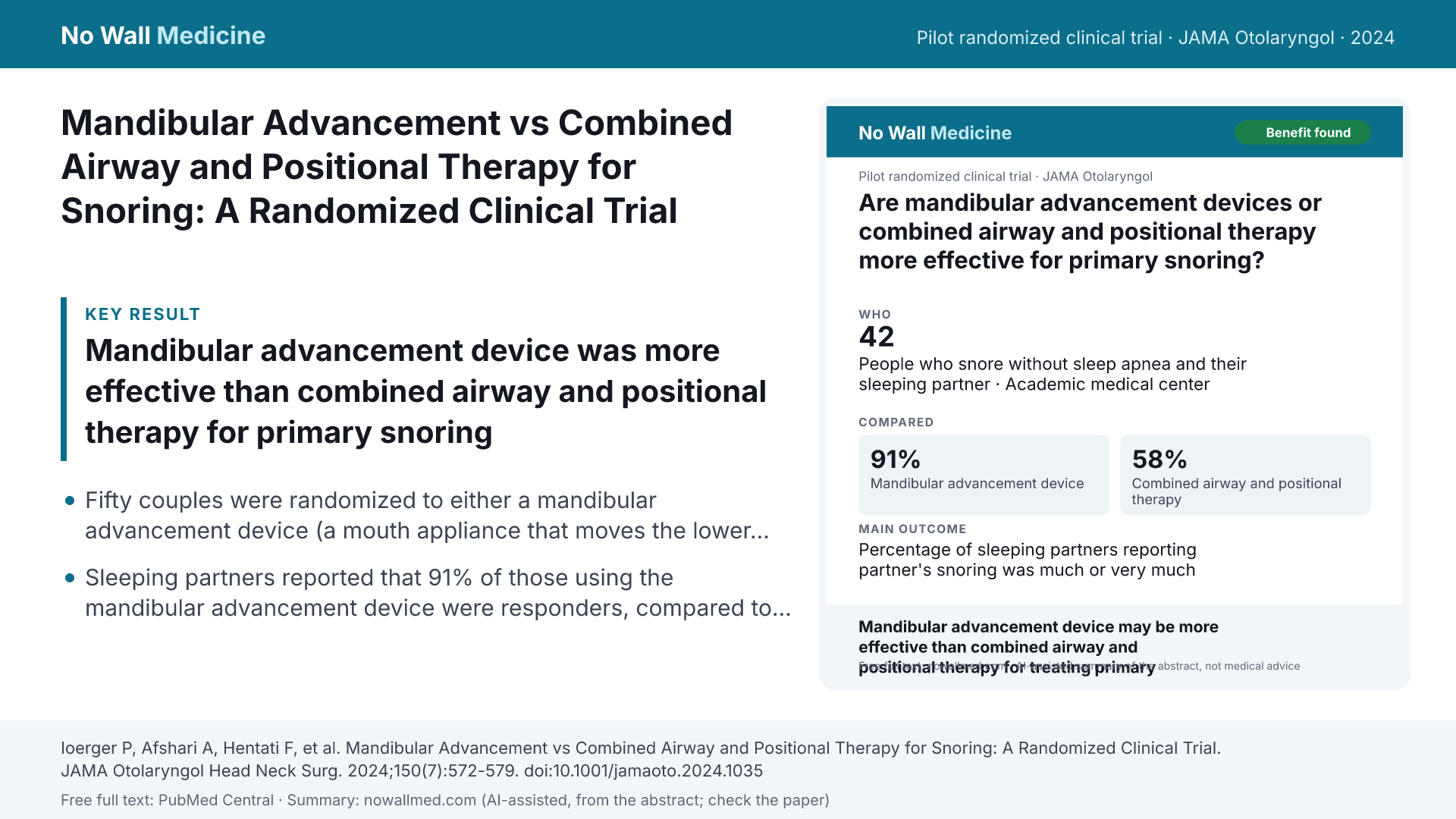
Key result: Mandibular advancement device was more effective than combined airway and positional therapy for primary snoring
Pilot randomized clinical trialBenefit found
Are mandibular advancement devices or combined airway and positional therapy more effective for primary snoring?
Who
42
People who snore without sleep apnea and their sleeping partner · Academic medical center
Compared
91%Mandibular advancement device
58%Combined airway and positional therapy
Main outcome
Percentage of sleeping partners reporting partner's snoring was much or very much improved
Result: difference of 33 percentage points (95% CI, 8-58)
Bottom line: Mandibular advancement device may be more effective than combined airway and positional therapy for treating primary snoring.
JAMA Otolaryngol · 2024-05-23
Key points
- Fifty couples were randomized to either a mandibular advancement device (a mouth appliance that moves the lower jaw forward) or combined airway and positional therapy for 4 weeks.
- Sleeping partners reported that 91% of those using the mandibular advancement device were responders, compared to 58% of those using combined airway and positional therapy.
- The difference between the two treatments was 33 percentage points, and 4 participants were withdrawn due to adverse effects.
Discussion prompts
- Would these patients look like yours? Who was left out?
- Is the main outcome one that matters to patients?
- Is the difference large enough to change what you do?
Cite: Ioerger P, Afshari A, Hentati F, et al. Mandibular Advancement vs Combined Airway and Positional Therapy for Snoring: A Randomized Clinical Trial. JAMA Otolaryngol Head Neck Surg. 2024;150(7):572-579. doi:10.1001/jamaoto.2024.1035
Free full text: PubMed Central · Summary and visual abstract: nowallmed.com/a/mandibular-advancement-vs-combined-airway-and-positional-therapy-for-1i7wxsf/ (AI-assisted from the abstract; check the paper before relying on it).