Mandibular advancement devices were noninferior to CPAP for reducing blood pressure in sleep apnea patients
Mandibular Advancement vs CPAP for Blood Pressure Reduction in Patients With Obstructive Sleep Apnea
Randomized, noninferiority trialBenefit found
Is mandibular advancement device noninferior to continuous positive airway pressure for blood pressure reduction?
Who
220
321 participants aged 40 years or older with hypertension and moderate-to-severe obstructive sleep apnea · 3 public hospitals
Compared
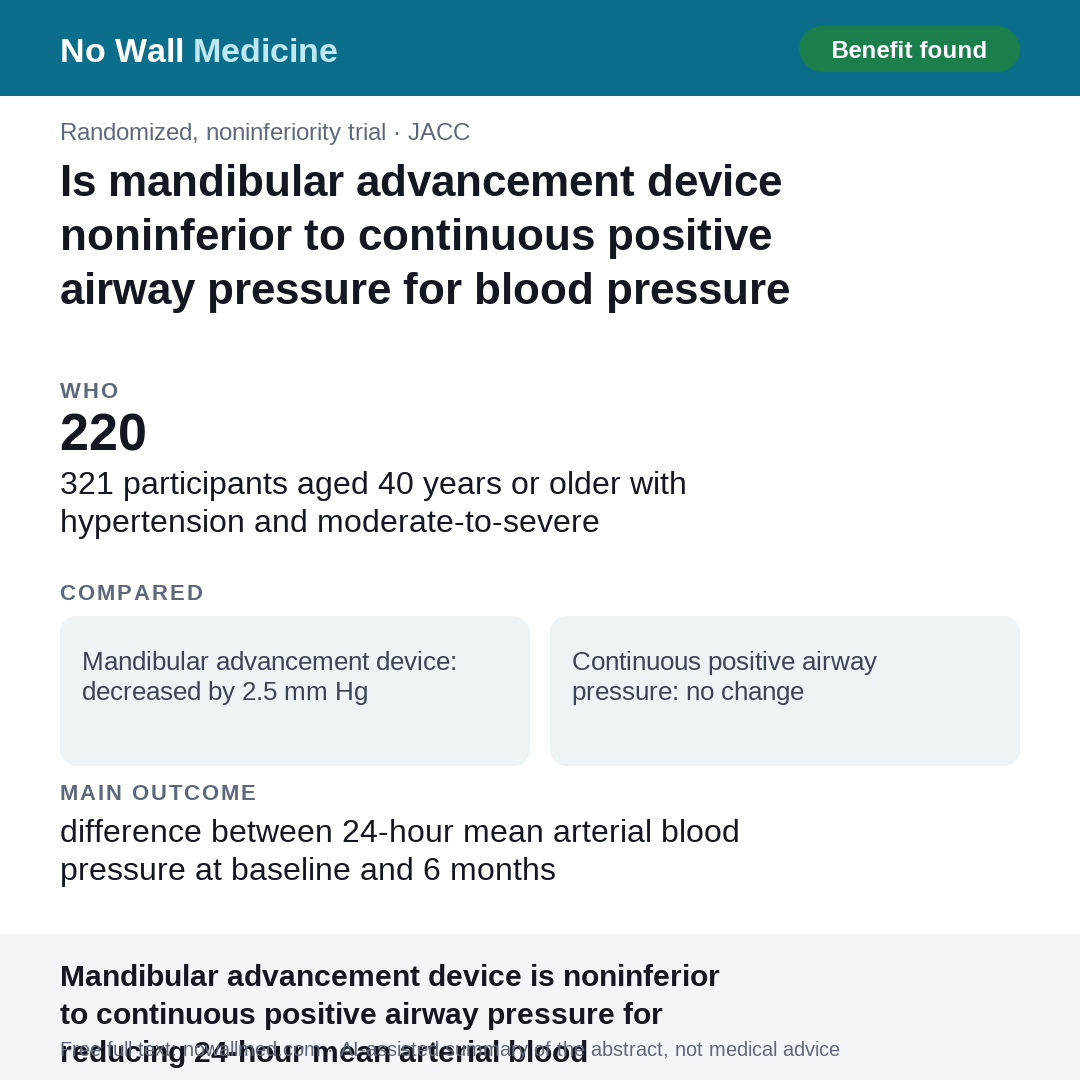
Mandibular advancement device: decreased by 2.5 mm Hg
Continuous positive airway pressure: no change
Main outcome
difference between 24-hour mean arterial blood pressure at baseline and 6 months
Result: -1.6 mm Hg (95% CI: -3.51 to 0.24)
Bottom line: Mandibular advancement device is noninferior to continuous positive airway pressure for reducing 24-hour mean arterial blood pressure.
JACC · 2024-04-06Download image
Clinical question: Is mandibular advancement device noninferior to continuous positive airway pressure for blood pressure reduction?
Why it matters: It was unknown if mandibular advancement devices, an oral appliance therapy, are as effective as continuous positive airway pressure for reducing 24-hour ambulatory blood pressure.
Key points
- Researchers studied 220 participants aged ≥40 years with hypertension and moderate-to-severe obstructive sleep apnea, comparing mandibular advancement devices to continuous positive airway pressure.
- In the mandibular advancement device group, 24-hour mean arterial blood pressure decreased by 2.5 mm Hg at 6 months, while no change was observed in the continuous positive airway pressure group.
- The between-group difference in mean arterial blood pressure was -1.6 mm Hg (95% CI: -3.51 to 0.24), meeting the noninferiority criteria.
Headline and key points written with AI from the paper’s abstract, with every number checked against it. Read the paper before relying on them.
Was this summary helpful?
Subject terms
Cite this article
Ou YH, Colpani JT, Cheong CS, Loke W, Thant AT, Shih EC. Mandibular Advancement vs CPAP for Blood Pressure Reduction in Patients With Obstructive Sleep Apnea. JACC. 2024. doi:10.1016/j.jacc.2024.03.359
Spotted a mistake? Suggest a correction
Top studies every Monday
The week’s key trials and guidelines in your specialties, plus any topics you follow. By email, free.
Get the weekly digest