Manual marking technique for cataract surgery was as accurate as digital guidance systems
Manual Marking Guidance vs Digital Guidance System-Assisted Capsulorhexis in Phacoemulsification: A Noninferiority Randomized Clinical Trial
Noninferiority randomized clinical trialBenefit found
Is manual marking-assisted capsulorhexis noninferior to digital guidance-assisted capsulorhexis in accuracy?
Who
156
Adults aged 55 to 80 years with age-related cataract · Zhongshan Ophthalmic Center, China
Compared
Manual marking-assisted capsulorhexis: 0.22 mm (95% CI, 0.11-0.37)
Digital guidance-assisted capsulorhexis: 0.27 mm (95% CI, 0.14-0.52)
Main outcome
Median deviation of capsulorhexis diameter from the target diameter
Result: difference, -0.05 mm; 95% CI, -0.16 to 0.07
Bottom line: Manual marking-assisted capsulorhexis was noninferior to digital guidance-assisted capsulorhexis for capsulorhexis accuracy.
JAMA Ophthalmol · 2025-11-13Download image
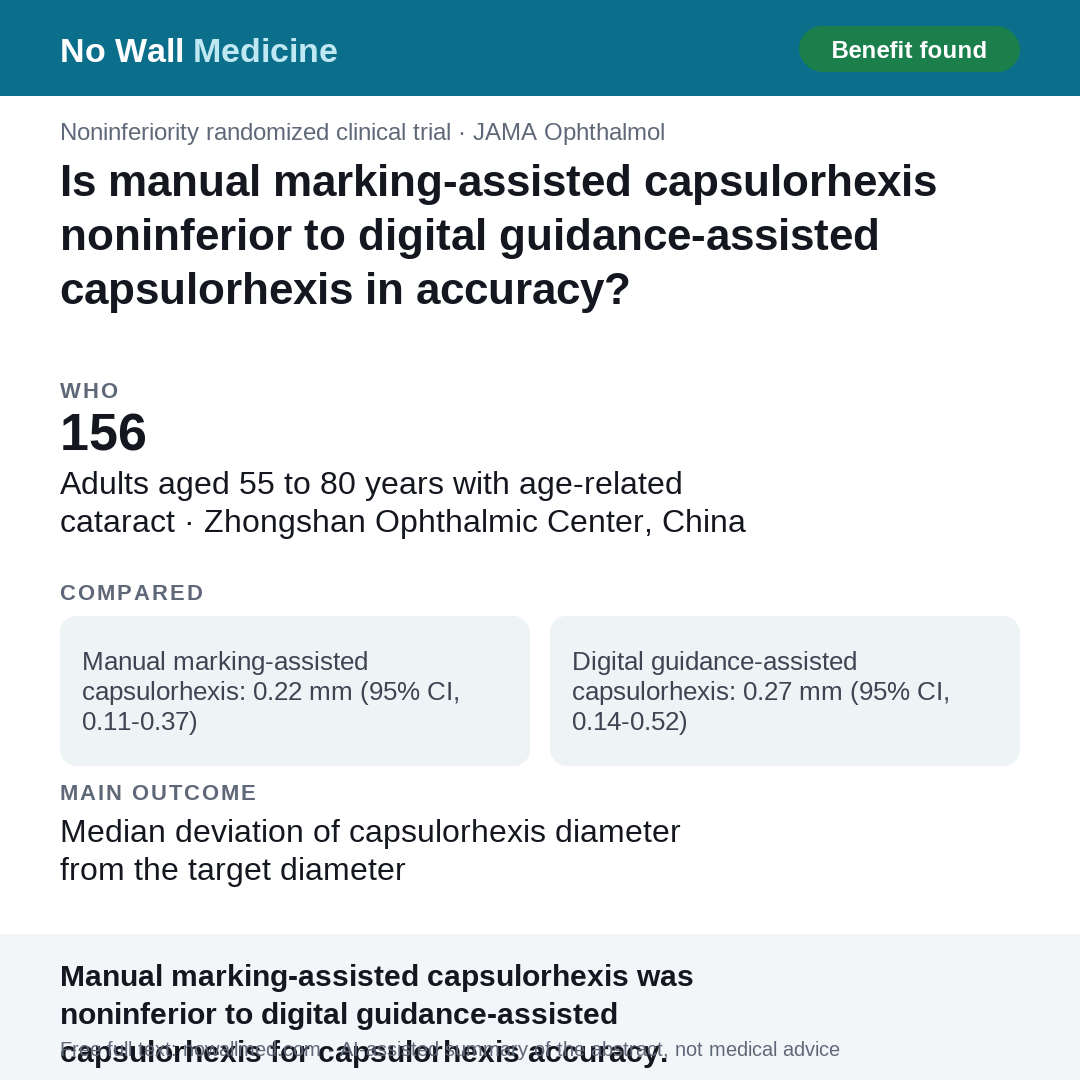
Clinical question: Is manual marking-assisted capsulorhexis noninferior to digital guidance-assisted capsulorhexis in accuracy?
Why it matters: Digital guidance devices for cataract surgery are not readily available, creating a need for device-free manual techniques that maintain accuracy.
Key points
- Researchers studied 156 adults with age-related cataracts, comparing manual marking with a lens caliper to a digital guidance system that projects a target ring.
- The median horizontal diameter deviation was 0.22 mm for the manual group versus 0.27 mm for the digital group, and the vertical deviation was 0.27 mm versus 0.33 mm.
- The proportion of ideal capsulorhexis, which is the opening made in the lens capsule, was 96.2% in the manual group and 88.5% in the digital group.
Headline and key points written with AI from the paper’s abstract, with every number checked against it. Read the paper before relying on them.
Topics
Cite this article
Chen X, Liu Z, Jin L, Zheng Y, Luo L, Liu Y. Manual Marking Guidance vs Digital Guidance System-Assisted Capsulorhexis in Phacoemulsification: A Noninferiority Randomized Clinical Trial. JAMA Ophthalmol. 2025. doi:10.1001/jamaophthalmol.2025.4448
Spotted a mistake? Suggest a correction