Flow limiting device reduces peak airway pressures during forceful manual ventilation in anesthetized patients
Manual ventilation with and without a flow limiting device during induction of general anesthesia: a randomized crossover trial
Randomized, two-group crossover superiority trialBenefit found
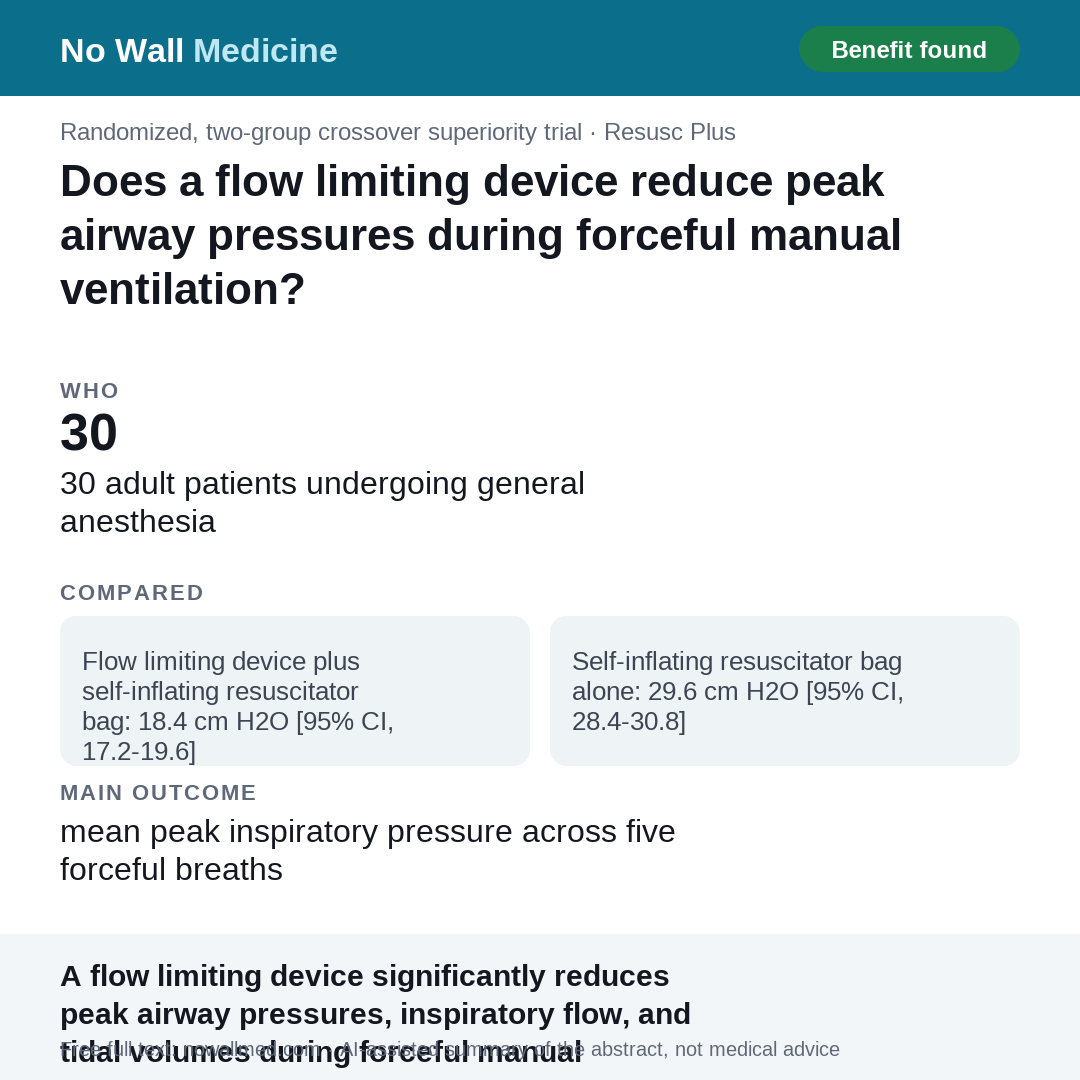
Does a flow limiting device reduce peak airway pressures during forceful manual ventilation?
Who
30
30 adult patients undergoing general anesthesia
Compared
Flow limiting device plus self-inflating resuscitator bag: 18.4 cm H2O [95% CI, 17.2-19.6]
Self-inflating resuscitator bag alone: 29.6 cm H2O [95% CI, 28.4-30.8]
Main outcome
mean peak inspiratory pressure across five forceful breaths
Result: mean difference of 11.2 cm H2O [95% CI, 10.5-11.9]
Bottom line: A flow limiting device significantly reduces peak airway pressures, inspiratory flow, and tidal volumes during forceful manual ventilation.
Limitation: Reduced tidal volumes may cause inadequate alveolar ventilation if not corrected over several breaths.
Resusc Plus · 2026-09-14Download image
Clinical question: Does a flow limiting device reduce peak airway pressures during forceful manual ventilation?
Why it matters: Forceful manual ventilation with a self-inflating resuscitator bag can cause excessive airway pressures and tidal volumes, increasing risks like lung injury or gastric insufflation.
Key points
- Researchers conducted a randomized crossover trial with 30 adult patients undergoing general anesthesia to compare manual ventilation using a self-inflating resuscitator bag with and without a flow limiting device.
- The mean peak inspiratory pressure was 18.4 cm H2O with the flow limiting device compared to 29.6 cm H2O with the bag alone, a difference of 11.2 cm H2O.
- The device was also associated with lower mean peak inspiratory flow of 60.1 L/min compared to 101.7 L/min and lower tidal volumes of 96.7 mL compared to 789.2 mL.
Headline and key points written with AI from the paper’s abstract, with every number checked against it. Read the paper before relying on them.
Cite this article
Brady MF, Ramanujam V, Dankievitch K, Barnicle R, Slutsky AS, Kendall MC. Manual ventilation with and without a flow limiting device during induction of general anesthesia: a randomized crossover trial. Resusc Plus. 2026. doi:10.1016/j.resplu.2026.101494
Spotted a mistake? Suggest a correction