Combining statistical models with expert knowledge helps map hotspots for emerging zoonotic viruses
Mapping hotspots of zoonotic pathogen emergence: an integrated model-based and participatory-based approach
Systematic literature review and integrated modeling approachBenefit found
Can model-based and participatory-based approaches be integrated to map zoonotic pathogen emergence hotspots?
Who
425
Articles on Filoviridae, Coronaviridae, and Paramyxoviridae virus families · Five countries: Kenya, Peru, Senegal, Thailand, and Viet Nam
Compared
Model-derived maps: 89% of participant-selected zones were moderate or high risk
Participant-selected zones: too large to be actionable
Main outcome
Identification and mapping of zoonotic pathogen emergence hotspots
Result: in-sample misclassification error 0·365
Bottom line: Integrating statistical models with expert knowledge improves the validity of mapping zoonotic pathogen emergence hotspots.
Limitation: Discordance due to missing predictors and homogeneity imposed by the global model.
Funded by: US Agency for International Development
Lancet Planet Health · 2025-01-25Download image
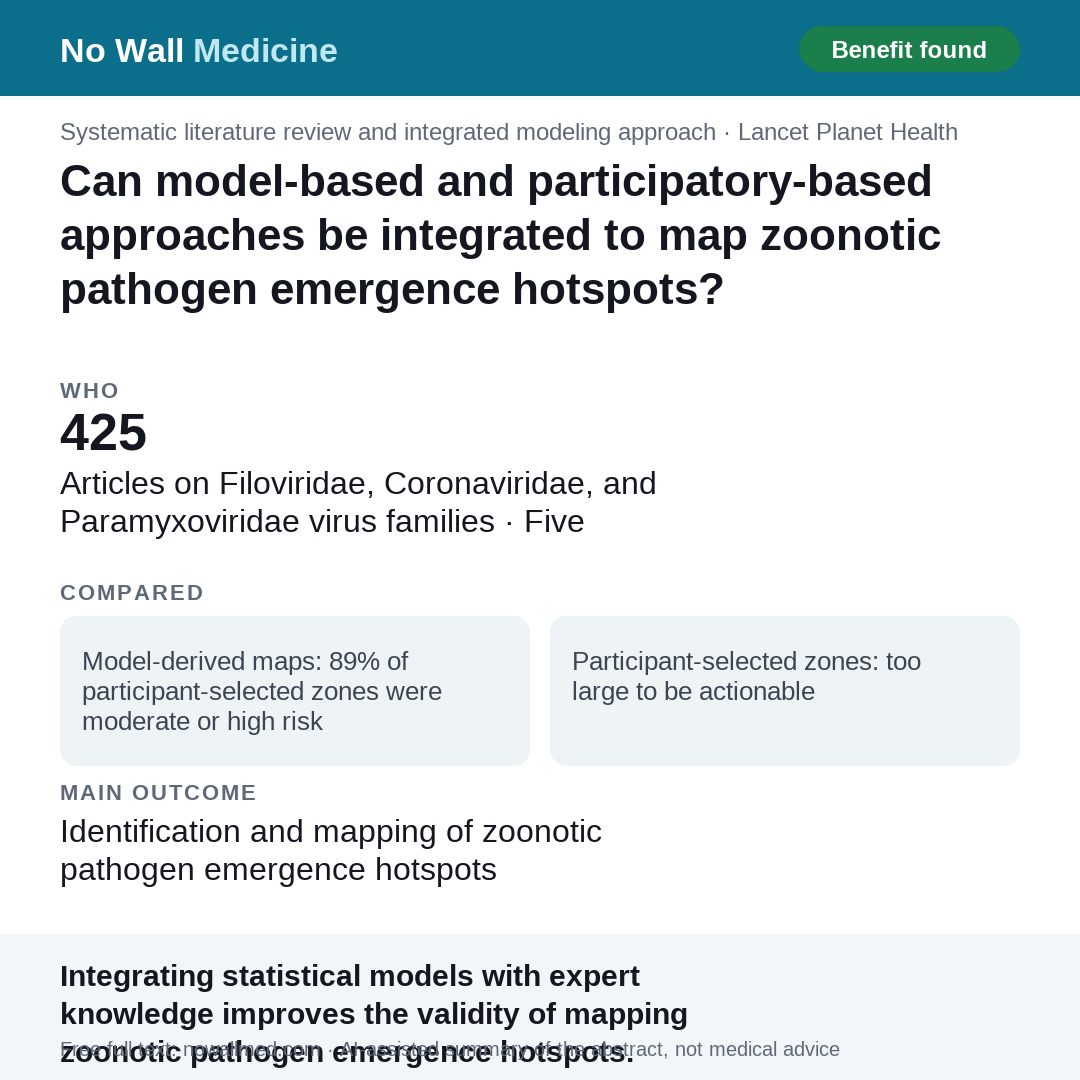
Clinical question: Can model-based and participatory-based approaches be integrated to map zoonotic pathogen emergence hotspots?
Why it matters: Statistical models for predicting where new viruses emerge often rely on simplifying assumptions that can limit their validity.
Key points
- Researchers analyzed 425 articles to identify 19 predictors and 1068 emergence events for three virus families: Filoviridae, Coronaviridae, and Paramyxoviridae.
- The model ranked 89% of zones selected by experts in five countries as moderate or high risk.
- The model had an in-sample misclassification error of 0.365.
Limitation the authors note: Participant-selected zones were too large to be actionable without further refinement.
Headline and key points written with AI from the paper’s abstract, with every number checked against it. Read the paper before relying on them.
Was this summary helpful?
Abstract
Background
An increase in pandemics of zoonotic origin has led to a growing interest in using statistical prediction to identify hotspots of zoonotic emergence. However, the rare nature of pathogen emergence requires modellers to impose simplifying assumptions, which limit the model's validity. We present a novel approach to hotspot mapping that aims to improve validity by combining model-based insights with expert knowledge. Methods
We conducted a systematic literature review to identify predictors for zoonotic emergence events in three priority virus families (Filoviridae, Coronaviridae, and Paramyxoviridae). We searched PubMed, Web of Science, Agricola, medRxiv, bioRxiv, Embase, CAB Global Health, and Google Scholar on Oct 14-28, 2021, with no restrictions on language or the date of publication. Articles suggested by subject matter experts and those identified by a review of reference lists were also included. We used regularised regression to fit a model to the data extracted from the literature and produced maps of ranked risk. In a series of workshops in five countries (Kenya, Peru, Senegal, Thailand, and Viet Nam), experts in zoonotic diseases produced qualitative hotspot maps based on their expertise, which were compared with the model-derived maps. Findings
425 articles were analysed, from which 19 predictors and 1068 outcome events were identified. The in-sample misclassification error was 0·365, and 89% of participant-selected zones were ranked as moderate or high risk by the model. Participant-selected zones were too large to be actionable without further refinement. Discordance was probably due to missing predictors for which no valid data exist, and homogeneity imposed by our global model. Interpretation
Concordance between the two sets of maps supports the validity of each. Because model-based and participatory strategies have non-overlapping limitations, the results can be harmonised to minimise bias, and model-based results could be used to refine participant-selected zones. This approach shows potential for refining deployment of countermeasures to prevent future pandemics. Funding
US Agency for International Development.
Abstract reproduced under the article’s CC BY NC licence.
Subject terms
Cite this article
Meisner J, Baines A, Ngere I, Garcia PJ, Sa-Nguansilp C, Nguyen N. Mapping hotspots of zoonotic pathogen emergence: an integrated model-based and participatory-based approach. Lancet Planet Health. 2025. doi:10.1016/S2542-5196(24)00309-7
Spotted a mistake? Suggest a correction
Top studies every Monday
The week’s key trials and guidelines in your specialties, plus any topics you follow. By email, free.
Get the weekly digest