Involved or close surgical margins were associated with higher recurrence in breast cancer patients
Margin status and survival outcomes after breast cancer conservation surgery: prospectively registered systematic review and meta-analysis
Systematic review and meta-analysisHarm found
Does margin status affect distant and local recurrence in breast cancer?
Who
112140
Patients with early stage invasive breast cancer undergoing breast conserving surgery
Compared
Tumour on ink margins: 25.4% (14.5% to 40.6%) distant recurrence
Tumour on ink or close margins: 8.4% (4.4% to 15.5%) distant recurrence
Negative margins: 7.4% (3.9% to 13.6%) distant recurrence
Main outcome
Distant recurrence and local recurrence
Result: hazard ratio 2.10 (95% confidence interval 1.65 to 2.69) for distant recurrence
Bottom line: Involved or close margins are associated with increased distant and local recurrence after breast conserving surgery.
BMJ · 2022-09-21Download image
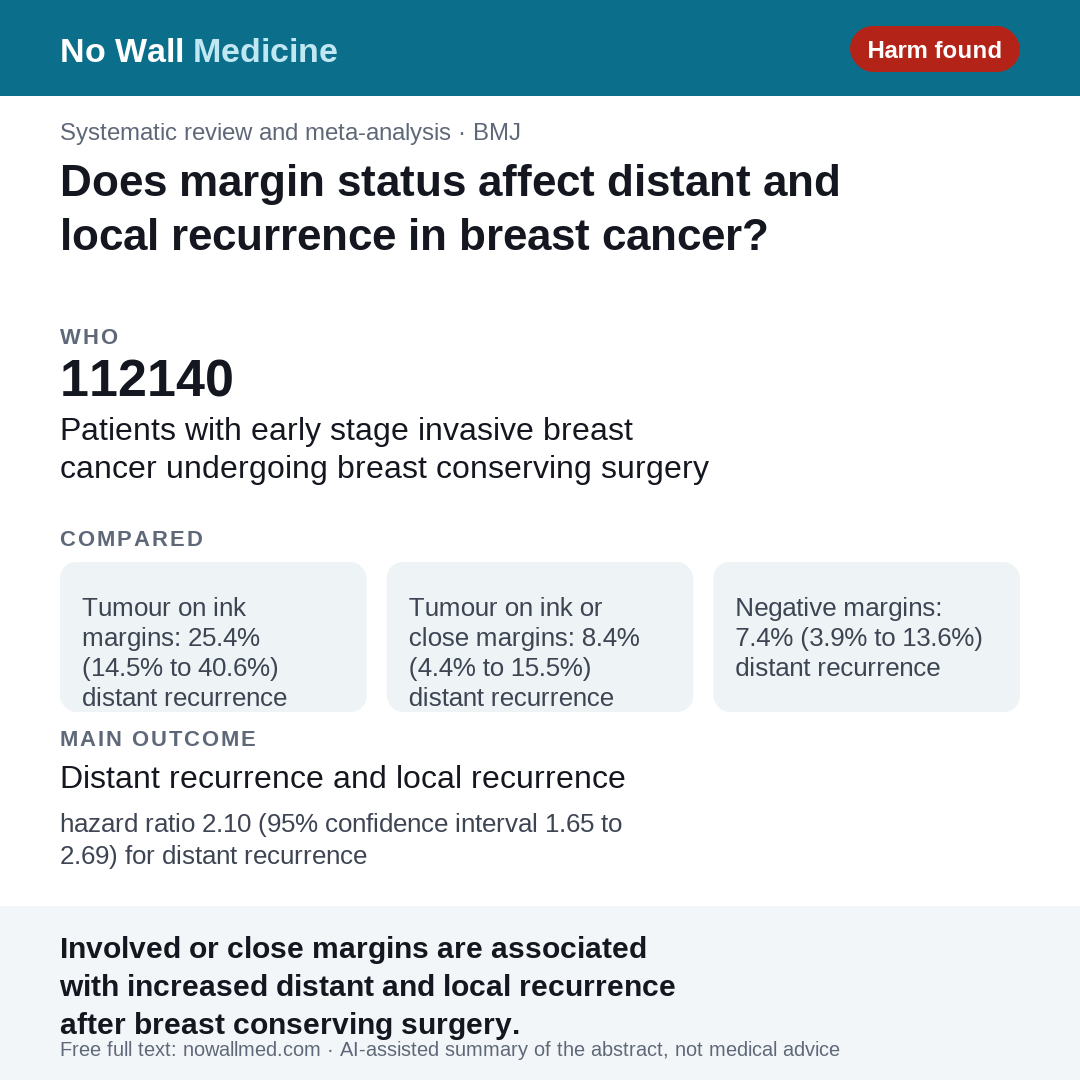
Clinical question: Does margin status affect distant and local recurrence in breast cancer?
Why it matters: It is unknown what specific margin distance minimizes both local and distant recurrence after breast conserving surgery.
Key points
- Researchers analyzed 68 studies involving 112,140 patients undergoing breast conserving surgery for early stage invasive breast cancer.
- Tumour on ink margins were associated with a 25.4% distant recurrence rate compared to 7.4% for negative margins of 2 mm or more.
- Close margins, defined as no tumour on ink but less than 2 mm, were associated with increased local and distant recurrence.
Headline and key points written with AI from the paper’s abstract, with every number checked against it. Read the paper before relying on them.
Was this summary helpful?
Abstract
Objective
To determine if margin involvement is associated with distant recurrence and to determine the required margin to minimise both local recurrence and distant recurrence in early stage invasive breast cancer. Design
Prospectively registered systematic review and meta-analysis of literature. Data sources
Medline (PubMed), Embase, and Proquest online databases. Unpublished data were sought from study authors. Eligibility criteria
Eligible studies reported on patients undergoing breast conserving surgery (for stages I-III breast cancer), allowed an estimation of outcomes in relation to margin status, and followed up patients for a minimum of 60 months. Patients with ductal carcinoma in situ only or treated with neoadjuvant chemotherapy or by mastectomy were excluded. Where applicable, margins were categorised as tumour on ink (involved), close margins (no tumour on ink but <2 mm), and negative margins (≥2 mm). Results
68 studies from 1 January 1980 to 31 December 2021, comprising 112 140 patients with breast cancer, were included. Across all studies, 9.4% (95% confidence interval 6.8% to 12.8%) of patients had involved (tumour on ink) margins and 17.8% (13.0% to 23.9%) had tumour on ink or a close margin. The rate of distant recurrence was 25.4% (14.5% to 40.6%) in patients with tumour on ink, 8.4% (4.4% to 15.5%) in patients with tumour on ink or close, and 7.4% (3.9% to 13.6%) in patients with negative margins. Compared with negative margins, tumour on ink margins were associated with increased distant recurrence (hazard ratio 2.10, 95% confidence interval 1.65 to 2.69, P<0.001) and local recurrence (1.98, 1.66 to 2.36, P<0.001). Close margins were associated with increased distant recurrence (1.38, 1.13 to 1.69, P<0.001) and local recurrence (2.09, 1.39 to 3.13, P<0.001) compared with negative margins, after adjusting for receipt of adjuvant chemotherapy and radiotherapy. In five studies published since 2010, tumour on ink margins were associated with increased distant recurrence (2.41, 1.81 to 3.21, P<0.001) as were tumour on ink and close margins (1.44, 1.22 to 1.71, P<0.001) compared with negative margins. Conclusions
Involved or close pathological margins after breast conserving surgery for early stage, invasive breast cancer are associated with increased distant recurrence and local recurrence. Surgeons should aim to achieve a minimum clear margin of at least 1 mm. On the basis of current evidence, international guidelines should be revised. Systematic review registration
CRD42021232115.
Abstract reproduced under the article’s CC BY NC licence.
Subject terms
Cite this article
Bundred JR, Michael S, Stuart B, Cutress RI, Beckmann K, Holleczek B. Margin status and survival outcomes after breast cancer conservation surgery: prospectively registered systematic review and meta-analysis. BMJ. 2022. doi:10.1136/bmj-2022-070346
Spotted a mistake? Suggest a correction
Top studies every Monday
The week’s key trials and guidelines in your specialties, plus any topics you follow. By email, free.
Get the weekly digest