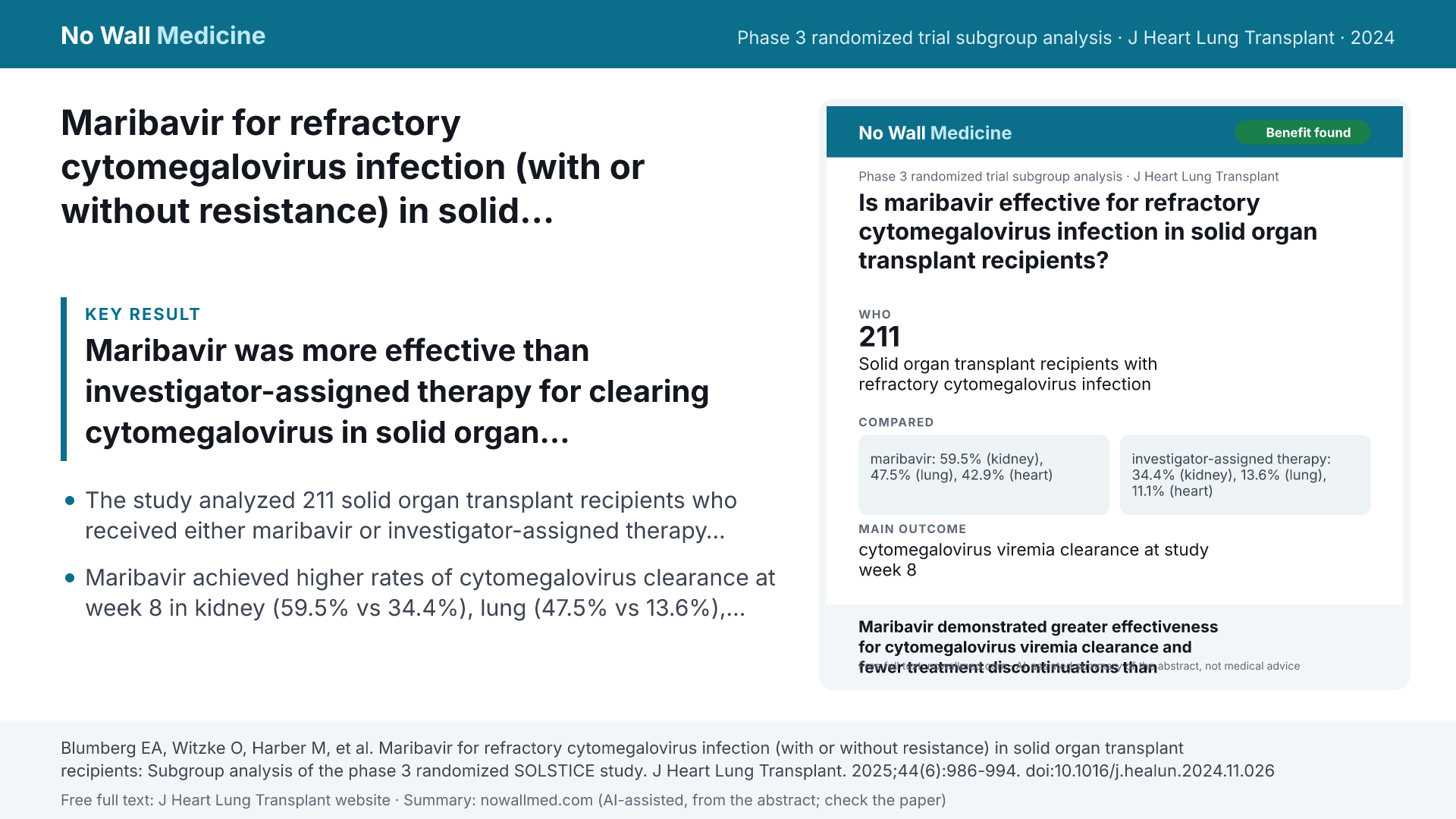
Maribavir was more effective than investigator-assigned therapy for clearing cytomegalovirus in solid organ transplant recipients
Maribavir for refractory cytomegalovirus infection (with or without resistance) in solid organ transplant recipients: Subgroup analysis of the phase 3 randomized SOLSTICE study
Phase 3 randomized trial subgroup analysisBenefit found
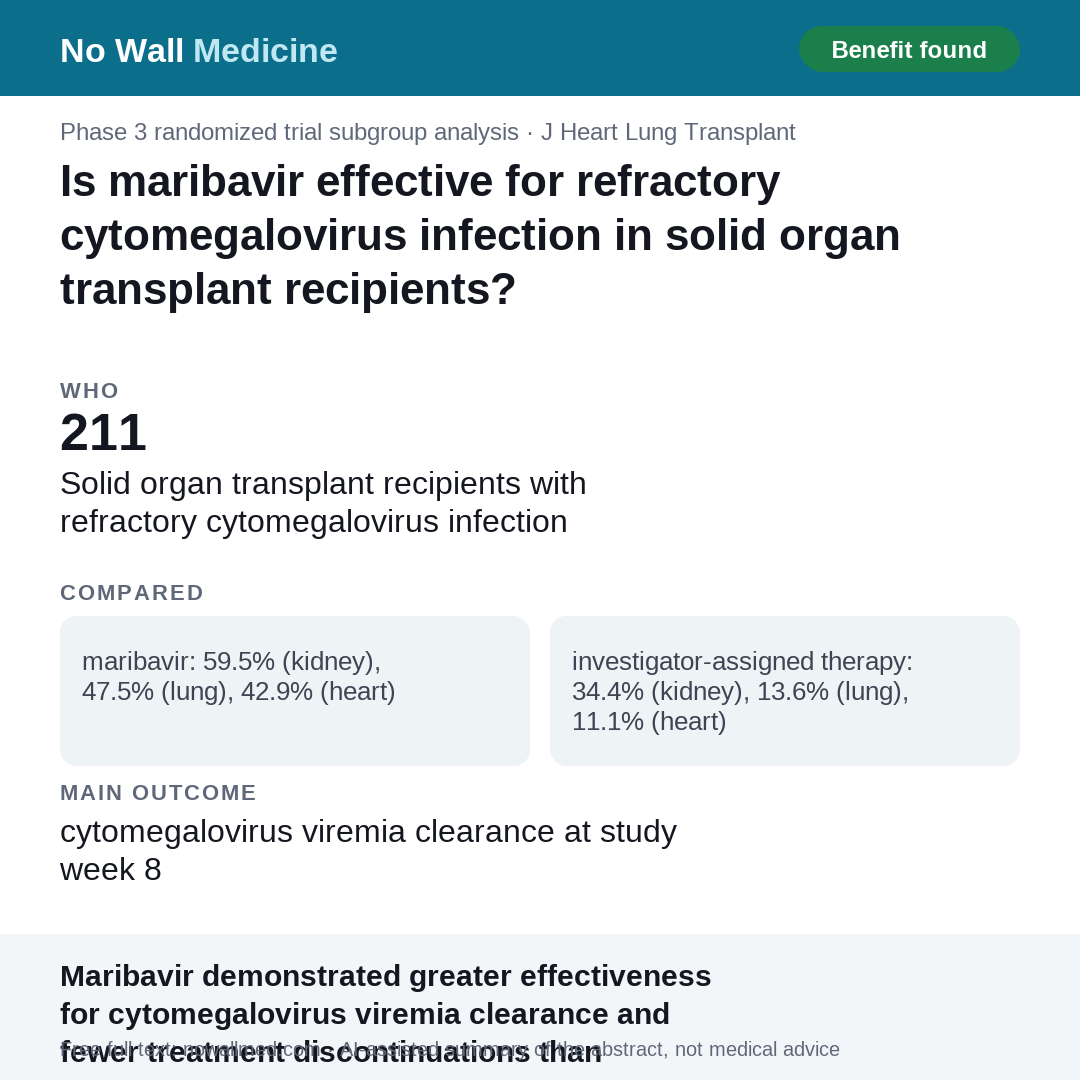
Is maribavir effective for refractory cytomegalovirus infection in solid organ transplant recipients?
Who
211
Solid organ transplant recipients with refractory cytomegalovirus infection
Compared
maribavir: 59.5% (kidney), 47.5% (lung), 42.9% (heart)
investigator-assigned therapy: 34.4% (kidney), 13.6% (lung), 11.1% (heart)
Main outcome
cytomegalovirus viremia clearance at study week 8
Result: adjusted difference: 2.4%; 95% CI: -7.05, 11.83%; p=0.620
Bottom line: Maribavir demonstrated greater effectiveness for cytomegalovirus viremia clearance and fewer treatment discontinuations than investigator-assigned therapy in solid organ transplant recipients.
J Heart Lung Transplant · 2024-11-28Download image
Clinical question: Is maribavir effective for refractory cytomegalovirus infection in solid organ transplant recipients?
Why it matters: It was unclear if the effectiveness of maribavir seen in the overall population applied specifically to the subgroup of solid organ transplant recipients.
Key points
- The study analyzed 211 solid organ transplant recipients who received either maribavir or investigator-assigned therapy for 8 weeks.
- Maribavir achieved higher rates of cytomegalovirus clearance at week 8 in kidney (59.5% vs 34.4%), lung (47.5% vs 13.6%), and heart (42.9% vs 11.1%) transplant patients.
- While 96.5% of the maribavir group experienced adverse events, only 3.5% discontinued treatment due to these events compared to 23.2% in the investigator-assigned therapy group.
Headline and key points written with AI from the paper’s abstract, with every number checked against it. Read the paper before relying on them.
Was this summary helpful?
Subject terms
Cite this article
Blumberg EA, Witzke O, Harber M, et al. Maribavir for refractory cytomegalovirus infection (with or without resistance) in solid organ transplant recipients: Subgroup analysis of the phase 3 randomized SOLSTICE study. J Heart Lung Transplant. 2024. doi:10.1016/j.healun.2024.11.026
Spotted a mistake? Suggest a correction