Systematic review identifies 61 ethical reasons regarding mass drug administration for neglected tropical diseases
Mass drug administration for neglected tropical disease control and elimination: a systematic review of ethical reasons
Systematic review of qualitative analysisMixed results
What are the ethical reasons for and against mass drug administration for neglected tropical disease control?
Who
60
Publications regarding mass drug administration for neglected tropical diseases
Compared
20Positive ethical reasons (32.7%)
13Ambivalent ethical reasons (21.3%)
28Negative ethical reasons (45.9%)
Main outcome
Ethical reasons for and against mass drug administration
Bottom line: Mass drug administration presents diverse ethical reasons, with negative implications being the most frequent among identified reasons.
Limitation: Due to the diversity of included studies, no general recommendations can be made.
BMJ Glob Health · 2024-03-13Download image
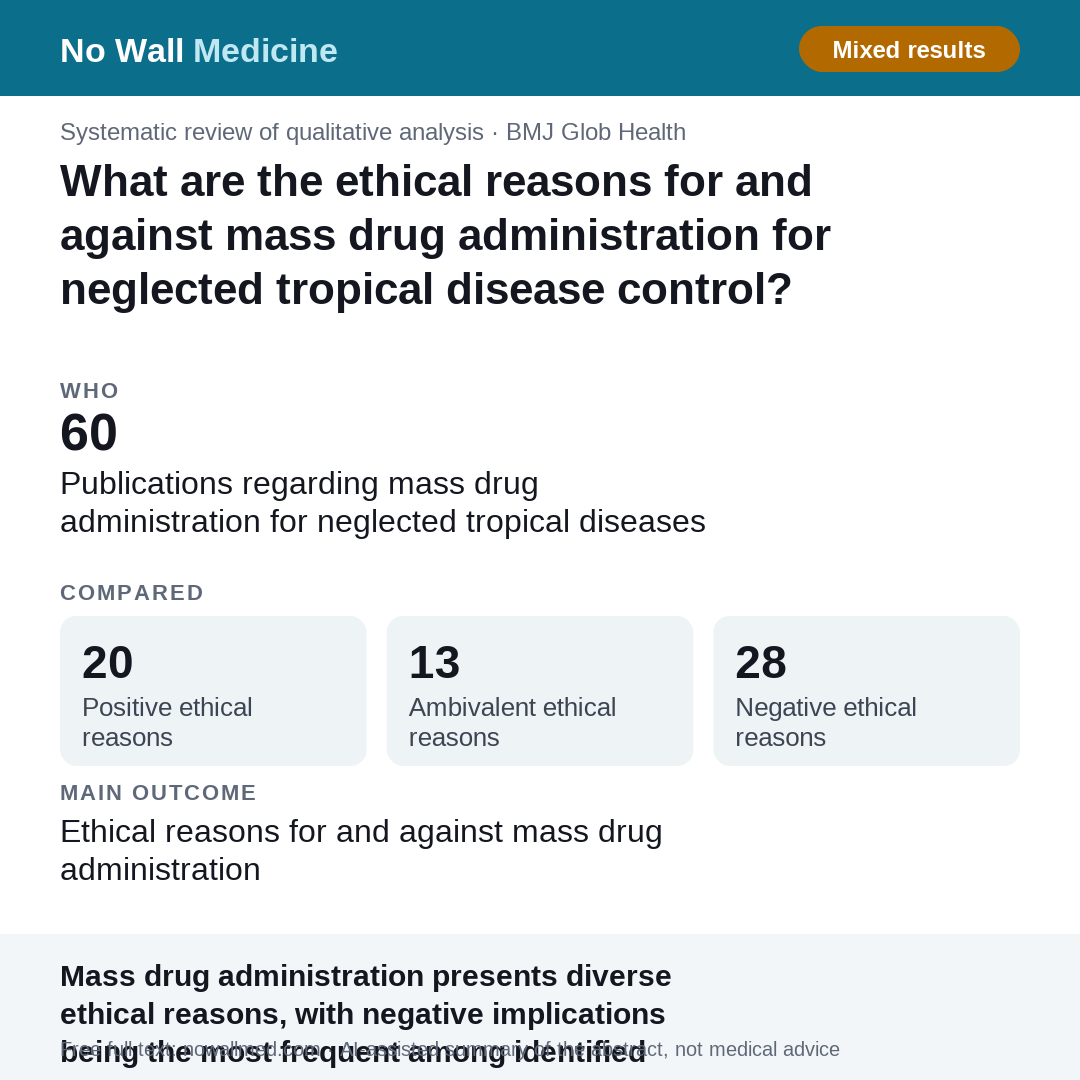
Clinical question: What are the ethical reasons for and against mass drug administration for neglected tropical disease control?
Why it matters: The ethical challenges and long-term impacts of delivering wide-spectrum drugs to entire communities regardless of individual health status are not fully understood.
Key points
- Researchers analyzed 60 publications to identify ethical arguments surrounding mass drug administration for neglected tropical diseases.
- Of the 61 ethical reasons identified, 20 (32.7%) were positive, 13 (21.3%) were ambivalent, and 28 (45.9%) were negative.
- While health benefits and cost-effectiveness were highlighted, equity, autonomy, and sustainability were the most pressing ethical concerns.
Headline and key points written with AI from the paper’s abstract, with every number checked against it. Read the paper before relying on them.
Was this summary helpful?
Abstract
Background
Neglected tropical diseases (NTDs) are a diverse group of debilitating diseases and conditions afflicting more than one billion people in impoverished communities. Control of these diseases is crucial to achieve Sustainable Development Goal 3 and the pledge to 'leave no one behind'. Relying on large-scale delivery of wide-spectrum drugs to individuals in at-risk communities irrespective of their health status, mass drug administration is a core strategy for tackling half of the NTDs targeted by the latest WHO roadmap (2021-2030). However, ethical challenges surround its implementation and long-term impact. This systematic review aims to give a comprehensive picture of the variety of ethical reasons for and against mass drug administration for NTD control and elimination, facilitating further debate in ethics and policy. Methods
PubMed and Web of Science Core Collection were searched for all relevant publications. Of the 486 retrieved records, 60 met the inclusion criteria for qualitative analysis. Ethical reasons discussing the topic at hand were extracted from full texts and synthesised through the Kuckartz method of qualitative content analysis. Results
Data extraction revealed 61 ethical reasons, of which 20 (32.7%) had positive, 13 (21.3%) had ambivalent and 28 (45.9%) had negative implications regarding mass drug administration for NTDs. The health benefits and cost-effectiveness of the measure were extensively highlighted. However, equity, autonomy and sustainability emerged as the domains with the most pressing ethical concerns. Many issues related to implementation are yet to be adequately addressed in policy documents. Conclusions
This is the first systematic review of ethical reasons pertaining to mass drug administration for NTD control and elimination. Due to the diversity of included studies, no general recommendations can be made. Instead, context-specific strategies seem necessary. Alternative approaches tackling socioecological determinants of ill health are needed for long-term sustainability. Future research could benefit from contributions of non-Western philosophies and perspectives by local researchers.
Abstract reproduced under the article’s CC BY NC licence.
Subject terms
Cite this article
Hoefle-Bénard J, Salloch S. Mass drug administration for neglected tropical disease control and elimination: a systematic review of ethical reasons. BMJ Glob Health. 2024. doi:10.1136/bmjgh-2023-013439
Spotted a mistake? Suggest a correction
Top studies every Monday
The week’s key trials and guidelines in your specialties, plus any topics you follow. By email, free.
Get the weekly digest