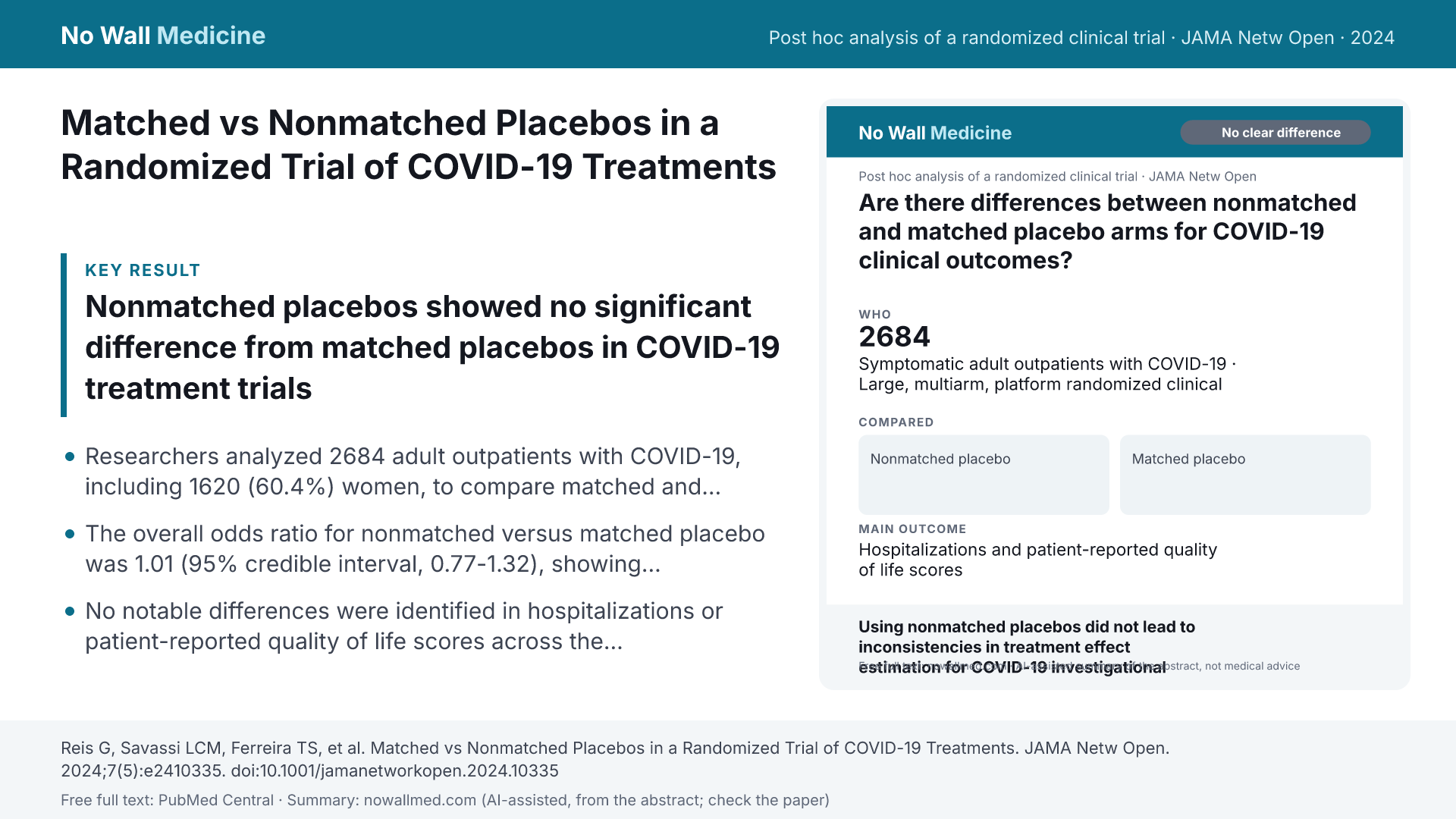
Nonmatched placebos showed no significant difference from matched placebos in COVID-19 treatment trials
Matched vs Nonmatched Placebos in a Randomized Trial of COVID-19 Treatments
Post hoc analysis of a randomized clinical trialNo clear difference
Are there differences between nonmatched and matched placebo arms for COVID-19 clinical outcomes?
Who
2684
Symptomatic adult outpatients with COVID-19 · Large, multiarm, platform randomized clinical trial
Compared
Nonmatched placebo
Matched placebo
Main outcome
Hospitalizations and patient-reported quality of life scores
Result: odds ratio 1.01 (95% credible interval, 0.77-1.32)
Bottom line: Using nonmatched placebos did not lead to inconsistencies in treatment effect estimation for COVID-19 investigational drugs.
Limitation: Post hoc analysis of data from a large platform trial
JAMA Netw Open · 2024-05-01Download image
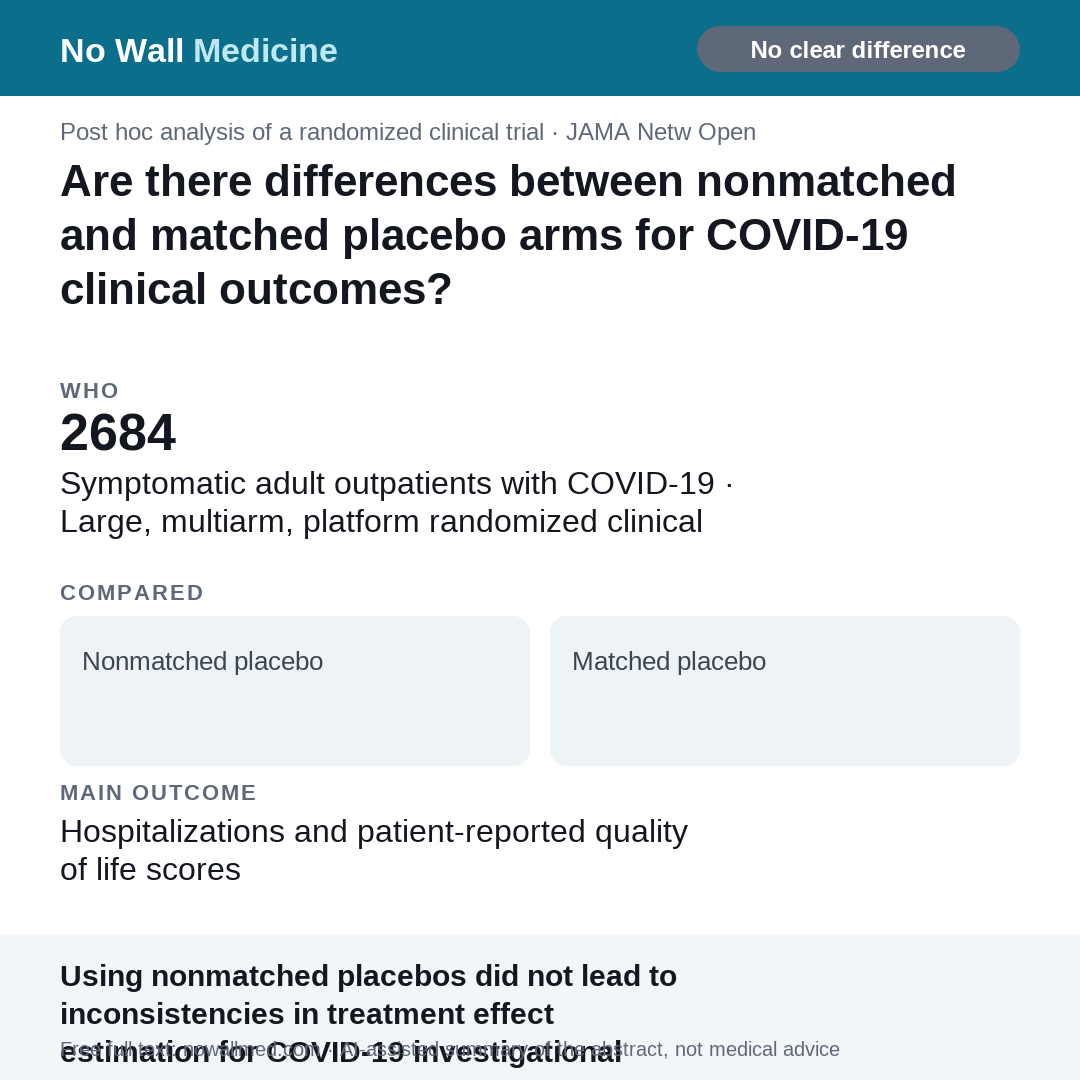
Clinical question: Are there differences between nonmatched and matched placebo arms for COVID-19 clinical outcomes?
Why it matters: It is unknown if using nonmatched placebos, which differ in dose or formulation from the treatment, introduces bias in infectious disease clinical trials.
Key points
- Researchers analyzed 2684 adult outpatients with COVID-19, including 1620 (60.4%) women, to compare matched and nonmatched placebo groups.
- The overall odds ratio for nonmatched versus matched placebo was 1.01 (95% credible interval, 0.77-1.32), showing no significant difference.
- No notable differences were identified in hospitalizations or patient-reported quality of life scores across the 7 treatment-placebo combinations.
Headline and key points written with AI from the paper’s abstract, with every number checked against it. Read the paper before relying on them.
Was this summary helpful?
Subject terms
Cite this article
Reis G, Savassi LCM, Ferreira TS, et al. Matched vs Nonmatched Placebos in a Randomized Trial of COVID-19 Treatments. JAMA Netw Open. 2024. doi:10.1001/jamanetworkopen.2024.10335
Spotted a mistake? Suggest a correction