Higher maternal education is associated with better child growth in middle-income and low-educated populations
Maternal education and its influence on child growth and nutritional status during the first two years of life: a systematic review and meta-analysis
Systematic review and meta-analysisMixed results
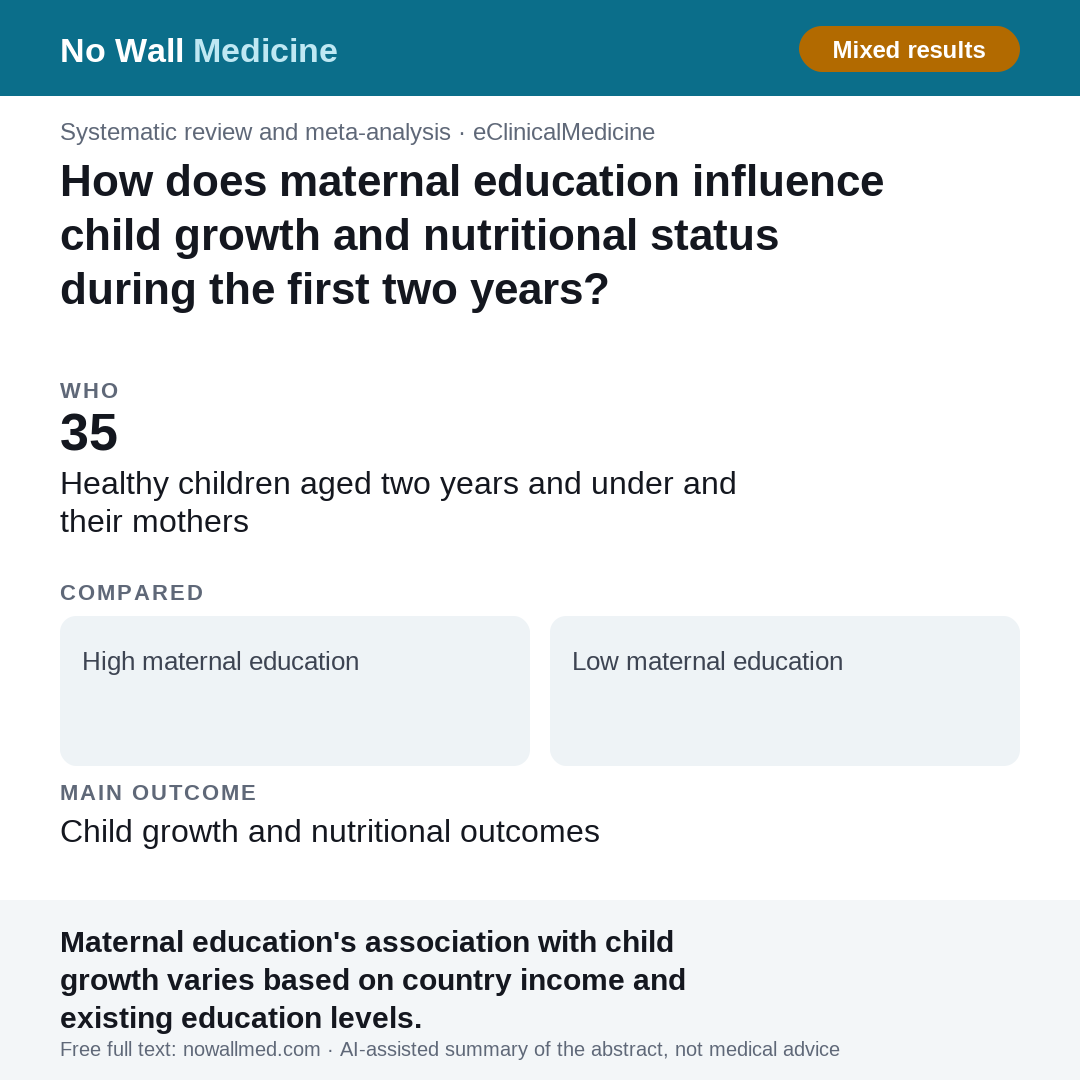
How does maternal education influence child growth and nutritional status during the first two years?
Who
35
Healthy children aged two years and under and their mothers
Compared
High maternal education
Low maternal education
Main outcome
Child growth and nutritional outcomes
Bottom line: Maternal education's association with child growth varies based on country income and existing education levels.
Funded by: Tehran University of Medical Sciences
eClinicalMedicine · 2024-04-04Download image
Clinical question: How does maternal education influence child growth and nutritional status during the first two years?
Why it matters: The specific impact of maternal education on child growth and nutritional status during the first two years of life remains to be determined.
Key points
- Researchers analyzed 35 population-based cohort studies involving children aged two years and under to examine how maternal education levels affect growth and nutrition.
- In middle-income countries, higher maternal education was linked to increased weight-for-age z-score (MD 0.398, 95% CI 0.301-0.496) and height-for-age z-score (MD 0.388, 95% CI 0.102-0.673).
- In high-income countries, higher maternal education was associated with a non-significant lower body mass index-for-age z-score (MD -0.028, 95% CI -0.061 to 0.006).
Headline and key points written with AI from the paper’s abstract, with every number checked against it. Read the paper before relying on them.
Was this summary helpful?
Cite this article
Rezaeizadeh G, Mansournia MA, Keshtkar A, Farahani Z, Zarepour F, Sharafkhah M. Maternal education and its influence on child growth and nutritional status during the first two years of life: a systematic review and meta-analysis. eClinicalMedicine. 2024. doi:10.1016/j.eclinm.2024.102574
Spotted a mistake? Suggest a correction
Top studies every Monday
The week’s key trials and guidelines in your specialties, plus any topics you follow. By email, free.
Get the weekly digest