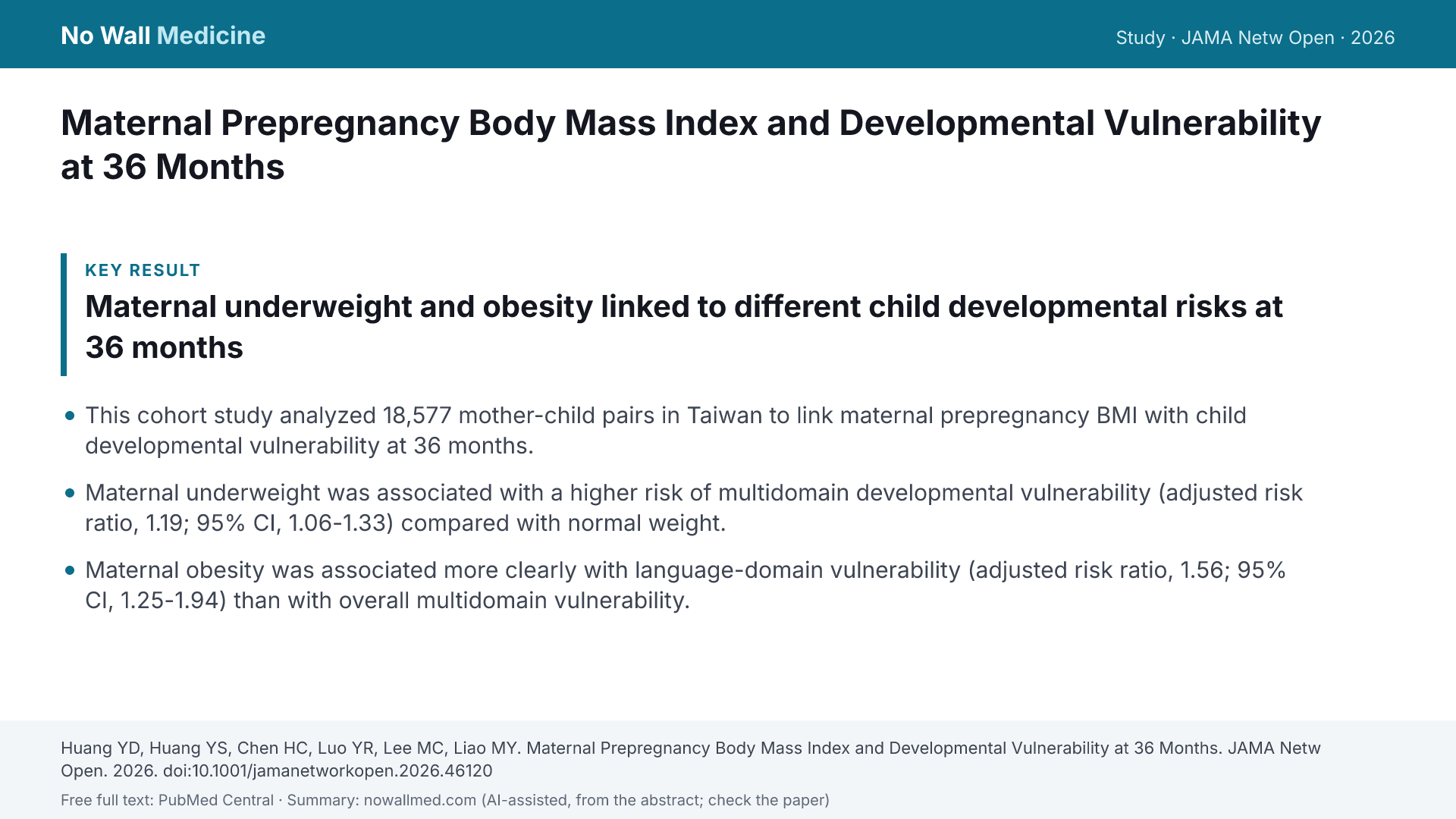
Maternal Prepregnancy Body Mass Index and Developmental Vulnerability at 36 Months
Key result: Maternal underweight and obesity linked to different child developmental risks at 36 months
Key points
- This cohort study analyzed 18,577 mother-child pairs in Taiwan to link maternal prepregnancy BMI with child developmental vulnerability at 36 months.
- Maternal underweight was associated with a higher risk of multidomain developmental vulnerability (adjusted risk ratio, 1.19; 95% CI, 1.06-1.33) compared with normal weight.
- Maternal obesity was associated more clearly with language-domain vulnerability (adjusted risk ratio, 1.56; 95% CI, 1.25-1.94) than with overall multidomain vulnerability.
Why it matters: The association between maternal prepregnancy BMI and domain-specific developmental vulnerability in early childhood remains unclear in Asian populations.
Limitation the authors note: The study excluded multiple births, participants lost to follow-up, and those with missing covariate or milestone data, leaving 18,577 pairs for analysis.
Discussion prompts
- Would these patients look like yours? Who was left out?
- Is the main outcome one that matters to patients?
- Is the difference large enough to change what you do?
Cite: Huang YD, Huang YS, Chen HC, Luo YR, Lee MC, Liao MY. Maternal Prepregnancy Body Mass Index and Developmental Vulnerability at 36 Months. JAMA Netw Open. 2026. doi:10.1001/jamanetworkopen.2026.46120
Free full text: PubMed Central · Summary and visual abstract: nowallmed.com/a/maternal-prepregnancy-body-mass-index-and-developmental-vulnerability-upuqh9/ (AI-assisted from the abstract; check the paper before relying on it).