Higher maternal prepregnancy body mass index was associated with increased risk of congenital heart defects
Maternal prepregnancy weight as an independent risk factor for congenital heart defect: systematic review and meta-analysis stratified by subtype and severity of defect
Systematic review and meta-analysisHarm found
Does increased maternal prepregnancy body mass index increase congenital heart defect risk?
Who
4861693
4,861,693 patients and 86,136 congenital heart defect cases
Compared
Normal weight
Moderate obesity: odds ratio 1.15 (95% CI, 1.11-1.20)
Severe obesity: odds ratio 1.39 (95% CI, 1.27-1.53)
Main outcome
risk of congenital heart defect
Result: odds ratio 1.15 (95% CI, 1.11-1.20) to 1.39 (95% CI, 1.27-1.53)
Bottom line: Increased maternal prepregnancy body mass index is associated with a progressive increase in congenital heart defect risk.
Ultrasound Obstet Gynecol · 2024-04-17Download image
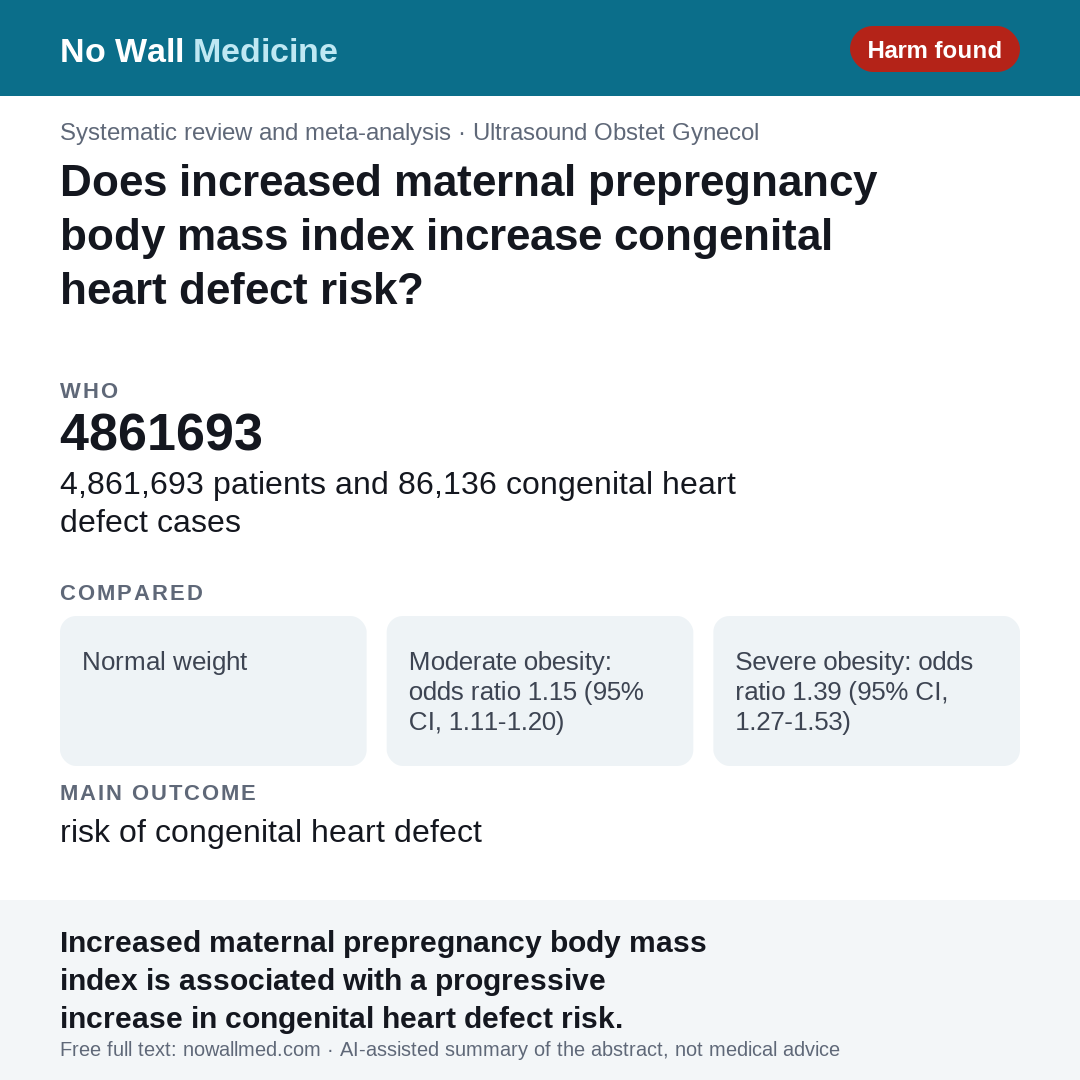
Clinical question: Does increased maternal prepregnancy body mass index increase congenital heart defect risk?
Why it matters: The association between maternal prepregnancy body mass index and the risk of specific subtypes and severities of congenital heart defects was not fully established.
Key points
- Researchers analyzed 31 studies involving 4,861,693 patients and 86,136 cases of congenital heart defects, which are structural heart problems present at birth.
- The risk of heart defects increased from moderate obesity with an odds ratio of 1.15 (95% CI, 1.11-1.20) to severe obesity with an odds ratio of 1.39 (95% CI, 1.27-1.53).
- Severe obesity was associated with 1.8-times higher odds for specific defects like pulmonary valve stenosis, tetralogy of Fallot, and atrial septal defect.
Headline and key points written with AI from the paper’s abstract, with every number checked against it. Read the paper before relying on them.
Topics
Cite this article
Salmeri N, Seidenari A, Cavoretto PI, Papale M, Candiani M, Farina A. Maternal prepregnancy weight as an independent risk factor for congenital heart defect: systematic review and meta-analysis stratified by subtype and severity of defect. Ultrasound Obstet Gynecol. 2024. doi:10.1002/uog.27659
Spotted a mistake? Suggest a correction
Top studies every Monday
The week’s key trials and guidelines in your specialties, plus any topics you follow. By email, free.
Get the weekly digest