Dual brain stimulation did not improve upper limb recovery during robotic therapy in chronic stroke patients
May Dual Transcranial Direct Current Stimulation Enhance the Efficacy of Robot-Assisted Therapy for Promoting Upper Limb Recovery in Chronic Stroke?
Prospective, bi-center, double-blind, randomized clinical trialNo clear difference
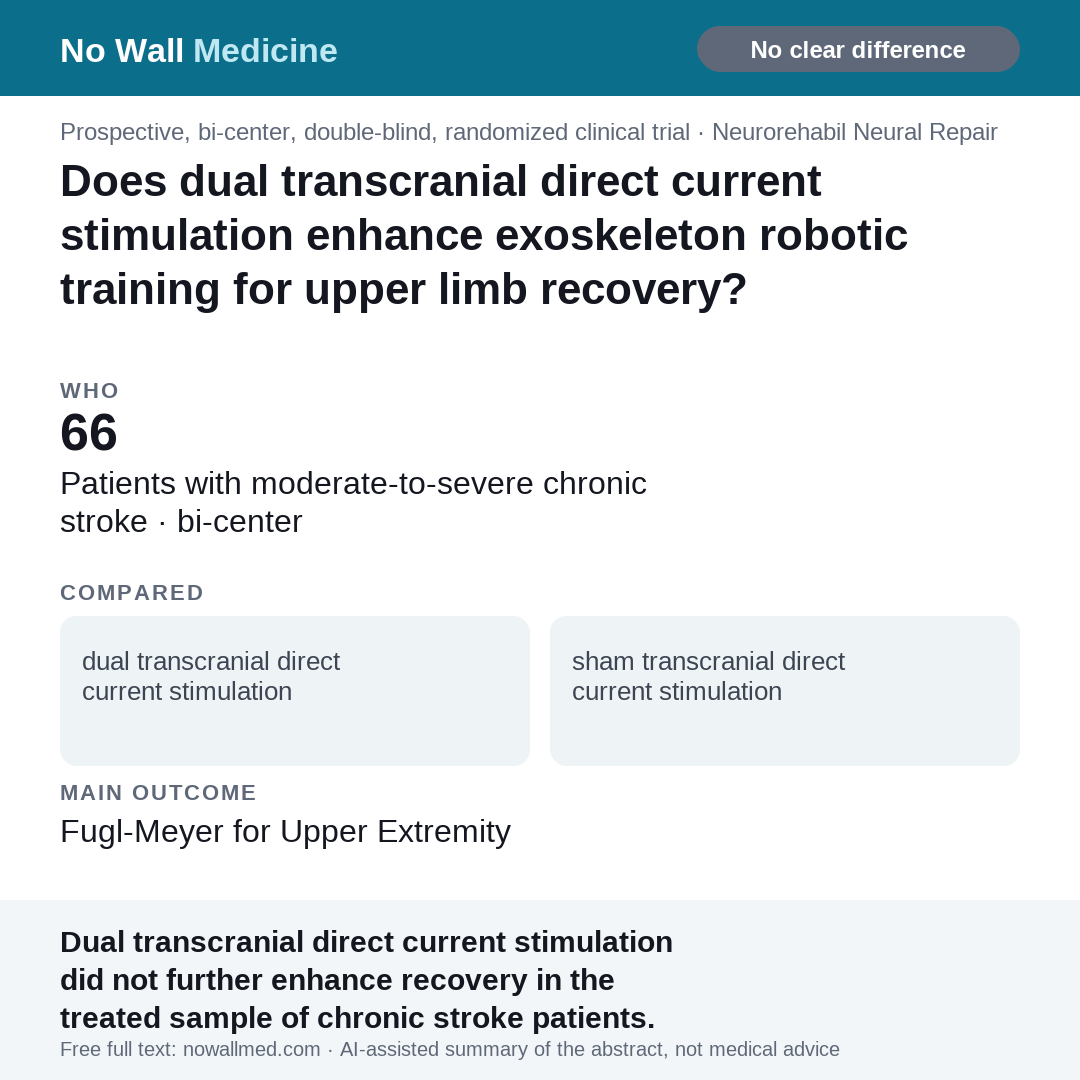
Does dual transcranial direct current stimulation enhance exoskeleton robotic training for upper limb recovery?
Who
66
Patients with moderate-to-severe chronic stroke · bi-center
Compared
dual transcranial direct current stimulation
sham transcranial direct current stimulation
Main outcome
Fugl-Meyer for Upper Extremity
Bottom line: Dual transcranial direct current stimulation did not further enhance recovery in the treated sample of chronic stroke patients.
Limitation: Post-hoc analysis showed potential benefit only in patients without motor evoked potentials at baseline.
Neurorehabil Neural Repair · 2022-12-02Download image
Clinical question: Does dual transcranial direct current stimulation enhance exoskeleton robotic training for upper limb recovery?
Why it matters: It was unknown whether adding dual transcranial direct current stimulation to exoskeleton robotic training would increase the effectiveness of motor function recovery in chronic stroke survivors.
Key points
- Researchers studied 66 patients with moderate-to-severe chronic stroke who received either dual transcranial direct current stimulation (a non-invasive brain stimulation technique) or a sham treatment before robotic therapy.
- The primary measure of upper limb motor function showed no significant difference in improvement between the two groups after 12 weeks.
- A subgroup analysis showed that real brain stimulation was associated with a significantly higher effect in patients without motor evoked potentials, which are electrical signals indicating nerve pathway function.
Headline and key points written with AI from the paper’s abstract, with every number checked against it. Read the paper before relying on them.
Was this summary helpful?
Subject terms
Cite this article
Morone G, Capone F, Iosa M, Cruciani A, Paolucci M, Martino Cinnera A. May Dual Transcranial Direct Current Stimulation Enhance the Efficacy of Robot-Assisted Therapy for Promoting Upper Limb Recovery in Chronic Stroke?. Neurorehabil Neural Repair. 2022. doi:10.1177/15459683221138743
Spotted a mistake? Suggest a correction
Top studies every Monday
The week’s key trials and guidelines in your specialties, plus any topics you follow. By email, free.
Get the weekly digest