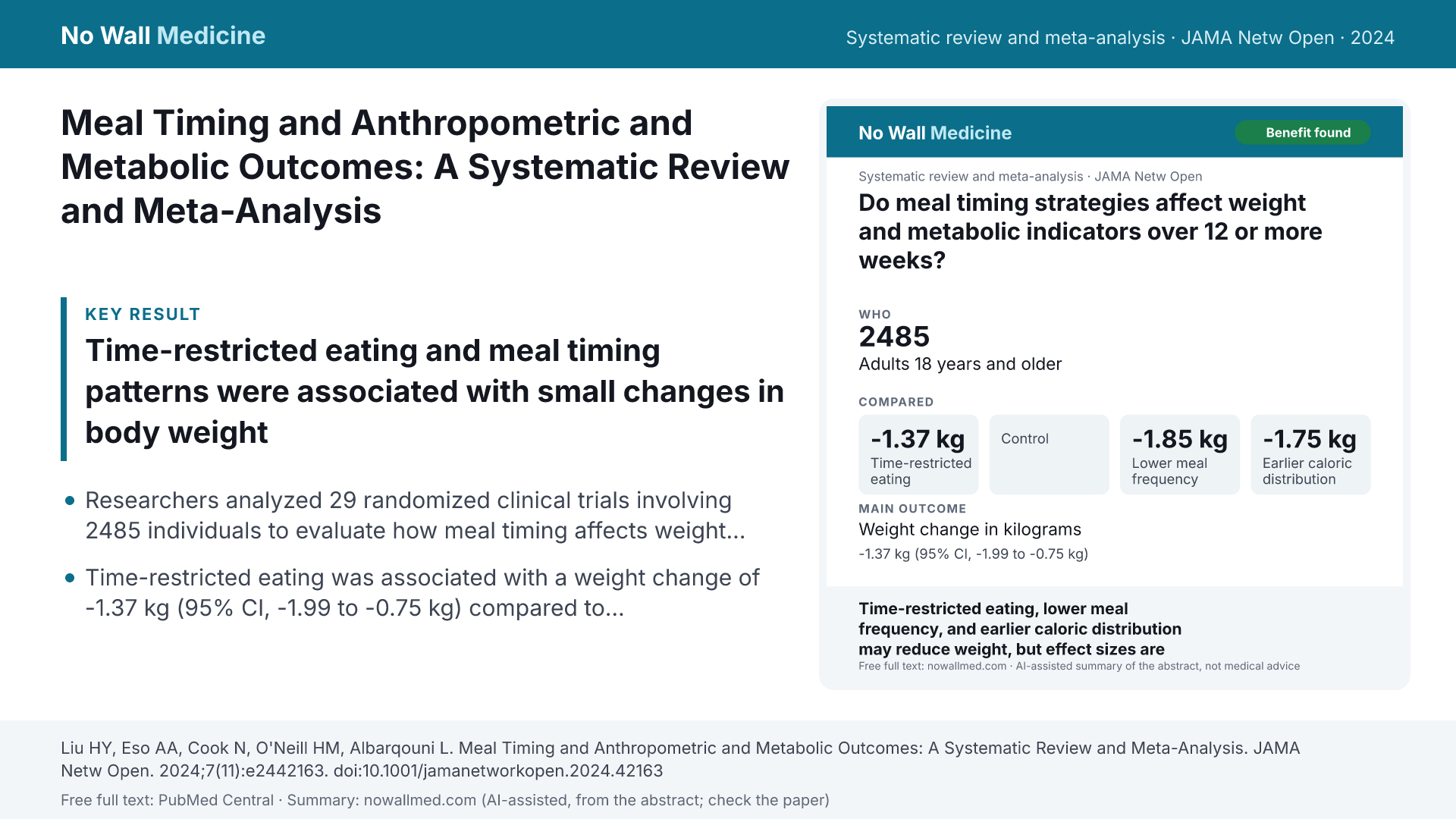
Time-restricted eating and meal timing patterns were associated with small changes in body weight
Meal Timing and Anthropometric and Metabolic Outcomes: A Systematic Review and Meta-Analysis
Systematic review and meta-analysisBenefit found
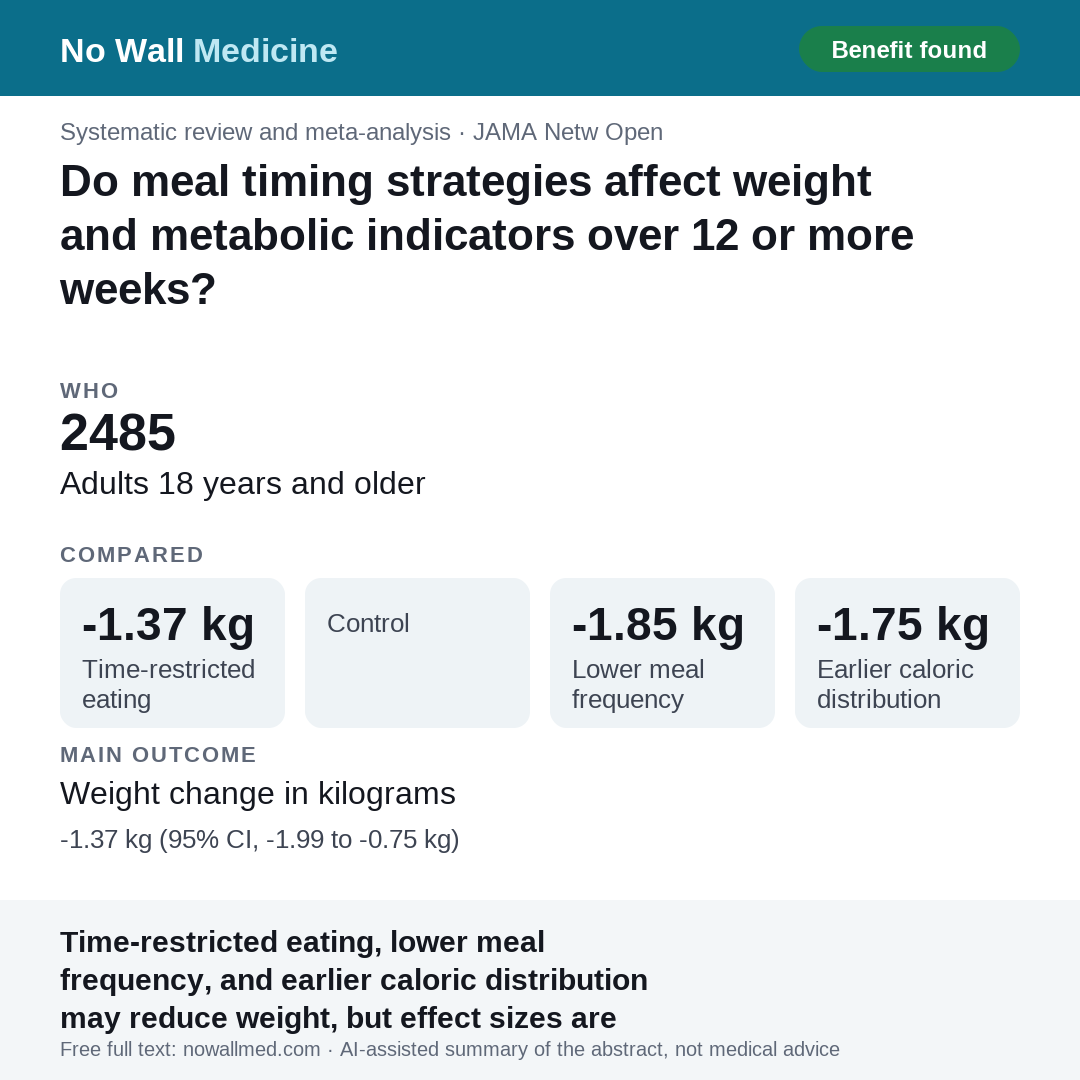
Do meal timing strategies affect weight and metabolic indicators over 12 or more weeks?
Who
2485
Adults 18 years and older
Compared
-1.37 kgTime-restricted eating
Control
-1.85 kgLower meal frequency
-1.75 kgEarlier caloric distribution
Main outcome
Weight change in kilograms
Result: -1.37 kg (95% CI, -1.99 to -0.75 kg)
Bottom line: Time-restricted eating, lower meal frequency, and earlier caloric distribution may reduce weight, but effect sizes are small.
Limitation: High heterogeneity and risk of bias among included studies led to concerns about certainty.
JAMA Netw Open · 2024-11-04Download image
Clinical question: Do meal timing strategies affect weight and metabolic indicators over 12 or more weeks?
Why it matters: The long-term benefits of meal timing strategies like time-restricted eating for weight loss and metabolic health are not known.
Key points
- Researchers analyzed 29 randomized clinical trials involving 2485 individuals to evaluate how meal timing affects weight and metabolic indicators.
- Time-restricted eating was associated with a weight change of -1.37 kg (95% CI, -1.99 to -0.75 kg) compared to control groups.
- Lower meal frequency and earlier calorie distribution were also associated with greater weight changes of -1.85 kg and -1.75 kg, respectively.
Limitation the authors note: High heterogeneity and risk of bias among included studies led to concerns about the certainty of the evidence.
Headline and key points written with AI from the paper’s abstract, with every number checked against it. Read the paper before relying on them.
Was this summary helpful?
Subject terms
Cite this article
Liu HY, Eso AA, Cook N, O'Neill HM, Albarqouni L. Meal Timing and Anthropometric and Metabolic Outcomes: A Systematic Review and Meta-Analysis. JAMA Netw Open. 2024. doi:10.1001/jamanetworkopen.2024.42163
Spotted a mistake? Suggest a correction