Ibrutinib and venetoclax combination showed higher disease clearance rates than FCR in intermediate-risk leukemia patients
Measurable residual disease-guided combination of ibrutinib plus venetoclax versus FCR in previously untreated patients with intermediate-risk chronic lymphocytic leukaemia: a phase 2, randomised trial (ERADIC) from the FILO group
Randomised, phase 2 trialEarly signal
Is measurable residual disease-guided ibrutinib plus venetoclax better than FCR in intermediate-risk chronic lymphocytic leukaemia?
Who
120
Previously untreated, fit adults with intermediate-risk chronic lymphocytic leukaemia · 35 French hospitals
Compared
37%Ibrutinib plus venetoclax (22/59; 95% CI 25, 51)
13%Fludarabine-cyclophosphamide-rituximab (8/61; 95% CI 6, 24)
Main outcome
Bone marrow measurable residual disease rate at Month 27
Result: hazard ratio 0.35 (95% CI 0.16, 0.80)
Bottom line: Ibrutinib plus venetoclax showed higher measurable residual disease negativity and longer progression-free survival than FCR.
Funded by: Abbvie and Janssen France
eClinicalMedicine · 2025-12-17 · Save PNG
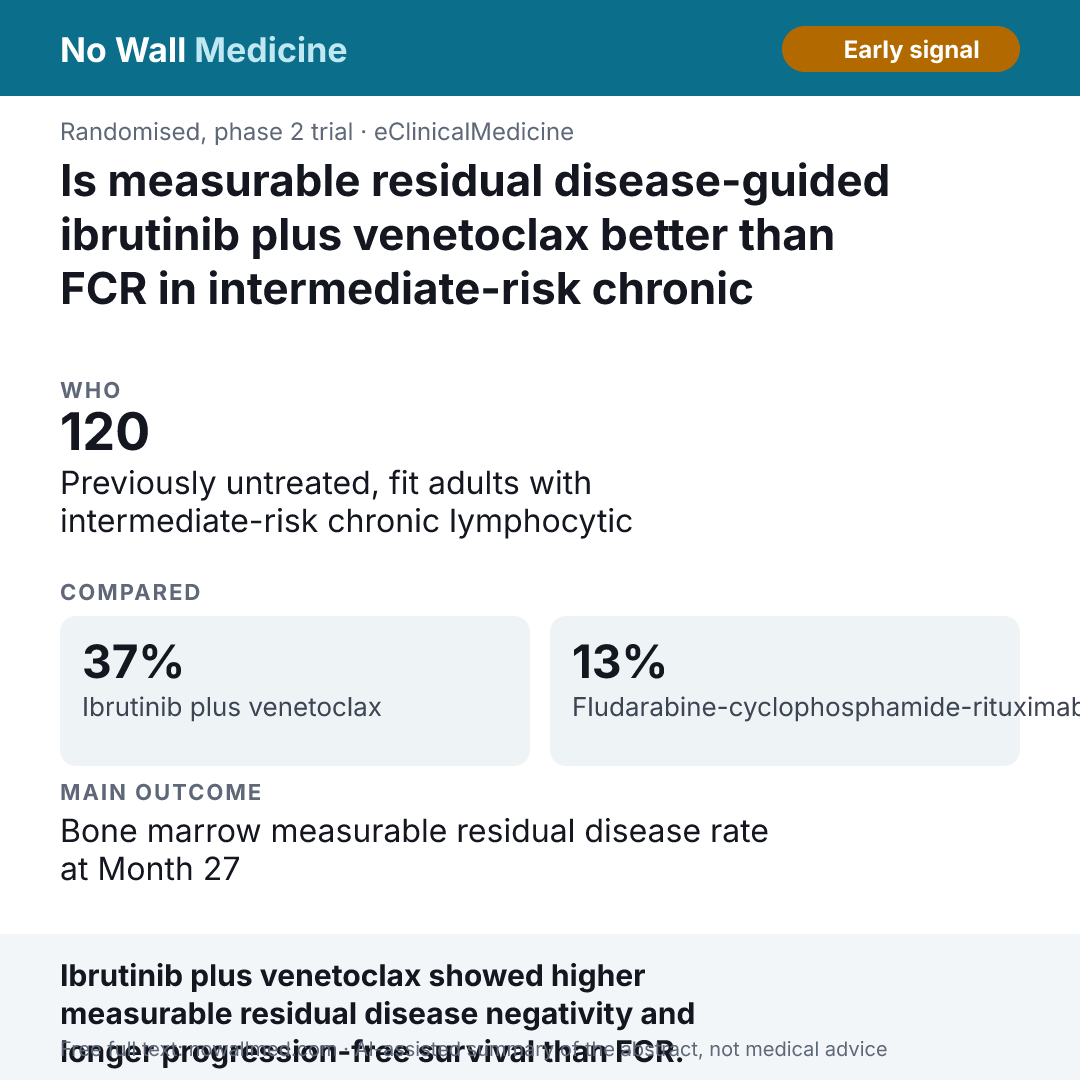
Clinical question: Is measurable residual disease-guided ibrutinib plus venetoclax better than FCR in intermediate-risk chronic lymphocytic leukaemia?
Key points
- The study enrolled 120 previously untreated adults with intermediate-risk chronic lymphocytic leukaemia to compare a fixed-duration combination therapy against fludarabine-cyclophosphamide-rituximab.
- At Month 27, the bone marrow undetectable measurable residual disease rate was 37% with the combination therapy versus 13% with FCR.
- The combination therapy group had a longer progression-free survival with an estimated hazard ratio of 0.35 compared to the FCR group.
Limitation the authors note: The authors state that a high amount of missing bone marrow measurable residual disease data meant the primary outcome statistical analysis was not feasible.
Headline and key points written with AI from the paper’s abstract, with every number checked against it. Read the paper before relying on them.
Was this summary helpful?
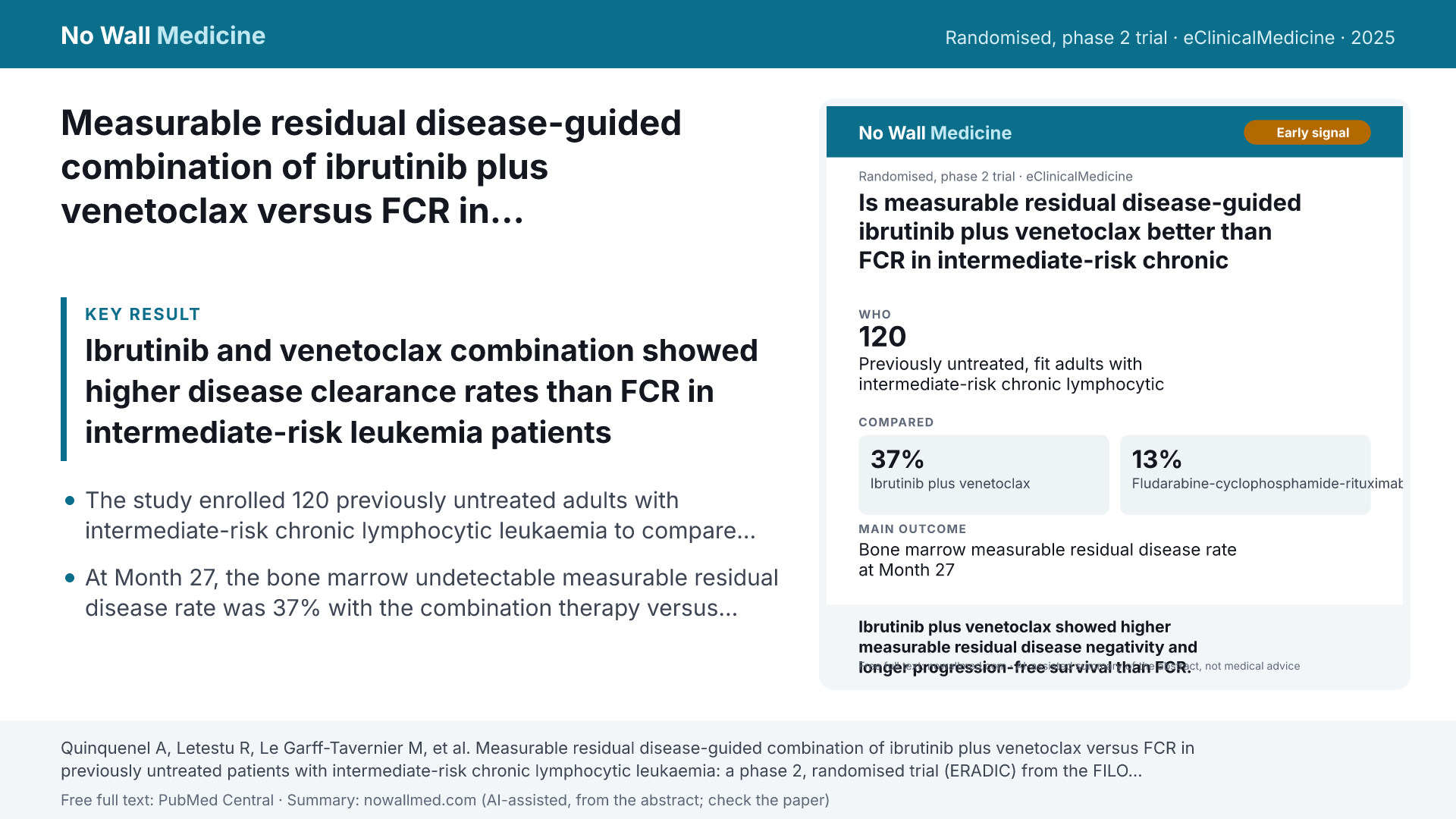
Headline, design, result, key points, caveat and citation as plain text.
Cite this article
Quinquenel A, Letestu R, Le Garff-Tavernier M, et al. Measurable residual disease-guided combination of ibrutinib plus venetoclax versus FCR in previously untreated patients with intermediate-risk chronic lymphocytic leukaemia: a phase 2, randomised trial (ERADIC) from the FILO group. EClinicalMedicine. 2026;91:103707. doi:10.1016/j.eclinm.2025.103707
Spotted a mistake? Suggest a correction