Composite scores showed better validity for measuring disease activity in peripheral spondyloarthritis patients
Measurement properties of disease activity instruments in peripheral spondyloarthritis: a post-hoc analysis of the CRESPA trial
Post-hoc analysis of a randomized controlled trialBenefit found
How well do disease activity instruments measure disease activity in peripheral spondyloarthritis?
Who
60
Patients with early active peripheral spondyloarthritis
Compared
golimumab
placebo
Main outcome
Construct validity and discriminatory capacity of disease activity instruments
Bottom line: Composite scores like DAPSA, ASDAS, and BASDAI showed better construct validity for measuring disease activity.
RMD Open · 2025-07-15Download image
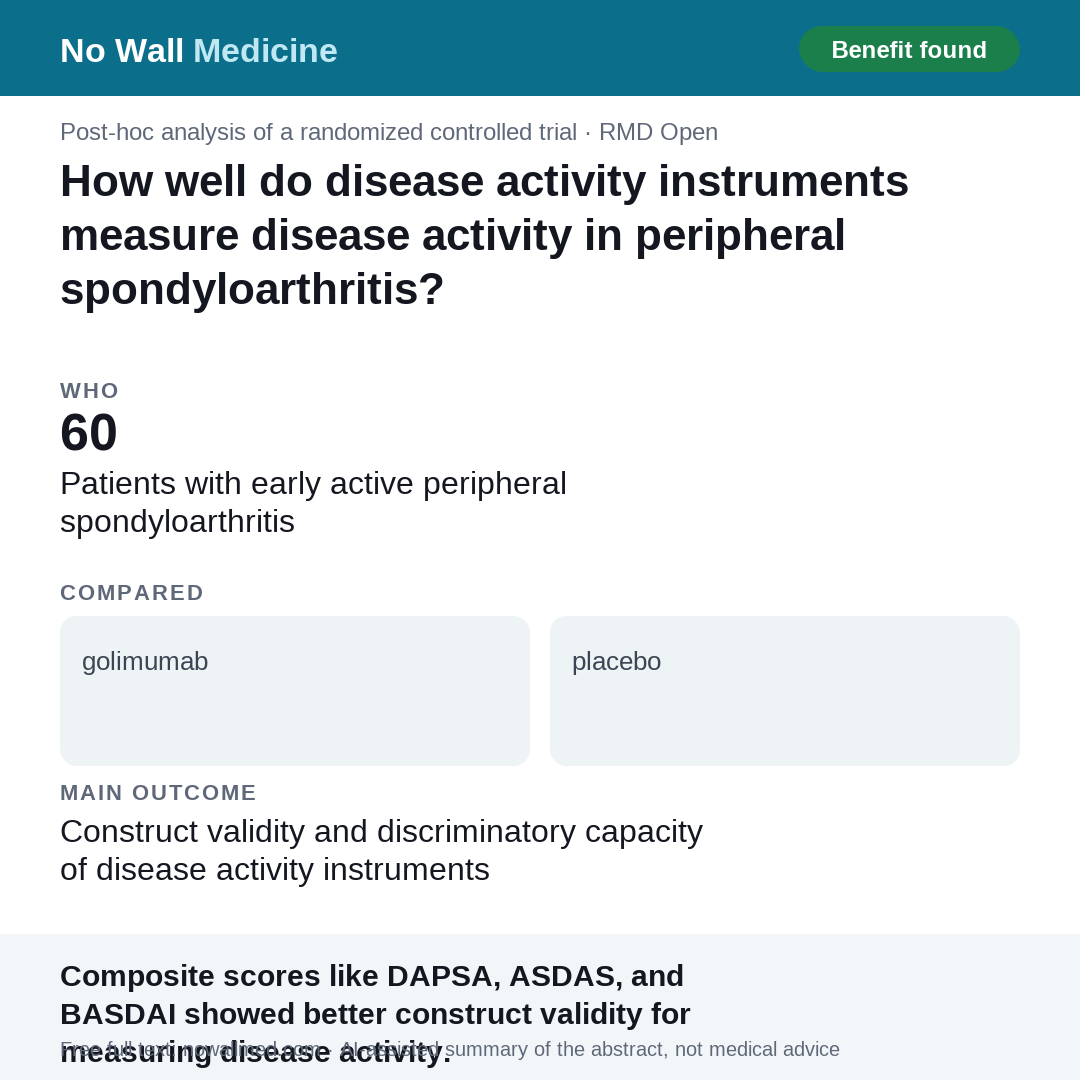
Clinical question: How well do disease activity instruments measure disease activity in peripheral spondyloarthritis?
Why it matters: The performance of different tools used to measure disease activity and response in peripheral spondyloarthritis needs to be understood for clinical study development.
Key points
- Researchers analyzed 60 patients with early active peripheral spondyloarthritis, comparing those receiving golimumab to those receiving a placebo.
- Composite outcomes like DAPSA, BASDAI, and ASDAS showed better construct validity and longitudinal validity than other measures.
- Clinical remission, defined as the absence of arthritis, enthesitis, and dactylitis, was the strongest criterion for discriminating trial results.
Headline and key points written with AI from the paper’s abstract, with every number checked against it. Read the paper before relying on them.
Was this summary helpful?
Abstract
Background
Unravelling the performance of disease activity measures in peripheral spondyloarthritis (pSpA) is crucial for the development of clinical studies. We aimed to evaluate the construct validity and discriminatory capacity of various instruments assessing disease activity and response criteria in patients with pSpA. Methods
Post-hoc analysis of the CRESPA randomised controlled trial including patients with early active pSpA. Patients were randomised to golimumab (GOL) or placebo (PBO). Data of the placebo-controlled part until week 12 were used. Construct validity (known group discrimination assessed with standardised mean difference, SMD) in the 12-week data, longitudinal construct validity (ie, standardised response mean and effect size) and trial discrimination (SMD) of several disease activity instruments were assessed. As part of trial discrimination, a χ2 test was performed for binary outcomes. Results
A total of 60 patients (40 GOL, 20 PBO) were included. Construct validity was better for composite outcomes (ie, Disease Activity in Psoriatic Arthritis (DAPSA), Bath Ankylosing Spondylitis Disease Activity Index (BASDAI) and Axial Spondyloarthritis Disease Activity Score (ASDAS)-higher SMD between active and inactive patients). Longitudinal construct validity was consistently good for composite outcomes (eg, ASDAS, DAPSA) and global assessments (Patient Global Assessment (PGA), Physician Global Assessment (PhGA)). Clinical trial discrimination was good for composites (BASDAI, ASDAS, DAPSA), global assessments (PGA, PhGA) and joint counts (swollen joint count (SJC66) and tender joint count (TJC68)).Among binary outcomes, trial discrimination was strongest for clinical remission (ie, absence of arthritis, enthesitis and dactylitis), BASDAI50, DAPSA-Low Disease Activity (LDA) and ASDAS-LDA. Conclusion
While both composite and global outcome measurement instruments performed well in pSpA, composite scores like DAPSA, ASDAS and BASDAI showed better construct validity. The clinical remission definition was the most discriminatory response criterion.
Abstract reproduced under the article’s CC BY NC licence.
Subject terms
Cite this article
López-Medina C, Capelusnik D, Webers C, Van den Bosch F, Boonen A, Carron P. Measurement properties of disease activity instruments in peripheral spondyloarthritis: a post-hoc analysis of the CRESPA trial. RMD Open. 2025. doi:10.1136/rmdopen-2025-005525
Spotted a mistake? Suggest a correction
Top studies every Monday
The week’s key trials and guidelines in your specialties, plus any topics you follow. By email, free.
Get the weekly digest