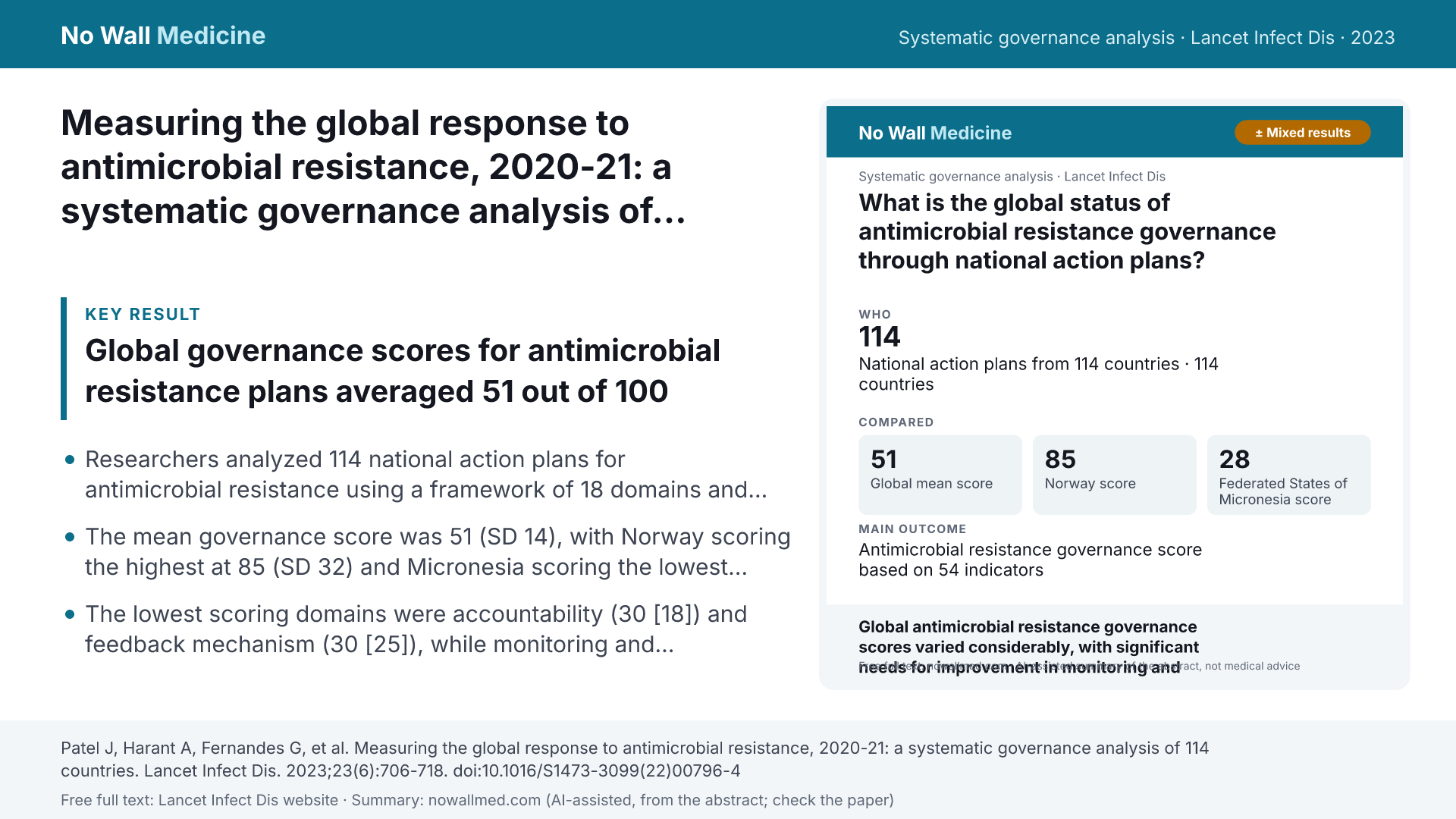
Global governance scores for antimicrobial resistance plans averaged 51 out of 100
Measuring the global response to antimicrobial resistance, 2020-21: a systematic governance analysis of 114 countries
Systematic governance analysisMixed results
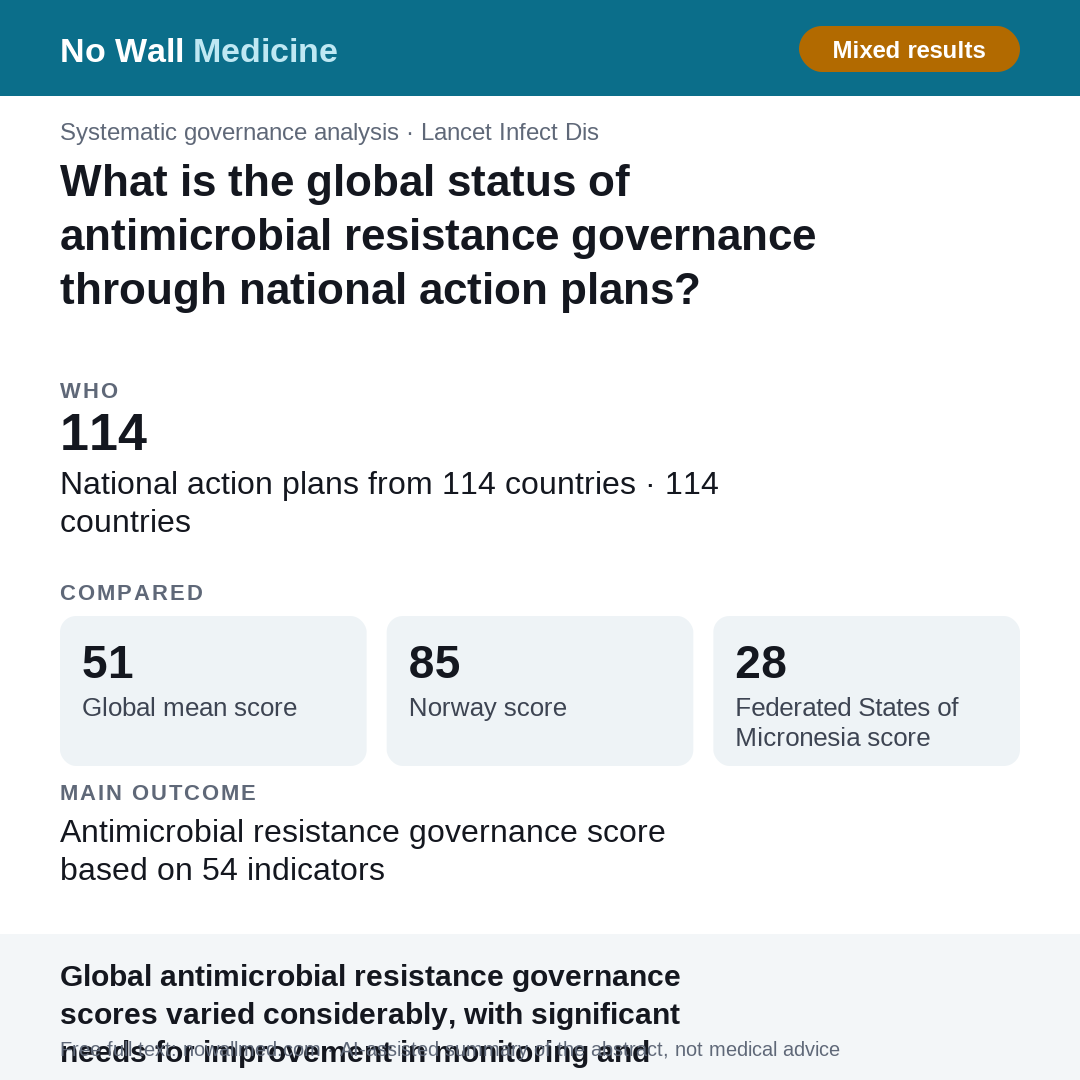
What is the global status of antimicrobial resistance governance through national action plans?
Who
114
National action plans from 114 countries · 114 countries
Compared
51Global mean score (SD 14)
85Norway score (SD 32)
28Federated States of Micronesia score (37)
Main outcome
Antimicrobial resistance governance score based on 54 indicators
Bottom line: Global antimicrobial resistance governance scores varied considerably, with significant needs for improvement in monitoring and evaluation efforts.
Lancet Infect Dis · 2023-01-16Download image
Clinical question: What is the global status of antimicrobial resistance governance through national action plans?
Why it matters: No comprehensive content analysis of national action plans for antimicrobial resistance has existed to evaluate strategic commitments and policy responses.
Key points
- Researchers analyzed 114 national action plans for antimicrobial resistance using a framework of 18 domains and 54 indicators.
- The mean governance score was 51 (SD 14), with Norway scoring the highest at 85 (SD 32) and Micronesia scoring the lowest at 28 (37).
- The lowest scoring domains were accountability (30 [18]) and feedback mechanism (30 [25]), while monitoring and evaluation efforts scored 38 [20].
Headline and key points written with AI from the paper’s abstract, with every number checked against it. Read the paper before relying on them.
Was this summary helpful?
Abstract
Background
Understanding strategic commitments and policy responses to overcome antimicrobial resistance at the national, regional, and global levels is required to evaluate current progress and direct future planning. National action plans (NAPs) are the primary mechanism for guiding national strategy and action for antimicrobial resistance governance. Although several NAPs have been developed, no comprehensive content analysis of these plans exists. Using a governance framework, we aimed to assess all publicly available NAPs on antimicrobial resistance. Methods
We systematically reviewed the contents of NAPs on antimicrobial resistance from 114 countries, applying a governance framework containing 18 domains and 54 indicators in three integral areas: policy design, implementation tools, and monitoring and evaluation. As well as manually searching NAPs and doing online and literature searches that were relevant to specific indicators from repository inception to June 1, 2022, several data sources were used to generate scores, including the Tripartite Antimicrobial Resistance Country Self-Assessment Survey, the Global Antimicrobial Resistance and Use Surveillance System, the Global Antimicrobial Resistance Research and Development Hub, and various WHO datasets. NAPs were included if the country had also submitted the NAP to the Tripartite Antimicrobial Resistance Country Self-Assessment Survey 2020-21, if the NAP was retrievable through a publicly accessible database or website, and if the NAP was either published in English or eligible for machine translation. Three researchers independently reviewed each NAP and were initially blinded to the evaluations of other researchers. They generated a score using a quantification system for each of 54 indicators. The Cochrane protocol for ensuring reliability was followed. The three researchers were then unblinded and met to resolve any disagreements in scoring to reach a consensus agreement. In each case of discrepancy, consensus was reached between the researchers. We developed criteria to standardise the process of quantifying each indicator. We also weighted and collated relevant national data from various sources to generate composite scores concordant with the key governance areas. We transformed these data to a scale of 0 (worst) to 100 (best), ranked countries on the basis of their mean scores, and used descriptive statistics to analyse global and regional trends. Findings
306 NAPs were identified and 114 were eligible for analysis. Between 2020 and 2021, the mean antimicrobial resistance governance score was 51 (SD 14). Norway had the highest governance score (mean 85 [SD 32]), and the Federated States of Micronesia had the lowest governance score (28 [37]). The highest scoring domain was participation (83 [16]), and the lowest scoring domains were accountability (30 [18]) and feedback mechanism (30 [25]). Domains relating to policy design (55 [13]) and implementation tools (54 [17]) scored similarly, whereas monitoring and evaluation (38 [20]) efforts were lower. Interpretation
International efforts to control antimicrobial resistance varied considerably between countries. Monitoring and evaluation efforts need improving for continuous understanding of national and international progress. International response might not be commensurate with the scale and severity of antimicrobial resistance. Funding
None.
Abstract reproduced under the article’s CC BY licence.
Subject terms
Cite this article
Patel J, Harant A, Fernandes G, et al. Measuring the global response to antimicrobial resistance, 2020-21: a systematic governance analysis of 114 countries. Lancet Infect Dis. 2023. doi:10.1016/S1473-3099(22)00796-4
Spotted a mistake? Suggest a correction