Mechanical chest compressions show no overall benefit or harm compared to manual compressions
Mechanical versus manual chest compression in cardiac arrest: a systematic review
Systematic review of randomized and quasi-randomised controlled trialsNo clear difference
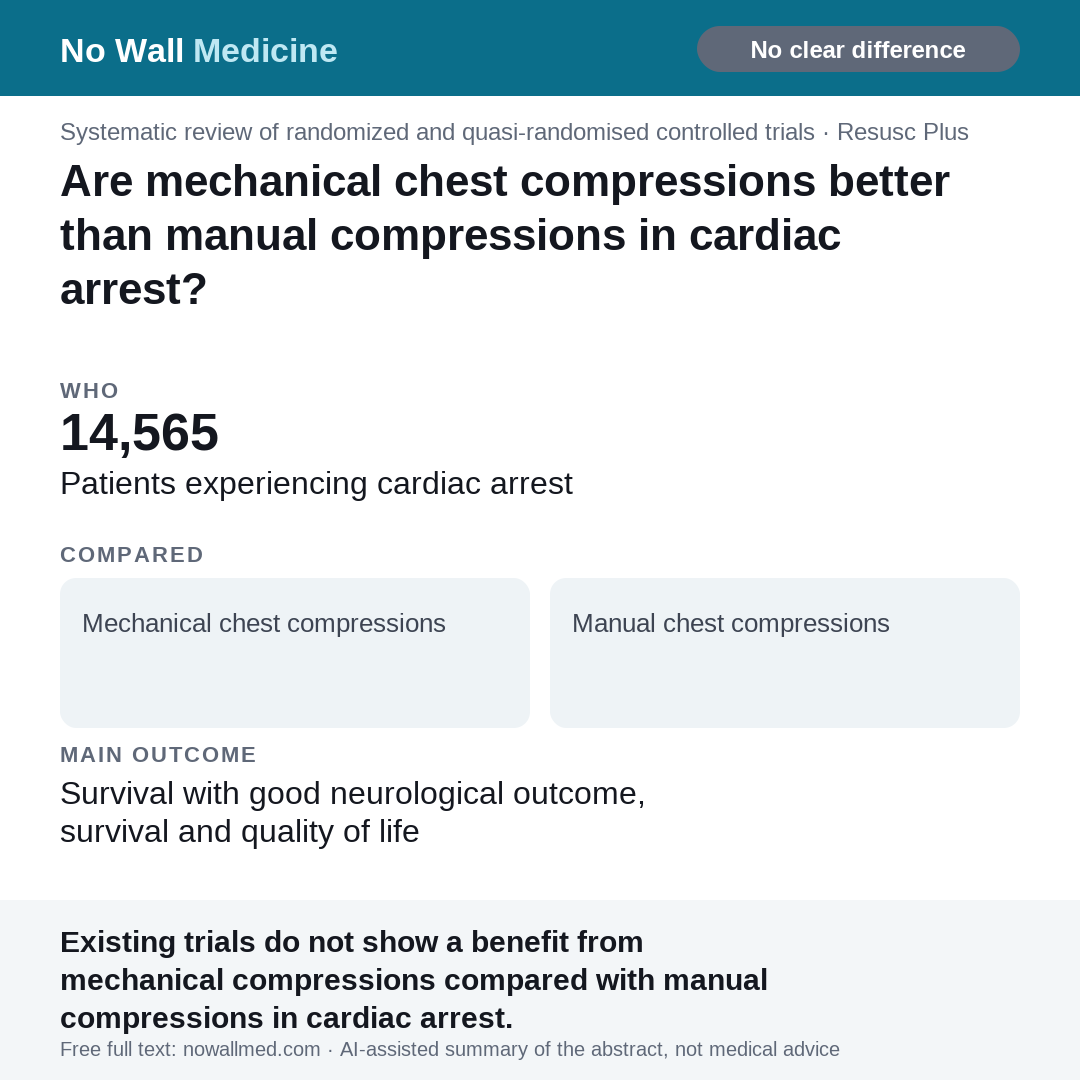
Are mechanical chest compressions better than manual compressions in cardiac arrest?
Who
14,565
Patients experiencing cardiac arrest
Compared
Mechanical chest compressions
Manual chest compressions
Main outcome
Survival with good neurological outcome, survival and quality of life
Bottom line: Existing trials do not show a benefit from mechanical compressions compared with manual compressions in cardiac arrest.
Limitation: Substantial methodological and clinical heterogeneity between the studies precluded meta-analysis.
Resusc Plus · 2026-04-01Download image
Clinical question: Are mechanical chest compressions better than manual compressions in cardiac arrest?
Why it matters: International guidelines currently advise against the routine use of mechanical chest compression devices, but new trial data prompted this review to inform treatment recommendations.
Key points
- Researchers reviewed 11 randomized and quasi-randomized controlled trials involving a total of 14,565 patients.
- The three largest trials, involving 11,291 patients, showed no benefit or harm from mechanical chest compressions compared to manual compressions.
- Smaller trials provided lower-certainty evidence that was conflicting, with some results showing benefit and others showing harm.
Limitation the authors note: Substantial methodological and clinical heterogeneity between the studies precluded meta-analysis.
Headline and key points written with AI from the paper’s abstract, with every number checked against it. Read the paper before relying on them.
Cite this article
Pocock H, Nicholson TC, Szarpak L, Soar J, Berg KM, International Liaison Committee on Resuscitation Advanced Life Support Task Force. Mechanical versus manual chest compression in cardiac arrest: a systematic review. Resusc Plus. 2026. doi:10.1016/j.resplu.2026.101311
Spotted a mistake? Suggest a correction