Mindfulness-based cognitive therapy reduces depressive symptoms through increased decentering regardless of initial severity
Mechanisms of mindfulness-based cognitive therapy in difficult-to-treat depression: moderation and mediation analyses from the RESPOND trial
Randomized trialBenefit found
Does baseline depressive severity moderate MBCT effectiveness or its mechanism of decentering?
Who
234
Adults not remitted after high-intensity psychological therapy
Compared
Mindfulness-based cognitive therapy plus treatment as usual
Treatment as usual alone
Main outcome
Depressive symptoms and decentering
Bottom line: Mindfulness-based cognitive therapy is effective for difficult-to-treat depression regardless of baseline symptom severity.
Psychol Med · 2026-07-13Download image
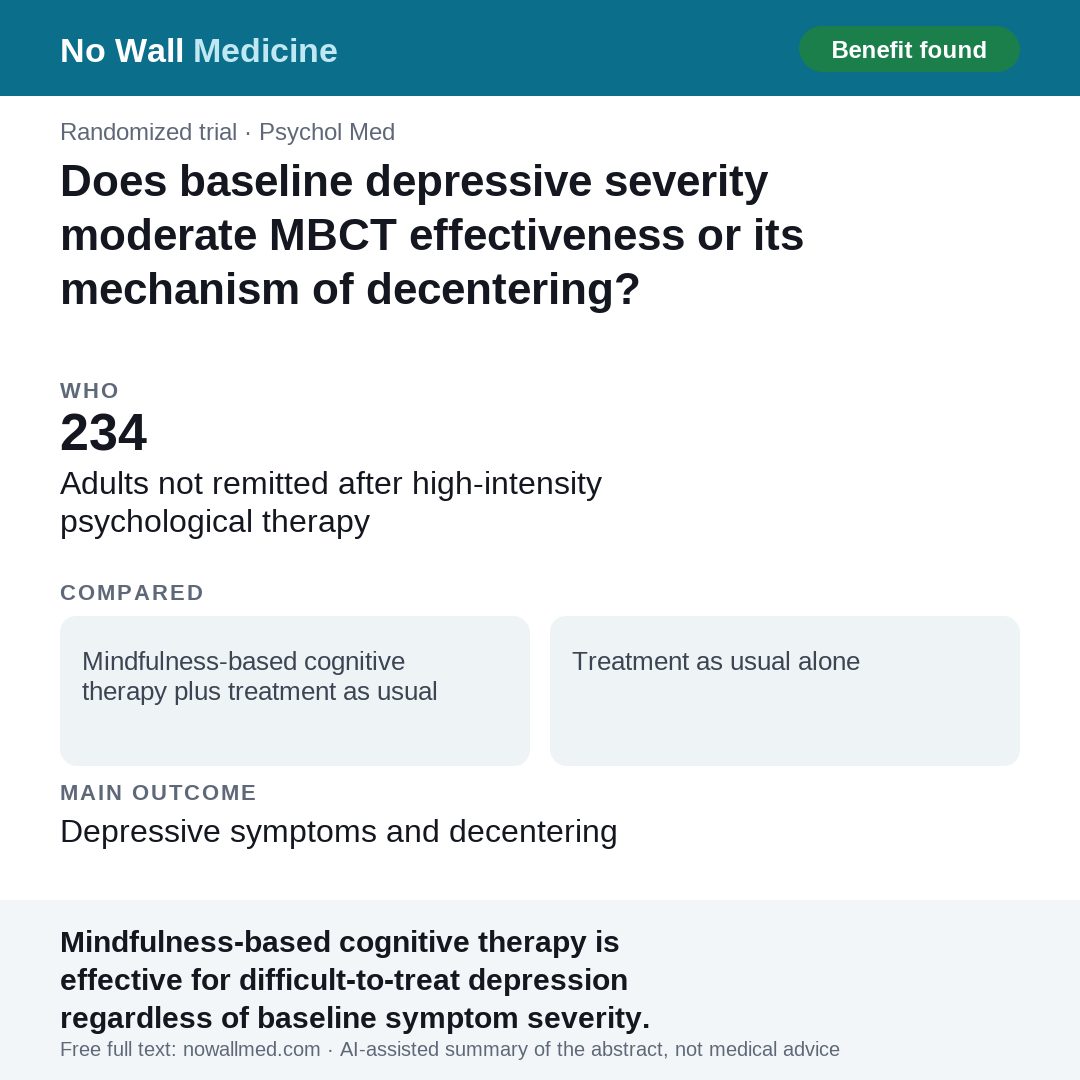
Clinical question: Does baseline depressive severity moderate MBCT effectiveness or its mechanism of decentering?
Why it matters: It was unclear if ongoing depressive symptoms would limit the effectiveness of mindfulness-based cognitive therapy or disrupt its proposed mechanism of decentering.
Key points
- Researchers studied 234 adults with difficult-to-treat depression by comparing mindfulness-based cognitive therapy plus usual care to usual care alone.
- Increases in decentering, or the ability to observe thoughts without judgment, partially explained how the mindfulness therapy reduced depressive symptoms at 34 weeks.
- Higher baseline symptom severity did not limit the treatment effect, but decentering was more strongly linked to symptom reduction in those with higher initial severity.
Headline and key points written with AI from the paper’s abstract, with every number checked against it. Read the paper before relying on them.
Topics
Cite this article
Barnhofer T, Dunn BD, Strauss C, Ruths FA, Ryan M, Ladwa A. Mechanisms of mindfulness-based cognitive therapy in difficult-to-treat depression: moderation and mediation analyses from the RESPOND trial. Psychol Med. 2026. doi:10.1017/S0033291726105212
Spotted a mistake? Suggest a correction