Motoric cognitive risk syndrome was associated with higher risks of dementia, falls, and mortality
Mechanisms of motoric cognitive risk-Hypotheses based on a systematic review and meta-analysis of longitudinal cohort studies of older adults
Systematic review and meta-analysisBenefit found
Is motoric cognitive risk prognostic of incident dementia and other major morbidity?
Who
Adults aged 60 years or older
Compared
Motoric cognitive risk group
Non-motoric cognitive risk group
Main outcome
Cognitive impairment, dementia, falls, and mortality
Result: cognitive impairment aHR 1.76 (95% CI 1.49-2.08); dementia aHR 2.12 (1.85-2.42); falls Relative Risk 1.38 (1.15-1.66); mortality aHR 1.49 (1.16-1.91)
Bottom line: Motoric cognitive risk is associated with increased risk of cognitive impairment, dementia, falls, and mortality in older adults.
Alzheimers Dement · 2022-02-09Download image
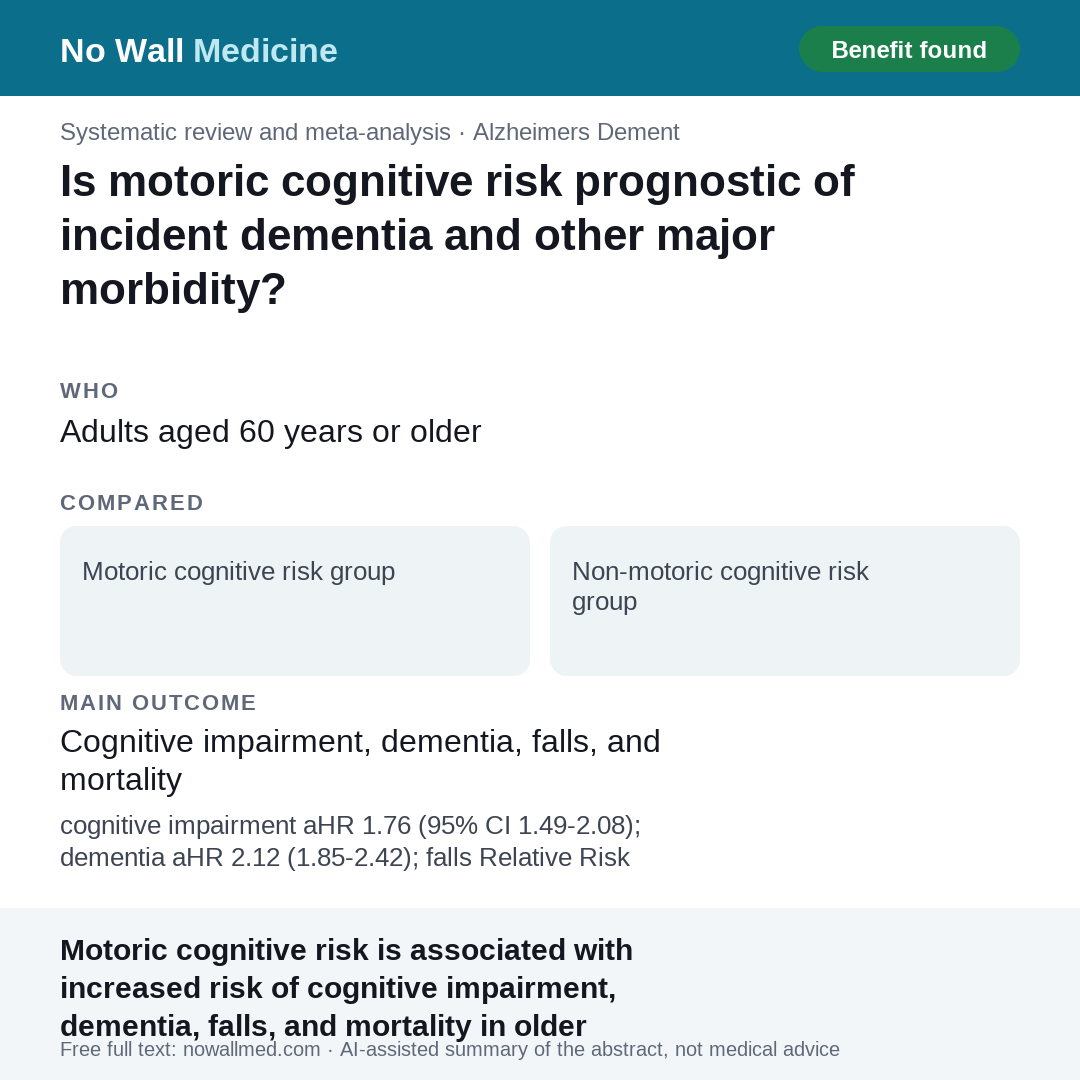
Clinical question: Is motoric cognitive risk prognostic of incident dementia and other major morbidity?
Why it matters: It was unclear how motoric cognitive risk syndrome, which combines slow walking speed and cognitive complaints, relates to future dementia and other health outcomes in older adults.
Key points
- Researchers performed a meta-analysis of 15 longitudinal cohort studies involving adults aged 60 years or older to examine motoric cognitive risk syndrome.
- The syndrome was associated with an increased risk of cognitive impairment (adjusted hazard ratio 1.76), dementia (adjusted hazard ratio 2.12), falls (relative risk 1.38), and mortality (adjusted hazard ratio 1.49).
- Motoric cognitive risk syndrome is defined as a combination of slow walking speed and self-reported problems with thinking or memory.
Headline and key points written with AI from the paper’s abstract, with every number checked against it. Read the paper before relying on them.
Was this summary helpful?
Subject terms
Cite this article
Mullin DS, Cockburn A, Welstead M, Luciano M, Russ TC, Muniz-Terrera G. Mechanisms of motoric cognitive risk-Hypotheses based on a systematic review and meta-analysis of longitudinal cohort studies of older adults. Alzheimers Dement. 2022. doi:10.1002/alz.12547
Spotted a mistake? Suggest a correction
Top studies every Monday
The week’s key trials and guidelines in your specialties, plus any topics you follow. By email, free.
Get the weekly digest