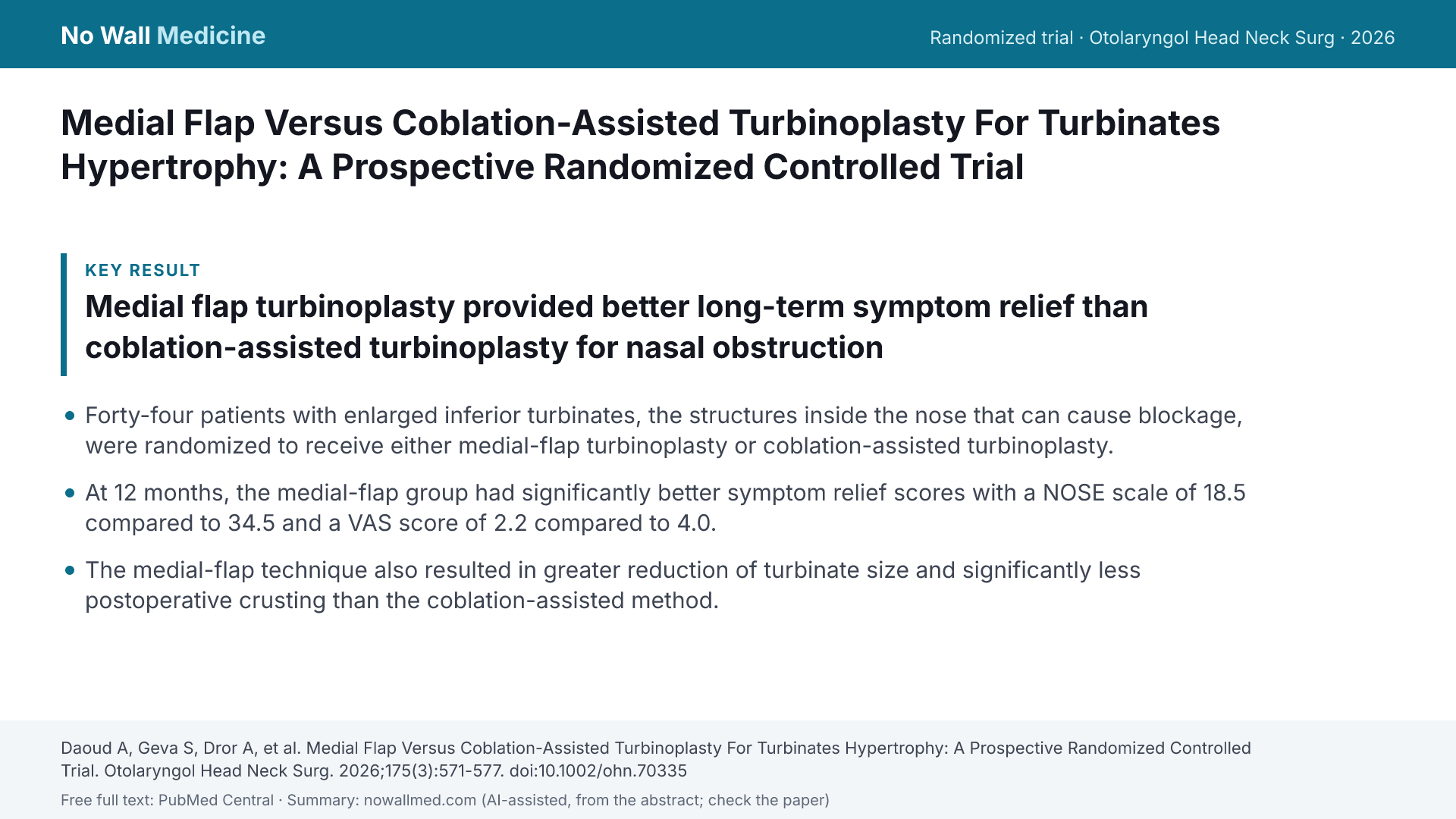
Medial flap turbinoplasty provided better long-term symptom relief than coblation-assisted turbinoplasty for nasal obstruction
Medial Flap Versus Coblation-Assisted Turbinoplasty For Turbinates Hypertrophy: A Prospective Randomized Controlled Trial
Why it matters: Doctors need to determine which surgical technique provides the best long-term relief for patients with nasal obstruction caused by enlarged inferior turbinates.
Key points
- Forty-four patients with enlarged inferior turbinates, the structures inside the nose that can cause blockage, were randomized to receive either medial-flap turbinoplasty or coblation-assisted turbinoplasty.
- At 12 months, the medial-flap group had significantly better symptom relief scores with a NOSE scale of 18.5 compared to 34.5 and a VAS score of 2.2 compared to 4.0.
- The medial-flap technique also resulted in greater reduction of turbinate size and significantly less postoperative crusting than the coblation-assisted method.
Headline and key points written with AI from the paper’s abstract, with every number checked against it. Read the paper before relying on them.
Was this summary helpful?
Subject terms
Headline, design, result, key points, caveat and citation as plain text.
Cite this article
Daoud A, Geva S, Dror A, et al. Medial Flap Versus Coblation-Assisted Turbinoplasty For Turbinates Hypertrophy: A Prospective Randomized Controlled Trial. Otolaryngol Head Neck Surg. 2026;175(3):571-577. doi:10.1002/ohn.70335
Spotted a mistake? Suggest a correction