Blood and lung fluid markers are associated with systemic sclerosis-associated interstitial lung disease
Mediators of systemic sclerosis-associated interstitial lung disease (SSc-ILD): systematic review and meta-analyses
Systematic review and meta-analysesBenefit found
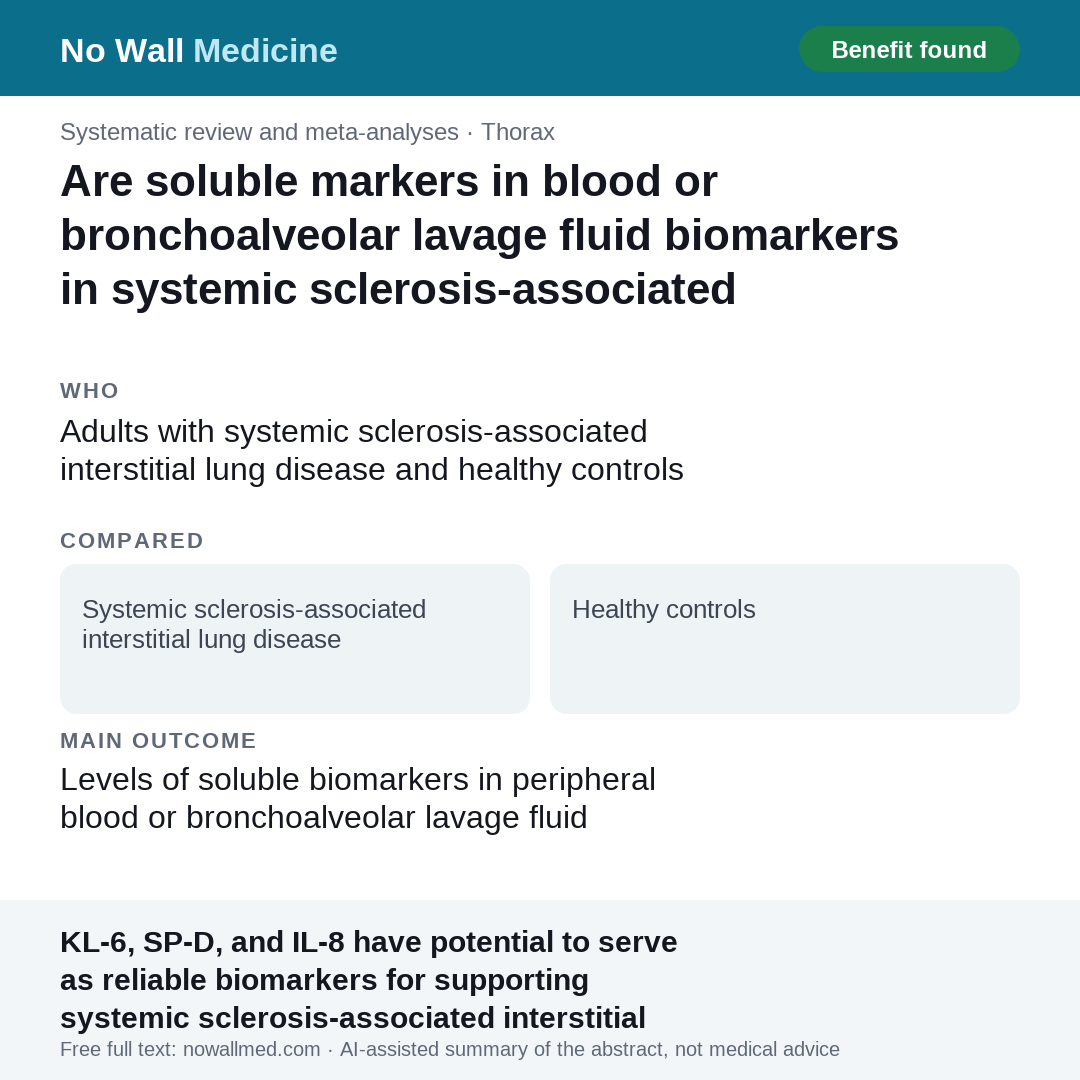
Are soluble markers in blood or bronchoalveolar lavage fluid biomarkers in systemic sclerosis-associated interstitial lung disease?
Who
Adults with systemic sclerosis-associated interstitial lung disease and healthy controls
Compared
Systemic sclerosis-associated interstitial lung disease
Healthy controls
Main outcome
Levels of soluble biomarkers in peripheral blood or bronchoalveolar lavage fluid
Result: IL-8 SMD 0.88 (95% CI 0.61 to 1.15); SP-D SMD 1.78 (95% CI 1.50 to 2.17); KL-6 SMD 1.66 (95% CI 1.17 to 2.14)
Bottom line: KL-6, SP-D, and IL-8 have potential to serve as reliable biomarkers for supporting systemic sclerosis-associated interstitial lung disease diagnosis.
Limitation: Evidence of independent value of other proposed biomarkers in diagnosis and prognosis is currently lacking.
Thorax · 2022-10-19Download image
Clinical question: Are soluble markers in blood or bronchoalveolar lavage fluid biomarkers in systemic sclerosis-associated interstitial lung disease?
Why it matters: Systemic sclerosis-associated interstitial lung disease is rare and has diverse characteristics that make diagnosis difficult.
Key points
- Researchers analyzed 38 studies from 768 identified papers to compare biomarkers in blood or bronchoalveolar lavage fluid (fluid from the lungs) between patients and healthy controls.
- Higher levels of IL-8, SP-D, and KL-6 were associated with the disease, with standardized mean differences of 0.88, 1.78, and 1.66 respectively.
- Evidence for the independent diagnostic or prognostic value of other proposed biomarkers is currently lacking.
Headline and key points written with AI from the paper’s abstract, with every number checked against it. Read the paper before relying on them.
Was this summary helpful?
Abstract
Unlabelled
Systemic sclerosis-associated interstitial lung disease (SSc-ILD) is rare, poorly understood, with heterogeneous characteristics resulting in difficult diagnosis. We aimed to systematically review evidence of soluble markers in peripheral blood or bronchoalveolar lavage fluid (BALF) as biomarkers in SSc-ILD. Method
Five databases were screened for observational or interventional, peer-reviewed studies in adults published between January 2000 and September 2021 that assessed levels of biomarkers in peripheral blood or BALF of SSc-ILD patients compared with healthy controls. Qualitative assessment was performed using Critical Appraisal Skills Programme (CASP) checklists. Standardised mean difference (SMD) in biomarkers were combined in random-effects meta-analyses where multiple independent studies reported quantitative data. Results
768 published studies were identified; 38 articles were included in the qualitative synthesis. Thirteen studies were included in the meta-analyses representing three biomarkers: KL6, SP-D and IL-8. Greater IL-8 levels were associated with SSc-ILD in both peripheral blood and BALF, overall SMD 0.88 (95% CI 0.61 to 1.15; I2=1%). Greater levels of SP-D and KL-6 were both estimated in SSc-ILD peripheral blood compared with healthy controls, at an SMD of 1.78 (95% CI 1.50 to 2.17; I2=8%) and 1.66 (95% CI 1.17 to 2.14; I2=76%), respectively. Conclusion
We provide robust evidence that KL-6, SP-D and IL-8 have the potential to serve as reliable biomarkers in blood/BALF for supporting the diagnosis of SSc-ILD. However, while several other biomarkers have been proposed, the evidence of their independent value in diagnosis and prognosis is currently lacking and needs further investigation. Prospero registration number
CRD42021282452.
Abstract reproduced under the article’s CC BY NC licence.
Subject terms
Cite this article
Fields A, Potel KN, Cabuhal R, Aziri B, Stewart ID, Schock BC. Mediators of systemic sclerosis-associated interstitial lung disease (SSc-ILD): systematic review and meta-analyses. Thorax. 2022. doi:10.1136/thorax-2022-219226
Spotted a mistake? Suggest a correction
Top studies every Monday
The week’s key trials and guidelines in your specialties, plus any topics you follow. By email, free.
Get the weekly digest