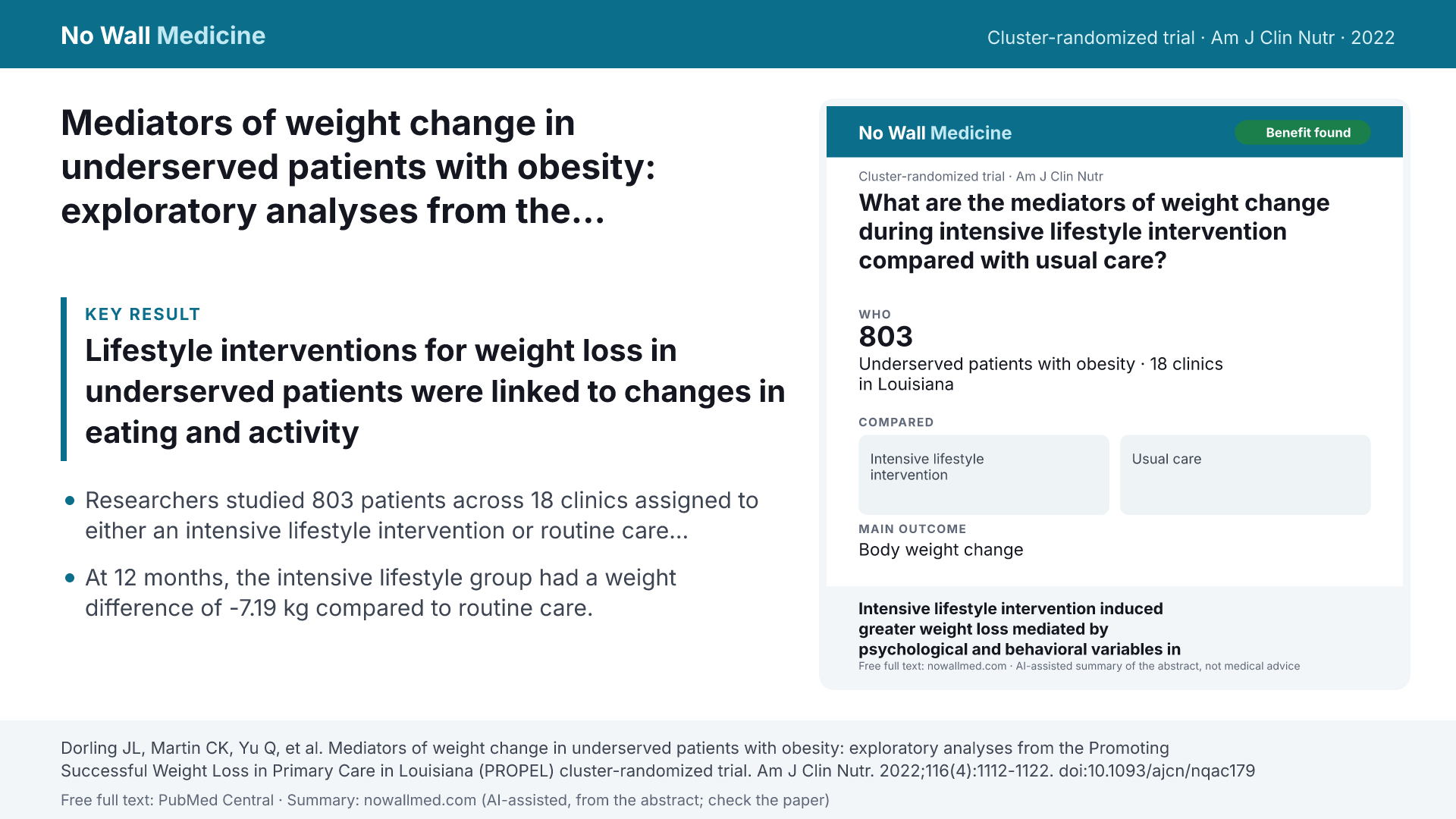
Lifestyle interventions for weight loss in underserved patients were linked to changes in eating and activity
Mediators of weight change in underserved patients with obesity: exploratory analyses from the Promoting Successful Weight Loss in Primary Care in Louisiana (PROPEL) cluster-randomized trial
Secondary analysis of a trialBenefit found
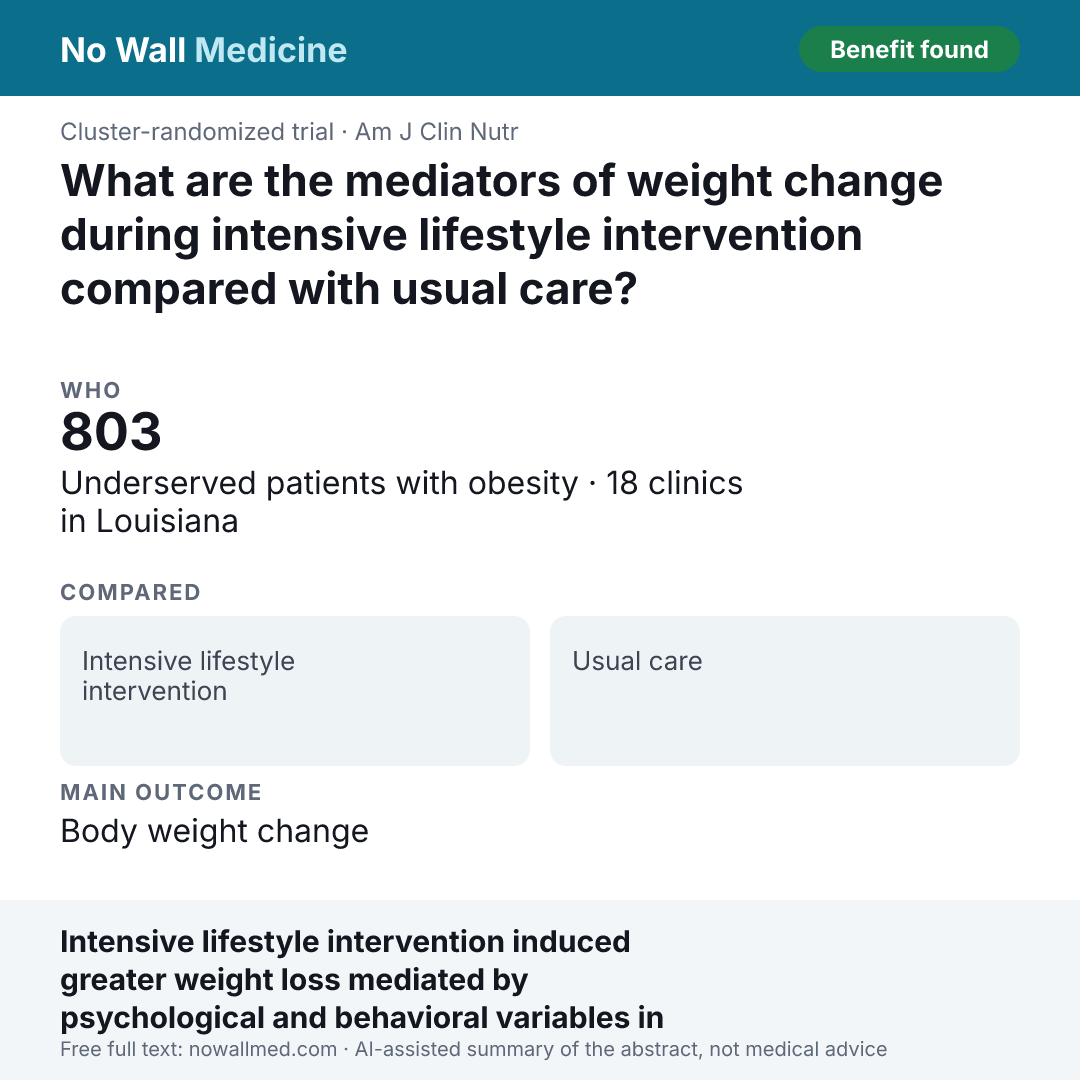
What are the mediators of weight change during intensive lifestyle intervention compared with usual care?
Who
803
Underserved patients with obesity · 18 clinics in Louisiana
Compared
Intensive lifestyle intervention
Usual care
Main outcome
Body weight change
Result: between-group difference: -7.19 kg; 95% CI: -8.43, -6.07 kg
Bottom line: Intensive lifestyle intervention induced greater weight loss mediated by psychological and behavioral variables in underserved patients with obesity.
Am J Clin Nutr · 2022-06-29 · Save PNG
Same trial (NCT02561221)
Papers we list that report this registered trial, oldest first. Read a secondary analysis alongside the main results.
- Main results Benefit found
Two-year intensive lifestyle intervention in primary care improved weight and cholesterol in adults with obesity Circulation 2021-02 - Secondary analysis Benefit found
This paper Am J Clin Nutr 2022-06
Clinical question: What are the mediators of weight change during intensive lifestyle intervention compared with usual care?
Key points
- Researchers studied 803 patients across 18 clinics assigned to either an intensive lifestyle intervention or routine care for 24 months.
- At 12 months, the intensive lifestyle group had a weight difference of -7.19 kg compared to routine care.
- Changes in eating disinhibition, fat intake, physical activity, and fatigue at 6 months partially explained the weight difference at 12 months.
Headline and key points written with AI from the paper’s abstract, with every number checked against it. Read the paper before relying on them.
Was this summary helpful?
Subject terms
Headline, design, result, key points, caveat and citation as plain text.
Cite this article
Dorling JL, Martin CK, Yu Q, et al. Mediators of weight change in underserved patients with obesity: exploratory analyses from the Promoting Successful Weight Loss in Primary Care in Louisiana (PROPEL) cluster-randomized trial. Am J Clin Nutr. 2022;116(4):1112-1122. doi:10.1093/ajcn/nqac179
Spotted a mistake? Suggest a correction