Randomized trial Journal of Medical Internet Research · Sep 21, 2026
Digital bottle cap data shows strong link between dose consistency and medication adherence Medication Adherence Behavior Assessed Using a Digital Bottle Cap: Retrospective Cohort Study
Nowojewski A, Elizarova O, Rutgersson A, Zarodkiewicz A, Jiang Y, Olsson A, et al
Post hoc analysis of a randomized, double-blind, placebo-controlled trial Benefit found
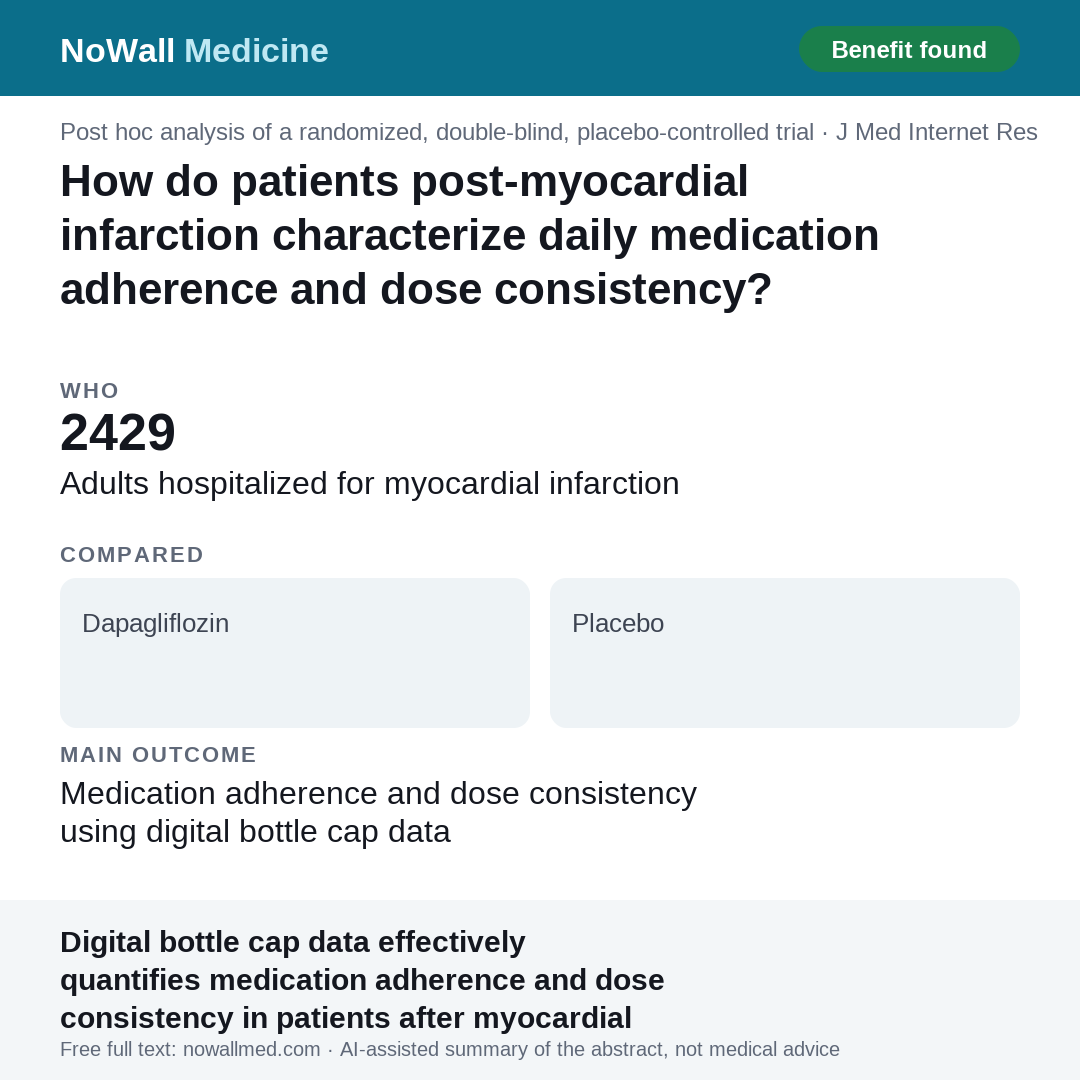
How do patients post-myocardial infarction characterize daily medication adherence and dose consistency?
Who
2429
Adults hospitalized for myocardial infarction
Main outcome
Medication adherence and dose consistency using digital bottle cap data
Bottom line: Digital bottle cap data effectively quantifies medication adherence and dose consistency in patients after myocardial infarction.
Limitation: This was a post hoc analysis of existing data.
Clinical question: How do patients post-myocardial infarction characterize daily medication adherence and dose consistency?
Why it matters: There is a lack of studies using objective measures to characterize medication adherence behavior in patients after a heart attack.
Key points Researchers analyzed 2,429 participants from a clinical trial using 733,490 timepoints recorded by digital bottle caps. The study found a strong association between dose consistency, or the timing of medication, and adherence over time. The analysis used data from a trial comparing 10 mg of dapagliflozin to a placebo in patients after a myocardial infarction (heart attack). Headline and key points written with AI from the paper’s abstract, with every number checked against it. Read the paper before relying on them.
Topics Humans; Retrospective Studies; Female; Middle Aged; Male; Myocardial Infarction; Medication Adherence; Aged; Drug Monitoring; Double-Blind Method; Drug Packaging; Benzhydryl Compounds
DOI: 10.2196/91299 · PubMed: 42767628
Spotted a mistake? Suggest a correction
More in Digital Health & AI Research Lancet Digit Health · Nov 23, 2026 · Digital Health & AI
ClinicalAge, a framework for modelling ageing trajectories from longitudinal electronic health records in the UK: a model development and validation study
Research Lancet Digit Health · Nov 23, 2026 · Digital Health & AI
Foundation artificial intelligence models for health recognition by use of face photographs (FAHR-Face): a model development and validation study
Research Lancet Digit Health · Nov 23, 2026 · Digital Health & AI
A prognostic model for use at labour onset to estimate the risk of severe fetal compromise at birth: a retrospective, model development and validation study
Research NPJ Digit Med · Nov 21, 2026 · Digital Health & AI
ECG foundation models for cardiovascular screening in a cohort of young competitive athletes
Research J Med Internet Res · Nov 20, 2026 · Digital Health & AI
Medical Reasoning in Large Language Models: Development and Evaluation of the MedEvalArena Benchmark