Medication optimization protocol did not reduce death or hospital visits in older patients
Medication Optimization Protocol Efficacy for Geriatric Inpatients: A Randomized Clinical Trial
Open-label randomized clinical trialNo clear difference
Does multidisciplinary team-based medication optimization improve survival and hospital visits in older inpatients?
Who
442
Medical inpatients 65 years or older receiving 5 or more regular medications · 8 internal medicine inpatient wards, community hospital in Japan
Compared
49.3%Medication optimization intervention
51.5%Usual care
Main outcome
Composite of death, unscheduled hospital visits, and rehospitalization within 12 months
Result: stratified hazard ratio 0.98 (95% CI 0.75 to 1.27)
Bottom line: Multidisciplinary medication optimization reduced potentially inappropriate medications but did not reduce death, unscheduled hospital visits, or rehospitalization.
JAMA Netw Open · 2024-07-01Download image
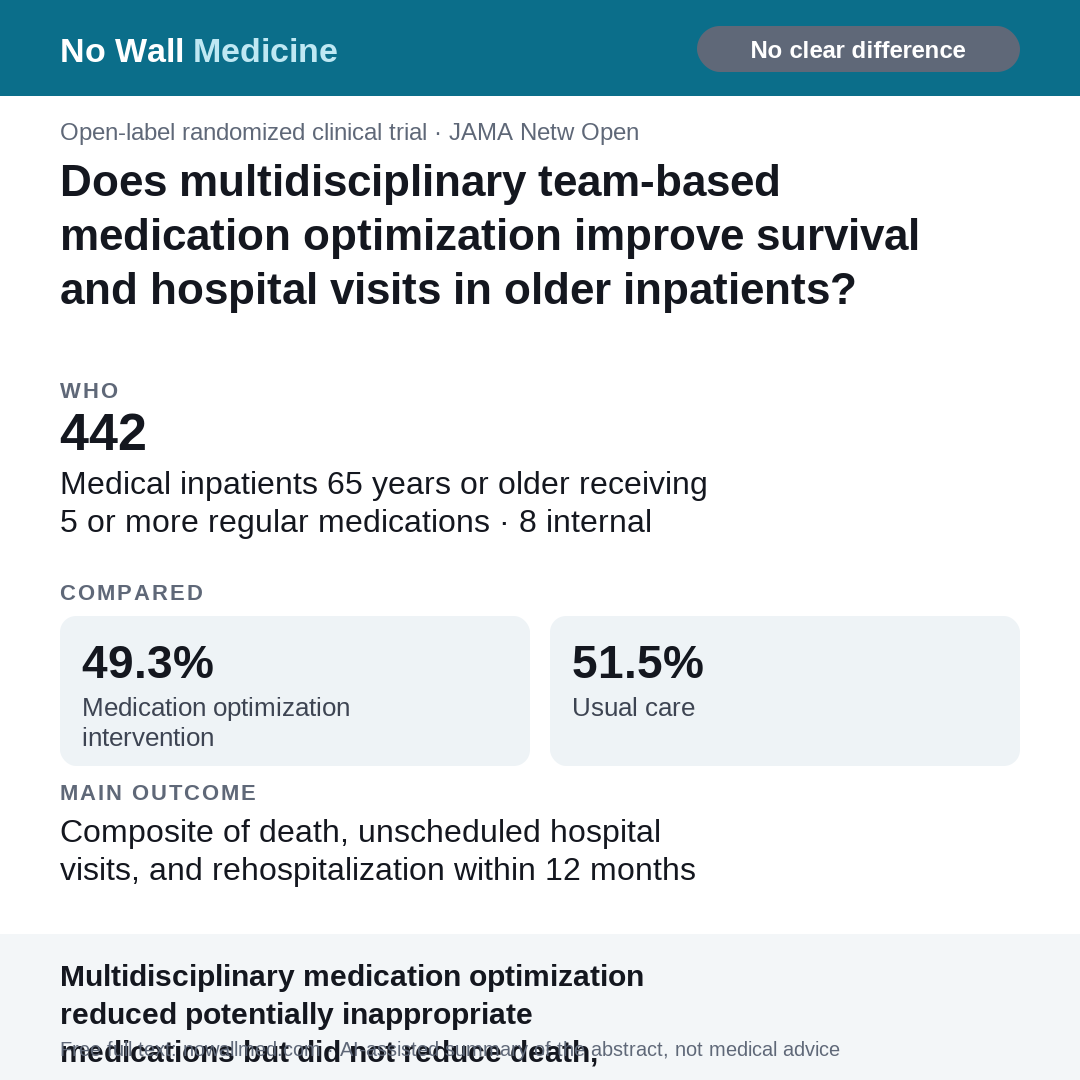
Clinical question: Does multidisciplinary team-based medication optimization improve survival and hospital visits in older inpatients?
Why it matters: There is no consensus on which interventions are clinically effective for managing polypharmacy, which is the use of multiple medications, among older hospital patients.
Key points
- Researchers studied 442 inpatients aged 65 years or older receiving 5 or more medications, comparing a multidisciplinary team intervention to usual care.
- The intervention group had a lower percentage of potentially inappropriate medications at discharge (26.2% vs 33.0%), at 6 months (27.7% vs 37.5%), and at 12 months (26.7% vs 37.4%).
- The primary composite outcome of death, unscheduled hospital visits, or rehospitalization occurred in 49.3% of the intervention group and 51.5% of the usual care group.
Headline and key points written with AI from the paper’s abstract, with every number checked against it. Read the paper before relying on them.
Was this summary helpful?
Subject terms
Cite this article
Ie K, Hirose M, Sakai T, Motohashi I, Aihara M, Otsuki T. Medication Optimization Protocol Efficacy for Geriatric Inpatients: A Randomized Clinical Trial. JAMA Netw Open. 2024. doi:10.1001/jamanetworkopen.2024.23544
Spotted a mistake? Suggest a correction
Top studies every Monday
The week’s key trials and guidelines in your specialties, plus any topics you follow. By email, free.
Get the weekly digest