MEDPass versus conventional administration of oral nutritional supplements - A randomized controlled trial comparing coverage of energy and protein requirements
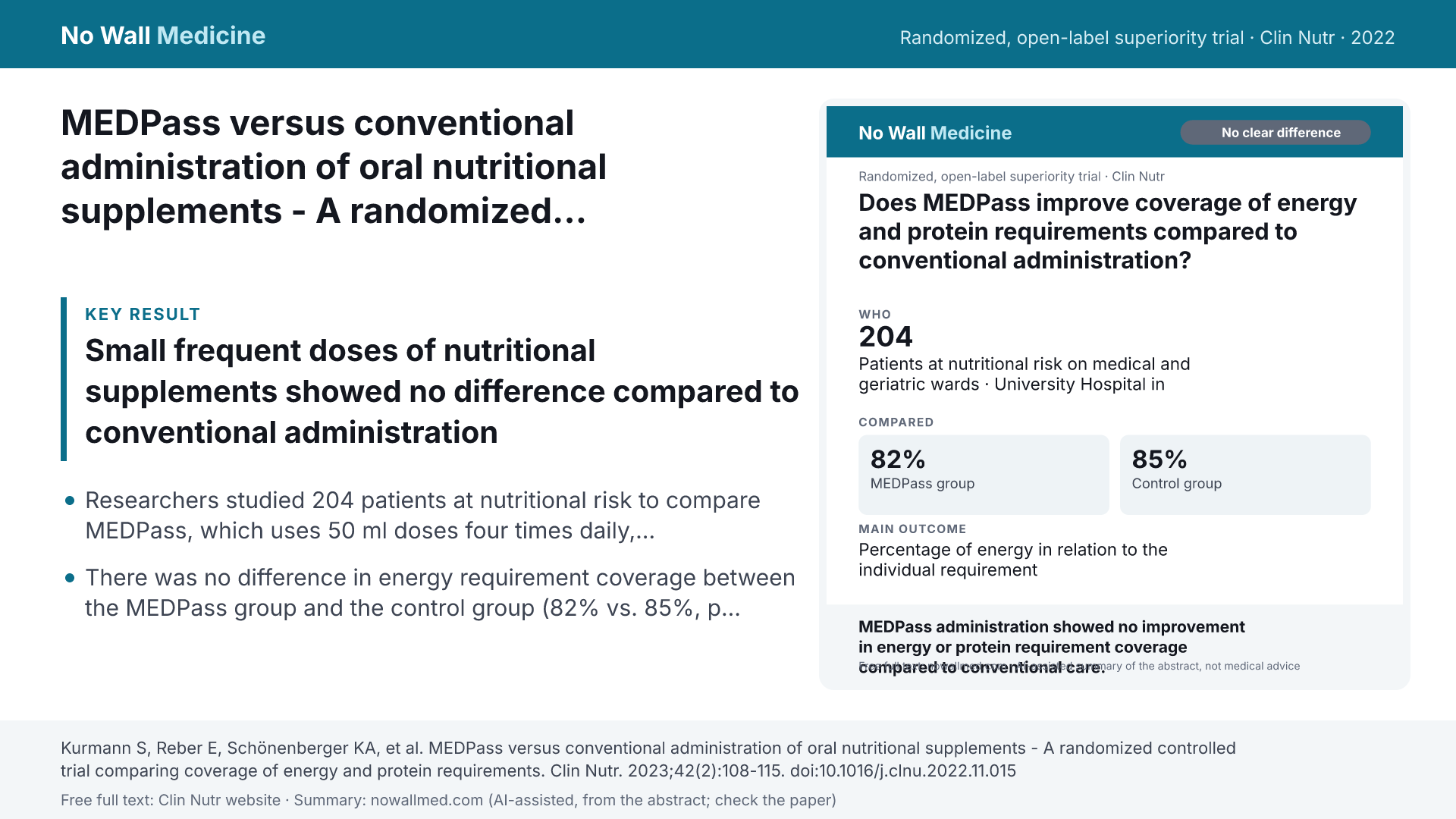
Key result: Small frequent doses of nutritional supplements showed no difference compared to conventional administration
Randomized, open-label superiority trialNo clear difference
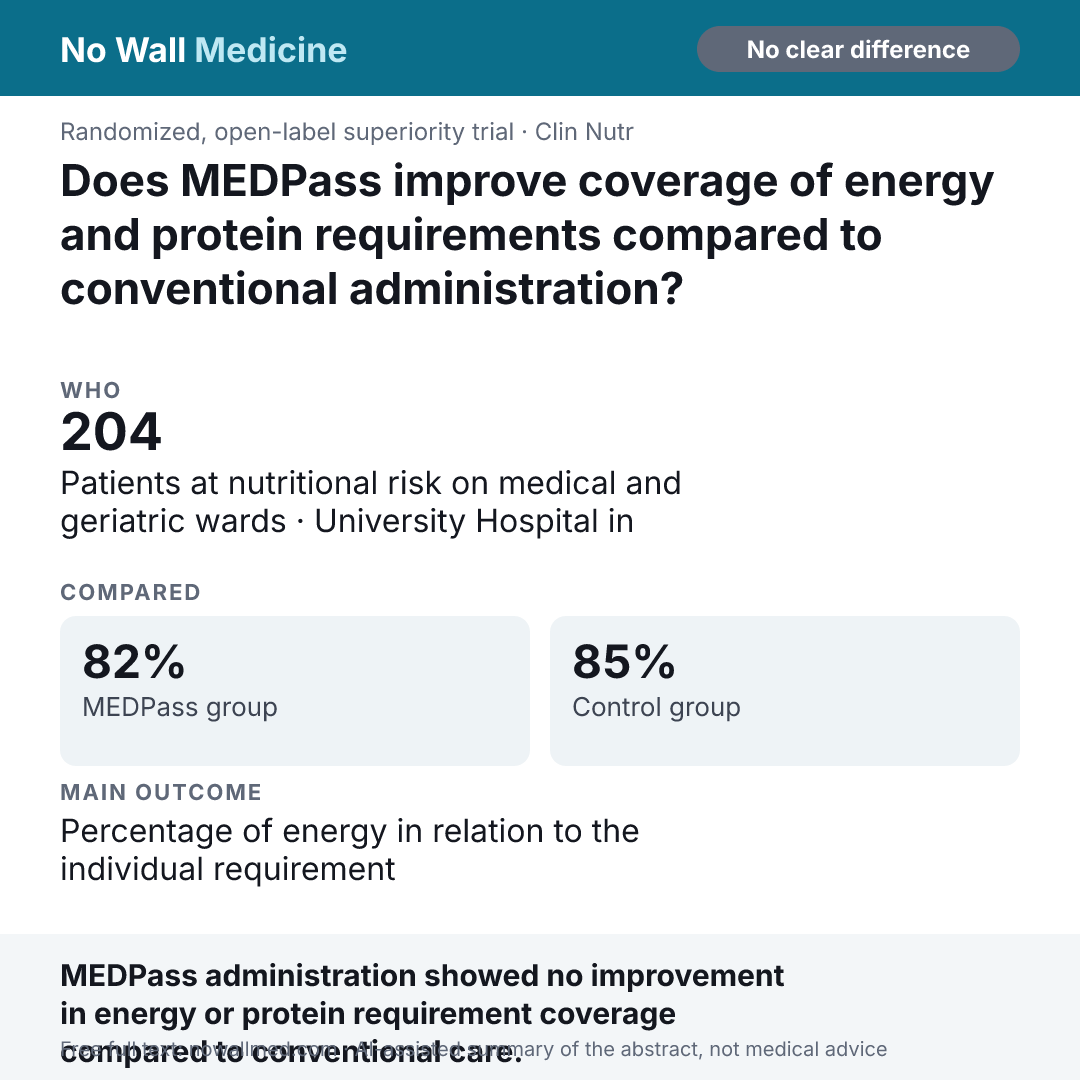
Does MEDPass improve coverage of energy and protein requirements compared to conventional administration?
Who
204
Patients at nutritional risk on medical and geriatric wards · University Hospital in Switzerland
Compared
82%MEDPass group
85%Control group
Main outcome
Percentage of energy in relation to the individual requirement
Result: Δ -3%, 95%CI -11 to 4%
Bottom line: MEDPass administration showed no improvement in energy or protein requirement coverage compared to conventional care.
Clin Nutr · 2022-12-05 · Save PNG
Key points
- Researchers studied 204 patients at nutritional risk to compare MEDPass, which uses 50 ml doses four times daily, against conventional oral nutritional supplement administration.
- There was no difference in energy requirement coverage between the MEDPass group and the control group (82% vs. 85%, p = 0.38).
- No significant differences were found for protein requirement coverage (101% vs. 104%, p = 0.57), daily supplement intake, or 30-day mortality.
Discussion prompts
- Would these patients look like yours? Who was left out?
- Is the main outcome one that matters to patients?
- Is the difference large enough to change what you do?
Cite: Kurmann S, Reber E, Schönenberger KA, et al. MEDPass versus conventional administration of oral nutritional supplements - A randomized controlled trial comparing coverage of energy and protein requirements. Clin Nutr. 2023;42(2):108-115. doi:10.1016/j.clnu.2022.11.015
Free full text: Clin Nutr website · Summary and visual abstract: nowallmed.com/a/medpass-versus-conventional-administration-of-oral-nutritional-10bewuj/ (AI-assisted from the abstract; check the paper before relying on it).