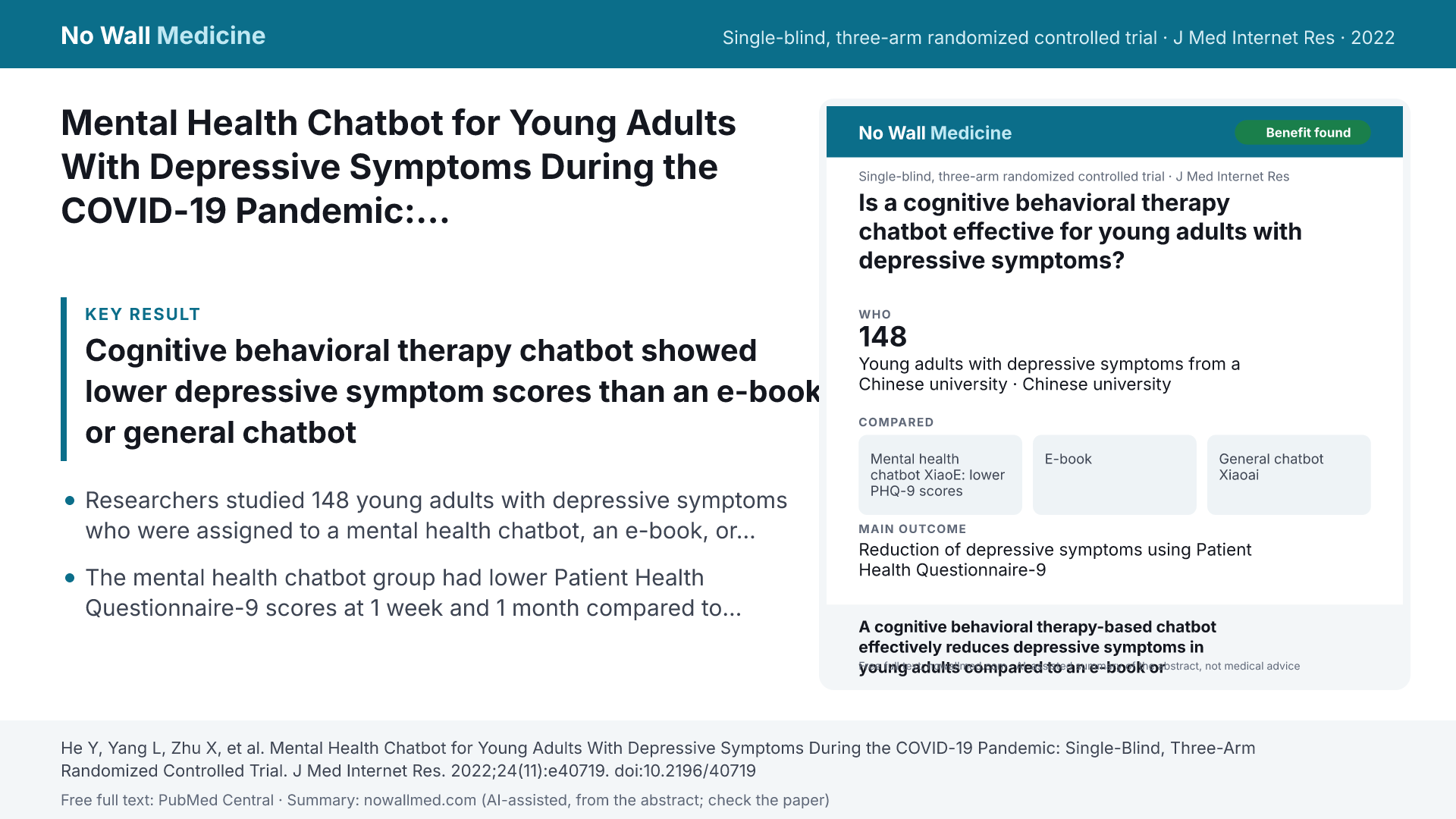
Cognitive behavioral therapy chatbot showed lower depressive symptom scores than an e-book or general chatbot
Mental Health Chatbot for Young Adults With Depressive Symptoms During the COVID-19 Pandemic: Single-Blind, Three-Arm Randomized Controlled Trial
Single-blind, three-arm randomized controlled trialBenefit found
Is a cognitive behavioral therapy chatbot effective for young adults with depressive symptoms?
Who
148
Young adults with depressive symptoms from a Chinese university · Chinese university
Compared
Mental health chatbot XiaoE: lower PHQ-9 scores
E-book
General chatbot Xiaoai
Main outcome
Reduction of depressive symptoms using Patient Health Questionnaire-9
Result: d=0.51 at 1 week and d=0.31 at 1 month
Bottom line: A cognitive behavioral therapy-based chatbot effectively reduces depressive symptoms in young adults compared to an e-book or general chatbot.
Limitation: Further evidence is required to confirm long-term effectiveness and efficacy against other active controls.
J Med Internet Res · 2022-11-21 · Save PNG
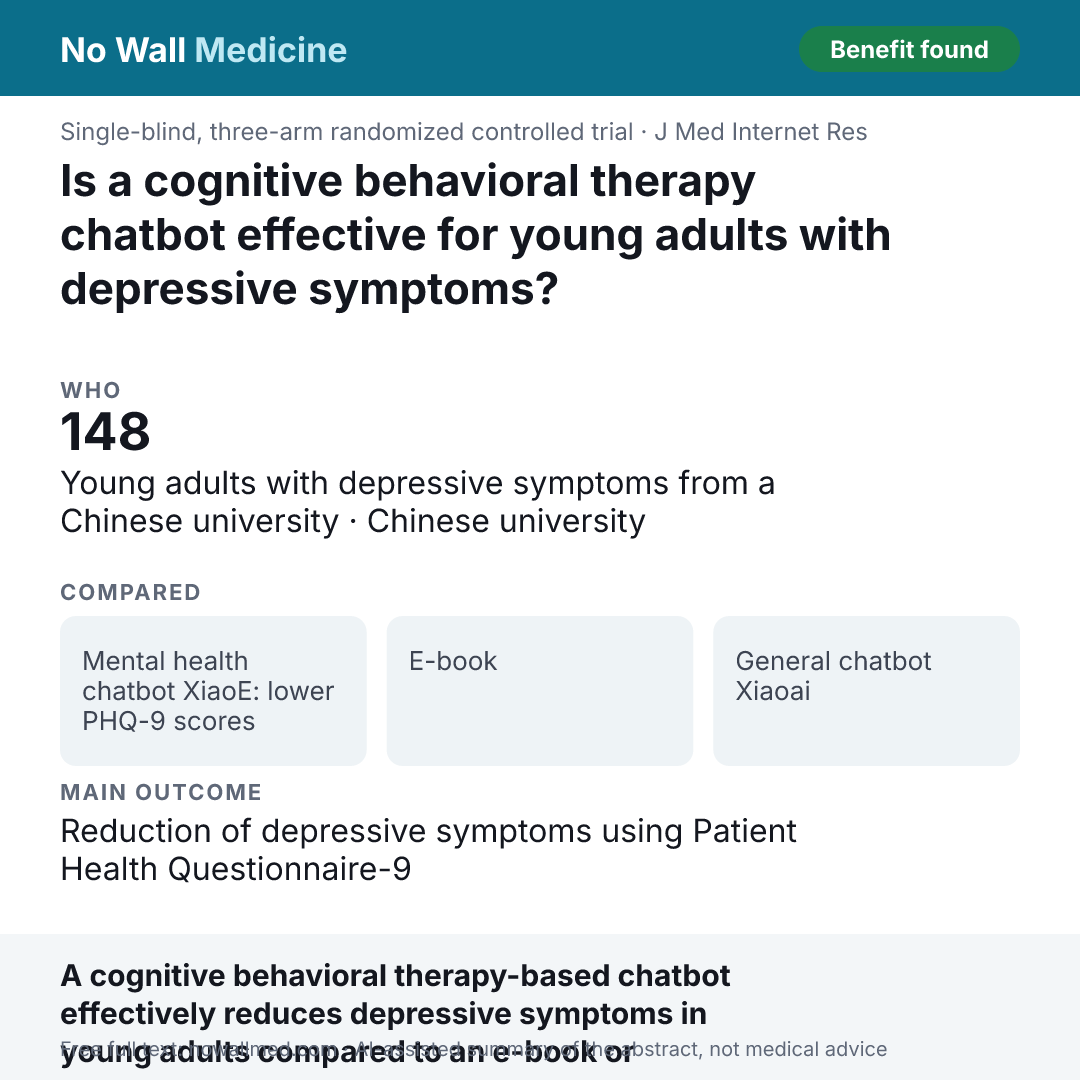
Clinical question: Is a cognitive behavioral therapy chatbot effective for young adults with depressive symptoms?
Why it matters: Mental health services are scarce and underutilized, leaving it unknown if automated cognitive behavioral therapy chatbots can effectively address depressive symptoms in young adults.
Key points
- Researchers studied 148 young adults with depressive symptoms who were assigned to a mental health chatbot, an e-book, or a general chatbot for one week.
- The mental health chatbot group had lower Patient Health Questionnaire-9 scores at 1 week and 1 month compared to the other two groups.
- The mental health chatbot was associated with better working alliance and acceptability, though usability showed no significant difference between the three groups.
Headline and key points written with AI from the paper’s abstract, with every number checked against it. Read the paper before relying on them.
Was this summary helpful?
Subject terms
Headline, design, result, key points, caveat and citation as plain text.
Cite this article
He Y, Yang L, Zhu X, et al. Mental Health Chatbot for Young Adults With Depressive Symptoms During the COVID-19 Pandemic: Single-Blind, Three-Arm Randomized Controlled Trial. J Med Internet Res. 2022;24(11):e40719. doi:10.2196/40719
Spotted a mistake? Suggest a correction