Stem cell implants improved motor function in patients with chronic traumatic brain injury deficits
Mesenchymal Stromal Cell Implants for Chronic Motor Deficits After Traumatic Brain Injury: Post Hoc Analysis of a Randomized Trial
Double-blind, randomized, surgical sham-controlled, phase 2 trialBenefit found
Does intracranial implantation of SB623 cells improve chronic motor deficits after traumatic brain injury?
Who
61
Participants with moderate-to-severe traumatic brain injury and chronic motor deficits · International, multicenter clinical trial
Compared
SB623 cells pooled: +8.3 [1.4]
control: +2.3 [2.5]
Main outcome
Fugl-Meyer Motor Scale score change from baseline
Result: p = 0.04
Bottom line: Intracranial implantation of SB623 cells significantly improved motor status at 24 weeks in patients with chronic traumatic brain injury.
Neurology · 2024-09-04Download image
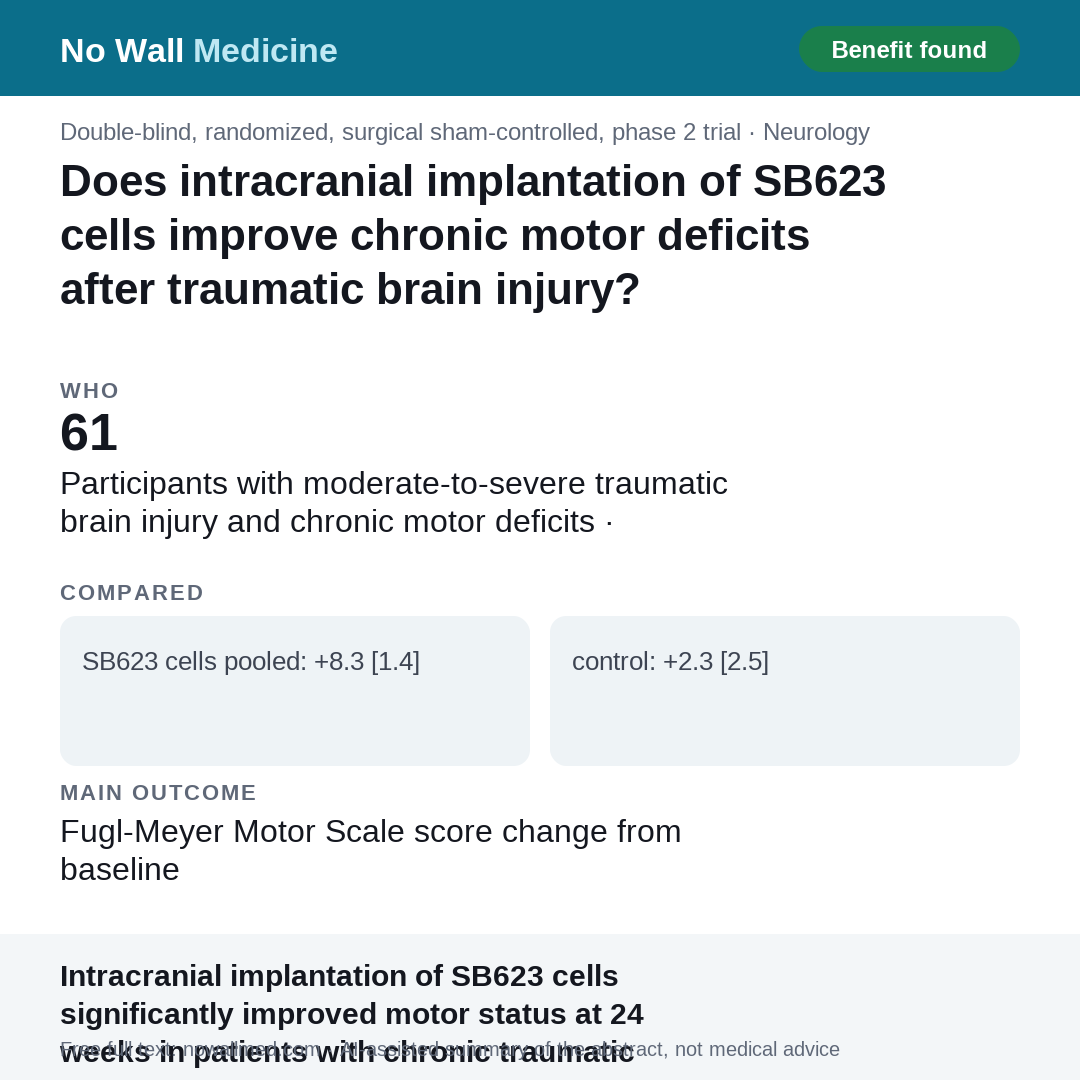
Clinical question: Does intracranial implantation of SB623 cells improve chronic motor deficits after traumatic brain injury?
Why it matters: It was unknown if intracranial implantation of allogeneic modified mesenchymal stromal cells could improve chronic motor deficits following traumatic brain injury.
Key points
- The trial randomized 61 participants with moderate-to-severe traumatic brain injury to receive either intracranial implantation of mesenchymal stromal cells or a surgical sham procedure.
- At 24 weeks, the stem cell group showed a Fugl-Meyer Motor Scale score change of +8.3 compared to +2.3 in the control group (p = 0.04).
- The incidence of adverse events was equivalent between the stem cell groups and the control group, with no deaths or withdrawals due to adverse events.
Headline and key points written with AI from the paper’s abstract, with every number checked against it. Read the paper before relying on them.
Topics
Cite this article
Okonkwo DO, McAllister P, Achrol AS, Karasawa Y, Kawabori M, Cramer SC. Mesenchymal Stromal Cell Implants for Chronic Motor Deficits After Traumatic Brain Injury: Post Hoc Analysis of a Randomized Trial. Neurology. 2024. doi:10.1212/WNL.0000000000209797
Spotted a mistake? Suggest a correction
Top studies every Monday
The week’s key trials and guidelines in your specialties, plus any topics you follow. By email, free.
Get the weekly digest