Umbilical cord-derived mesenchymal stromal cell infusions showed no change in disease severity for children with RDEB
Mesenchymal stromal cell infusions of umbilical cord-derived mesenchymal stromal cells in children with recessive dystrophic epidermolysis bullosa (MissionEB): a randomised, double-blind, placebo controlled, crossover, phase 3 trial with an internal phase 1 dose de-escalation phase
Randomised, double-blind, placebo-controlled, crossover, phase 3 trialNo clear difference
Do umbilical cord-derived mesenchymal stromal cells improve disease severity in children with recessive dystrophic epidermolysis bullosa?
Who
30
Children aged 6 months to 16 years with recessive dystrophic epidermolysis bullosa · Two United Kingdom specialist centres
Compared
5.5Umbilical cord-derived mesenchymal stromal cells (95% CI -2.53 to 13.53)
2Placebo (95% CI -5.33 to 9.33)
Main outcome
Change in Epidermolysis Bullosa Disease Activity and Scarring Index at three months
Result: 3.75 point difference (95% CI -1.46 to 8.96) in favour of placebo
Bottom line: Umbilical cord-derived mesenchymal stromal cell infusions showed no significant change in disease severity compared to placebo.
eClinicalMedicine · 2025-08-14 · Save PNG
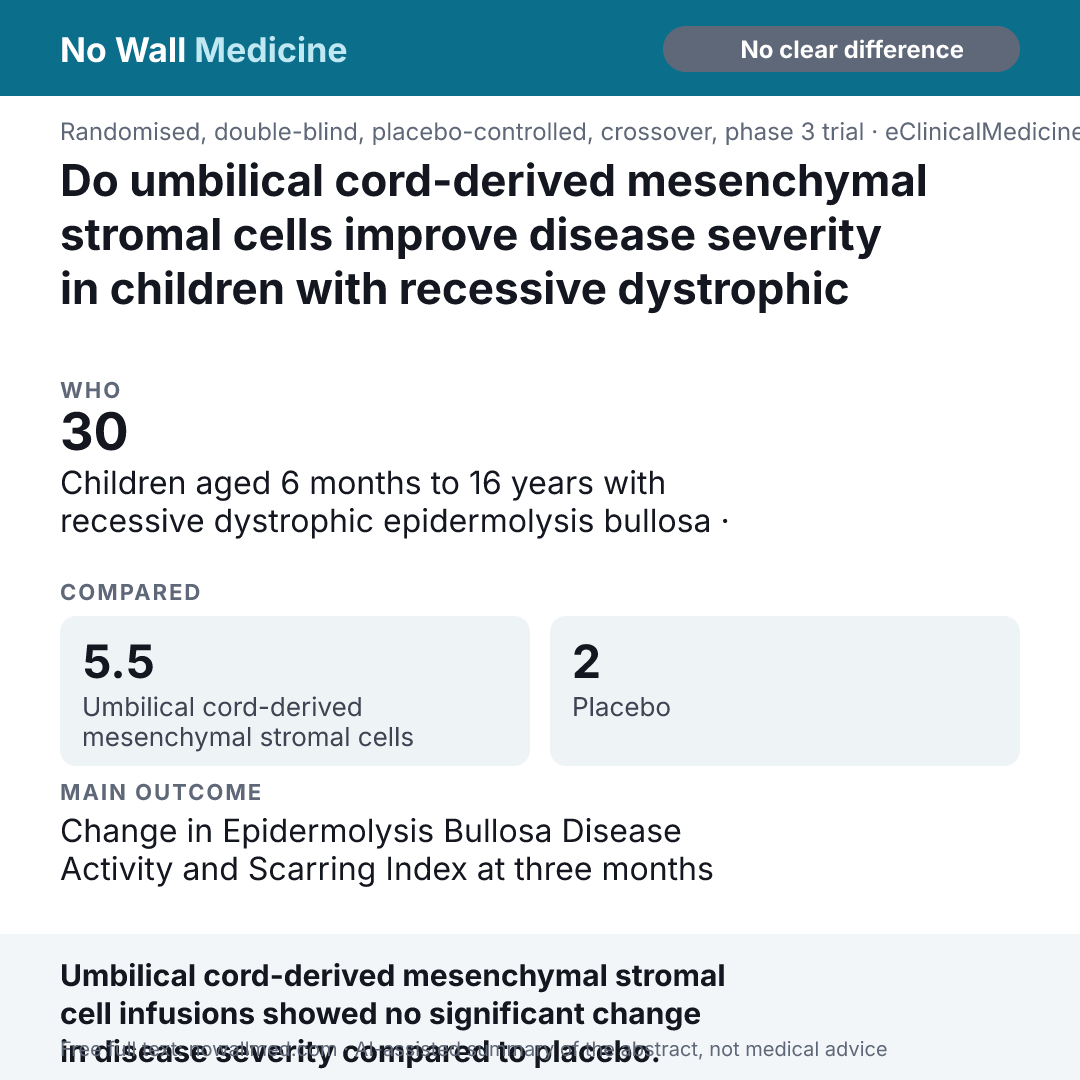
Clinical question: Do umbilical cord-derived mesenchymal stromal cells improve disease severity in children with recessive dystrophic epidermolysis bullosa?
Why it matters: Evidence is needed to inform commissioning decisions regarding the use of umbilical cord-derived mesenchymal stromal cells for children with recessive dystrophic epidermolysis bullosa.
Key points
- This phase 3 randomized crossover trial studied 30 children with recessive dystrophic epidermolysis bullosa, a rare genetic skin blistering disorder.
- At three months post-infusion, umbilical cord-derived mesenchymal stromal cell infusions showed no significant change in the Epidermolysis Bullosa Disease Activity and Scarring Index compared to placebo.
- The difference in disease activity scores at three months was 3.75 points in favor of placebo (95% CI of -1.46, 8.96, p = 0.15).
Headline and key points written with AI from the paper’s abstract, with every number checked against it. Read the paper before relying on them.
Was this summary helpful?
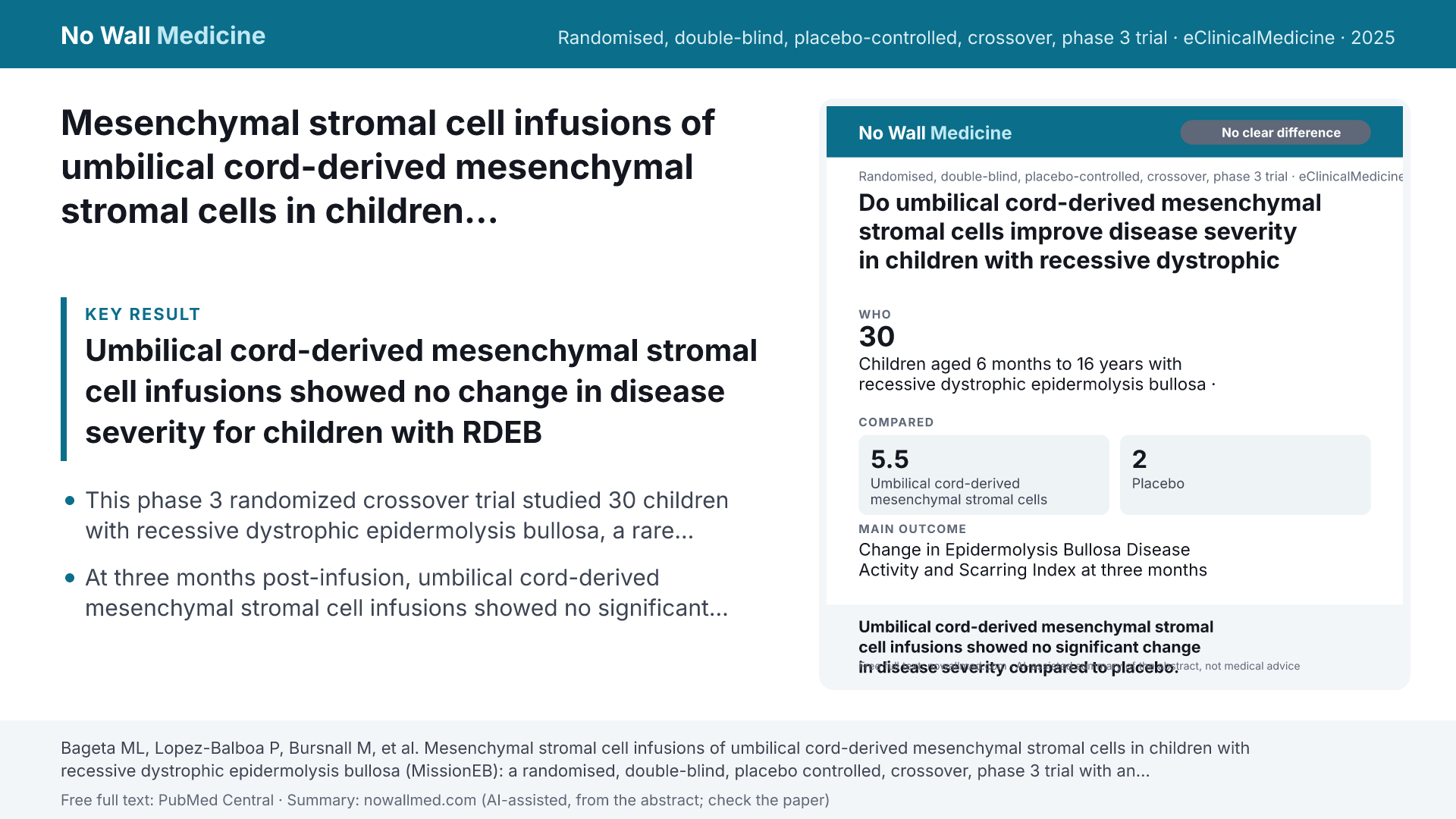
Headline, design, result, key points, caveat and citation as plain text.
Cite this article
Bageta ML, Lopez-Balboa P, Bursnall M, et al. Mesenchymal stromal cell infusions of umbilical cord-derived mesenchymal stromal cells in children with recessive dystrophic epidermolysis bullosa (MissionEB): a randomised, double-blind, placebo controlled, crossover, phase 3 trial with an internal phase 1 dose de-escalation phase. EClinicalMedicine. 2025;88:103417. doi:10.1016/j.eclinm.2025.103417
Spotted a mistake? Suggest a correction