Mesenteric surgical approach did not improve survival compared to conventional approach for pancreatic cancer
Mesenteric Versus Conventional Approach During Pancreatoduodenectomy for Pancreatic Ductal Adenocarcinoma (MAPLE-PD trial): A Multicenter Randomized Controlled Trial
Multicenter randomized controlled trialNo clear difference
Does the mesenteric approach improve survival compared to the conventional approach in pancreatic cancer?
Who
360
Patients with resectable or borderline resectable pancreatic ductal adenocarcinoma · 24 Japanese high-volume centers
Compared
41.7 monthsConventional approach
39.3 monthsMesenteric approach
Main outcome
Overall survival
Result: hazard ratio 1.02 (95% CI 0.76-1.37)
Bottom line: The mesenteric approach does not improve overall survival compared to the conventional approach in these patients.
Ann Surg · 2025-08-07Download image
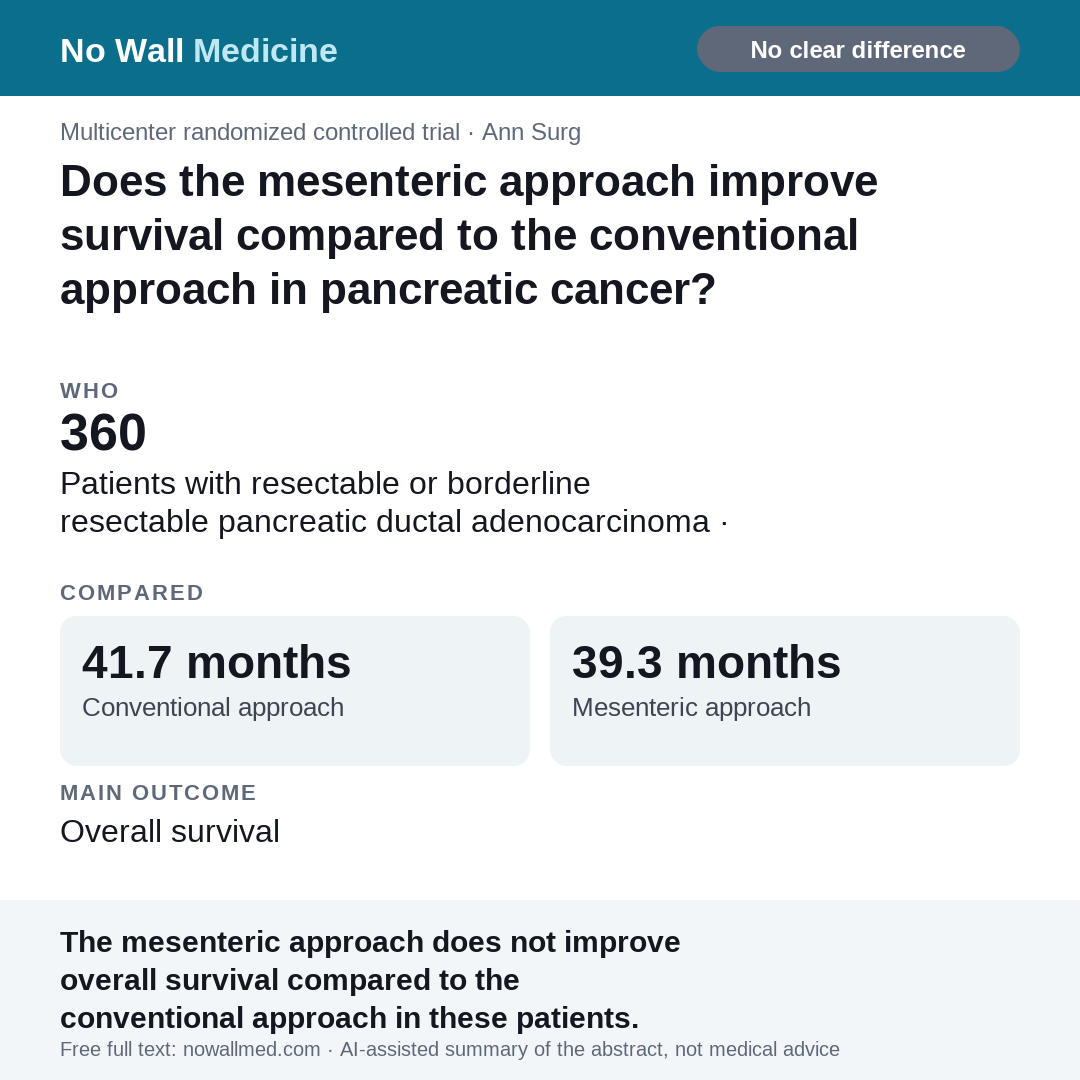
Clinical question: Does the mesenteric approach improve survival compared to the conventional approach in pancreatic cancer?
Why it matters: It is unclear if a mesenteric approach using a nontouch isolation technique improves survival for patients with resectable or borderline resectable pancreatic ductal adenocarcinoma.
Key points
- Researchers studied 360 patients undergoing pancreatoduodenectomy, a surgery for pancreatic cancer, comparing a mesenteric approach to a conventional Kocher-first approach.
- The median overall survival was 41.7 months for the conventional group and 39.3 months for the mesenteric group, showing no significant difference.
- The mesenteric approach was associated with a different mean change in circulating tumor cell DNA copy number in portal vein blood compared to the conventional group.
Headline and key points written with AI from the paper’s abstract, with every number checked against it. Read the paper before relying on them.
Was this summary helpful?
Subject terms
Cite this article
Hirono S, Kitahata Y, Motobayashi H, Satoi S, Sho M, Takami H. Mesenteric Versus Conventional Approach During Pancreatoduodenectomy for Pancreatic Ductal Adenocarcinoma (MAPLE-PD trial): A Multicenter Randomized Controlled Trial. Ann Surg. 2025. doi:10.1097/SLA.0000000000006900
Spotted a mistake? Suggest a correction
Top studies every Monday
The week’s key trials and guidelines in your specialties, plus any topics you follow. By email, free.
Get the weekly digest