Meta-analysis of longitudinal neurocognitive performance in people at clinical high-risk for psychosis
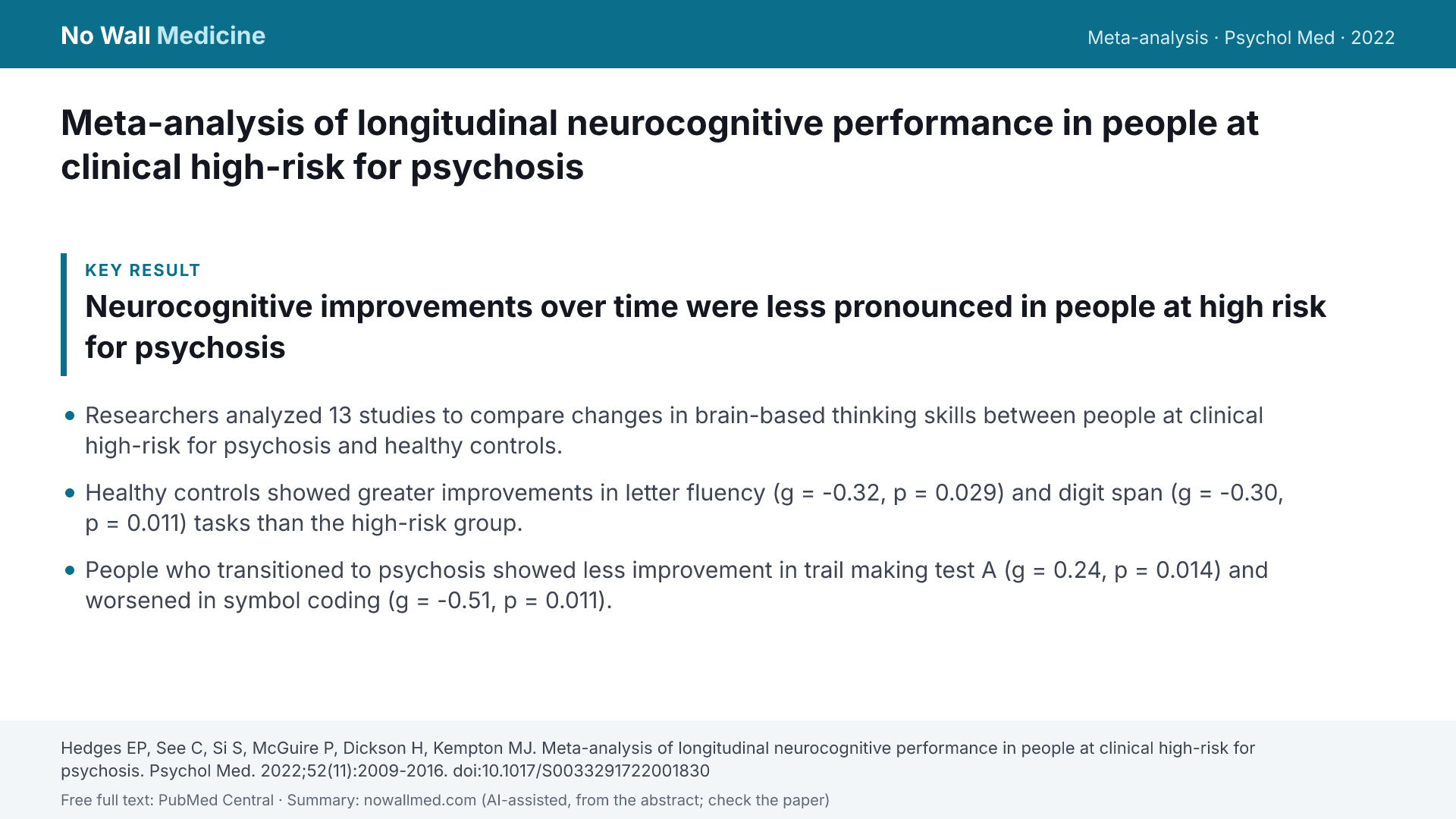
Key result: Neurocognitive improvements over time were less pronounced in people at high risk for psychosis
Key points
- Researchers analyzed 13 studies to compare changes in brain-based thinking skills between people at clinical high-risk for psychosis and healthy controls.
- Healthy controls showed greater improvements in letter fluency (g = -0.32, p = 0.029) and digit span (g = -0.30, p = 0.011) tasks than the high-risk group.
- People who transitioned to psychosis showed less improvement in trail making test A (g = 0.24, p = 0.014) and worsened in symbol coding (g = -0.51, p = 0.011).
Discussion prompts
- Would these patients look like yours? Who was left out?
- Is the main outcome one that matters to patients?
- Is the difference large enough to change what you do?
Cite: Hedges EP, See C, Si S, McGuire P, Dickson H, Kempton MJ. Meta-analysis of longitudinal neurocognitive performance in people at clinical high-risk for psychosis. Psychol Med. 2022;52(11):2009-2016. doi:10.1017/S0033291722001830
Free full text: PubMed Central · Summary and visual abstract: nowallmed.com/a/meta-analysis-of-longitudinal-neurocognitive-performance-in-people-at-5akrl0/ (AI-assisted from the abstract; check the paper before relying on it).