Meta-Analysis of Reversal Agents for Severe Bleeding Associated With Direct Oral Anticoagulants
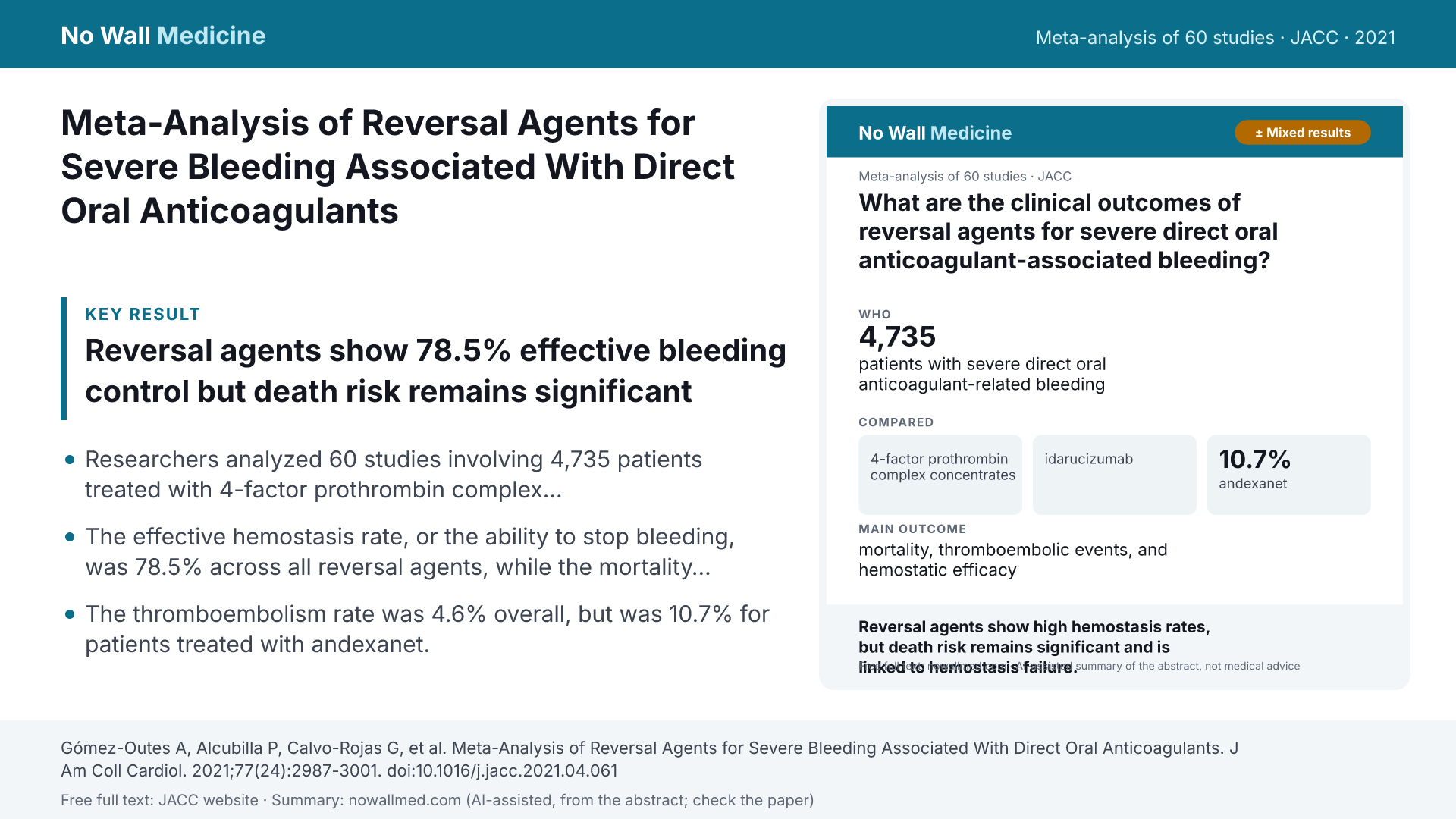
Key result: Reversal agents show 78.5% effective bleeding control but death risk remains significant
Meta-analysis of 60 studiesMixed results
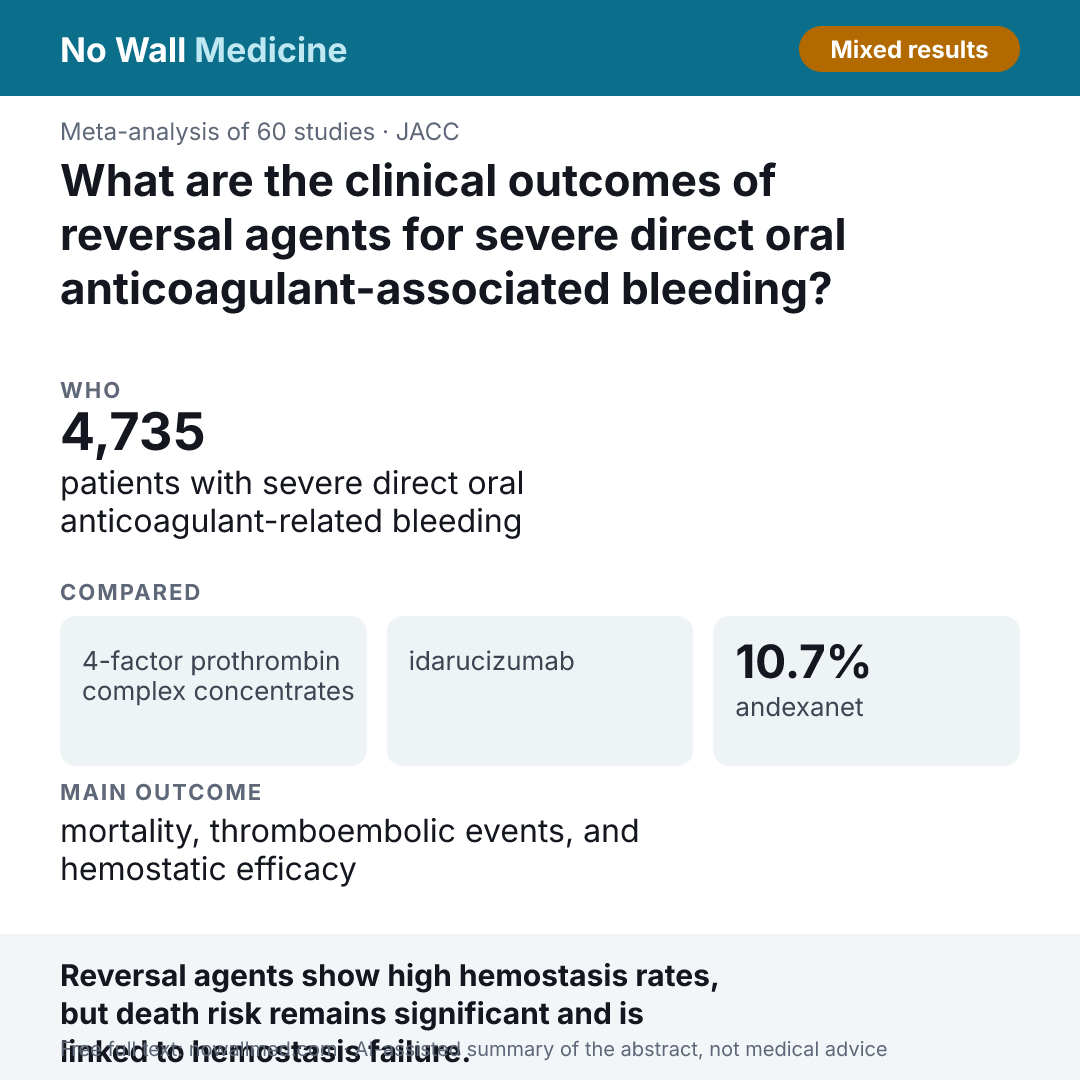
What are the clinical outcomes of reversal agents for severe direct oral anticoagulant-associated bleeding?
Who
4,735
patients with severe direct oral anticoagulant-related bleeding
Compared
4-factor prothrombin complex concentrates
idarucizumab
10.7%andexanet (95% CI 6.5% to 15.7%)
Main outcome
mortality, thromboembolic events, and hemostatic efficacy
Result: relative risk 3.63 (95% CI 2.56 to 5.16)
Bottom line: Reversal agents show high hemostasis rates, but death risk remains significant and is linked to hemostasis failure.
JACC · 2021-06-18 · Save PNG
Key points
- Researchers analyzed 60 studies involving 4,735 patients treated with 4-factor prothrombin complex concentrates, idarucizumab, or andexanet for severe bleeding caused by direct oral anticoagulants.
- The effective hemostasis rate, or the ability to stop bleeding, was 78.5% across all reversal agents, while the mortality rate was 17.7%.
- The thromboembolism rate was 4.6% overall, but was 10.7% for patients treated with andexanet.
Discussion prompts
- Would these patients look like yours? Who was left out?
- Is the main outcome one that matters to patients?
- Is the difference large enough to change what you do?
Cite: Gómez-Outes A, Alcubilla P, Calvo-Rojas G, et al. Meta-Analysis of Reversal Agents for Severe Bleeding Associated With Direct Oral Anticoagulants. J Am Coll Cardiol. 2021;77(24):2987-3001. doi:10.1016/j.jacc.2021.04.061
Free full text: JACC website · Summary and visual abstract: nowallmed.com/a/meta-analysis-of-reversal-agents-for-severe-bleeding-associated-with-1nabmp0/ (AI-assisted from the abstract; check the paper before relying on it).