Meta-analysis of surrogate endpoints for overall survival in extensive-stage small-cell lung cancer
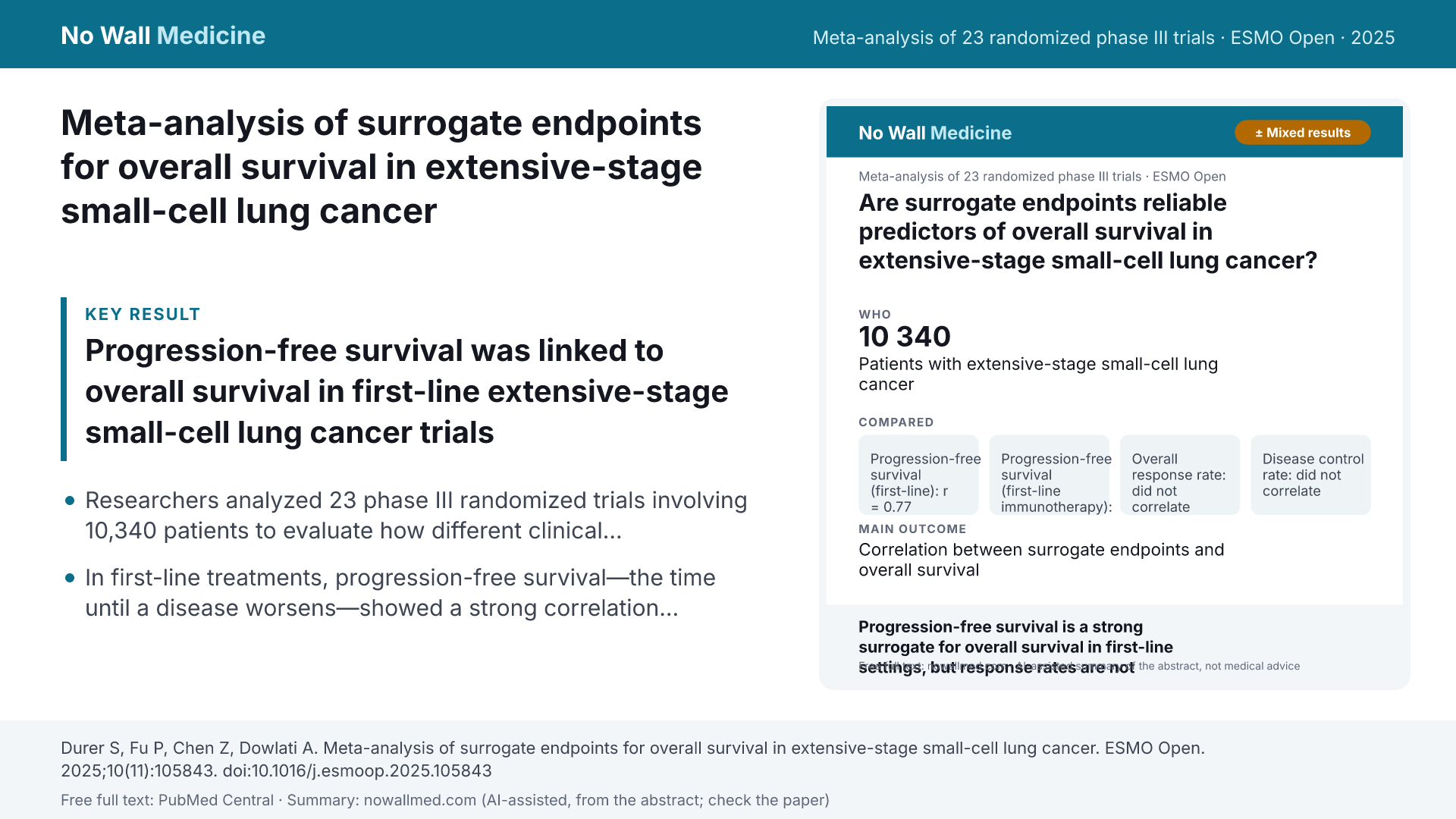
Key result: Progression-free survival was linked to overall survival in first-line extensive-stage small-cell lung cancer trials
Meta-analysis of 23 randomized phase III trialsMixed results
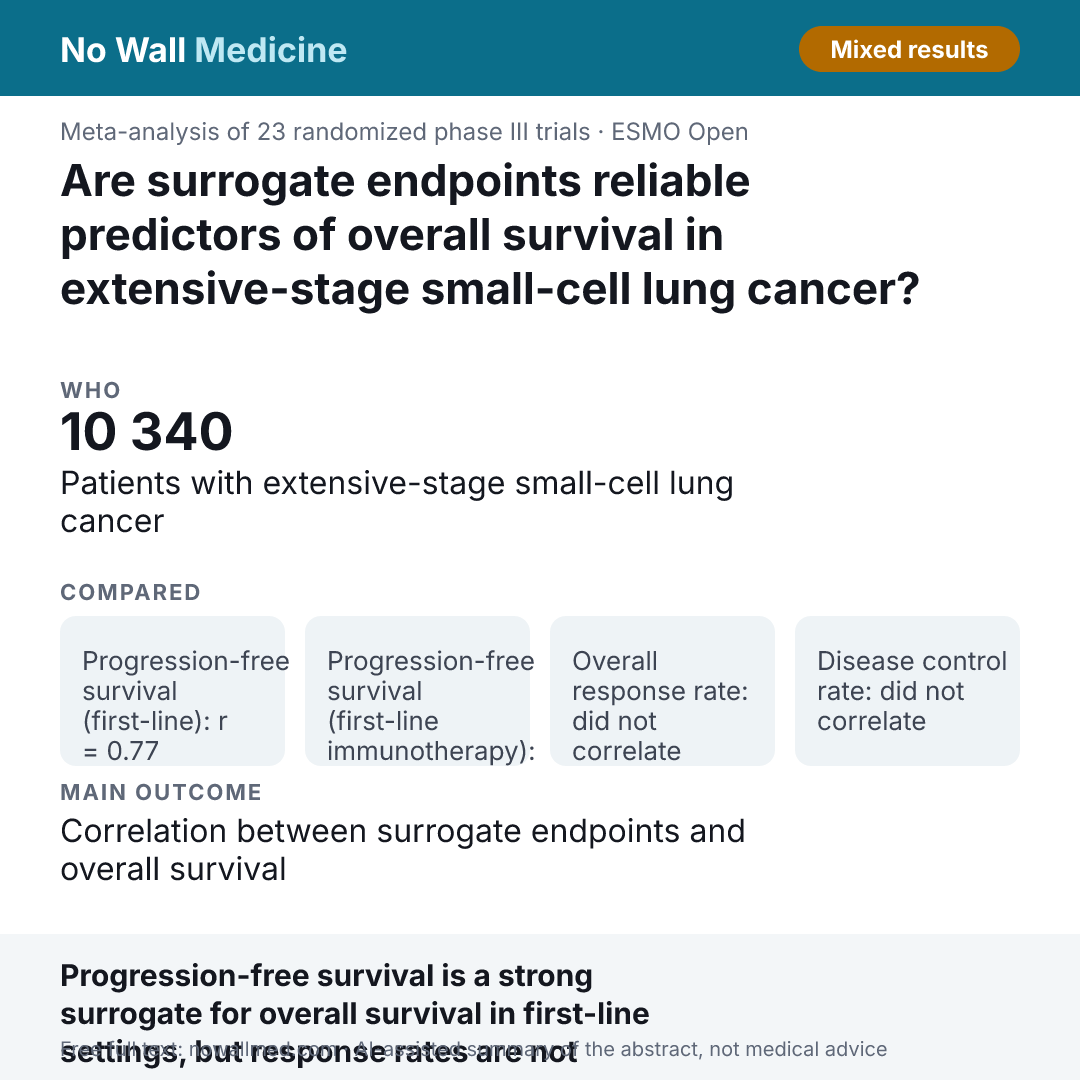
Are surrogate endpoints reliable predictors of overall survival in extensive-stage small-cell lung cancer?
Who
10 340
Patients with extensive-stage small-cell lung cancer
Compared
Progression-free survival (first-line): r = 0.77
Progression-free survival (first-line immunotherapy): r = 0.80
Overall response rate: did not correlate
Disease control rate: did not correlate
Main outcome
Correlation between surrogate endpoints and overall survival
Bottom line: Progression-free survival is a strong surrogate for overall survival in first-line settings, but response rates are not reliable.
ESMO Open · 2025-10-15 · Save PNG
Key points
- Researchers analyzed 23 phase III randomized trials involving 10,340 patients to evaluate how different clinical markers predict overall survival.
- In first-line treatments, progression-free survival—the time until a disease worsens—showed a strong correlation with overall survival (r = 0.77, P < 0.001).
- Overall response rate and disease control rate were not linked to overall survival in either first-line or second-line treatment settings.
Discussion prompts
- Would these patients look like yours? Who was left out?
- Is the main outcome one that matters to patients?
- Is the difference large enough to change what you do?
Cite: Durer S, Fu P, Chen Z, Dowlati A. Meta-analysis of surrogate endpoints for overall survival in extensive-stage small-cell lung cancer. ESMO Open. 2025;10(11):105843. doi:10.1016/j.esmoop.2025.105843
Free full text: PubMed Central · Summary and visual abstract: nowallmed.com/a/meta-analysis-of-surrogate-endpoints-for-overall-survival-in-69fjti/ (AI-assisted from the abstract; check the paper before relying on it).