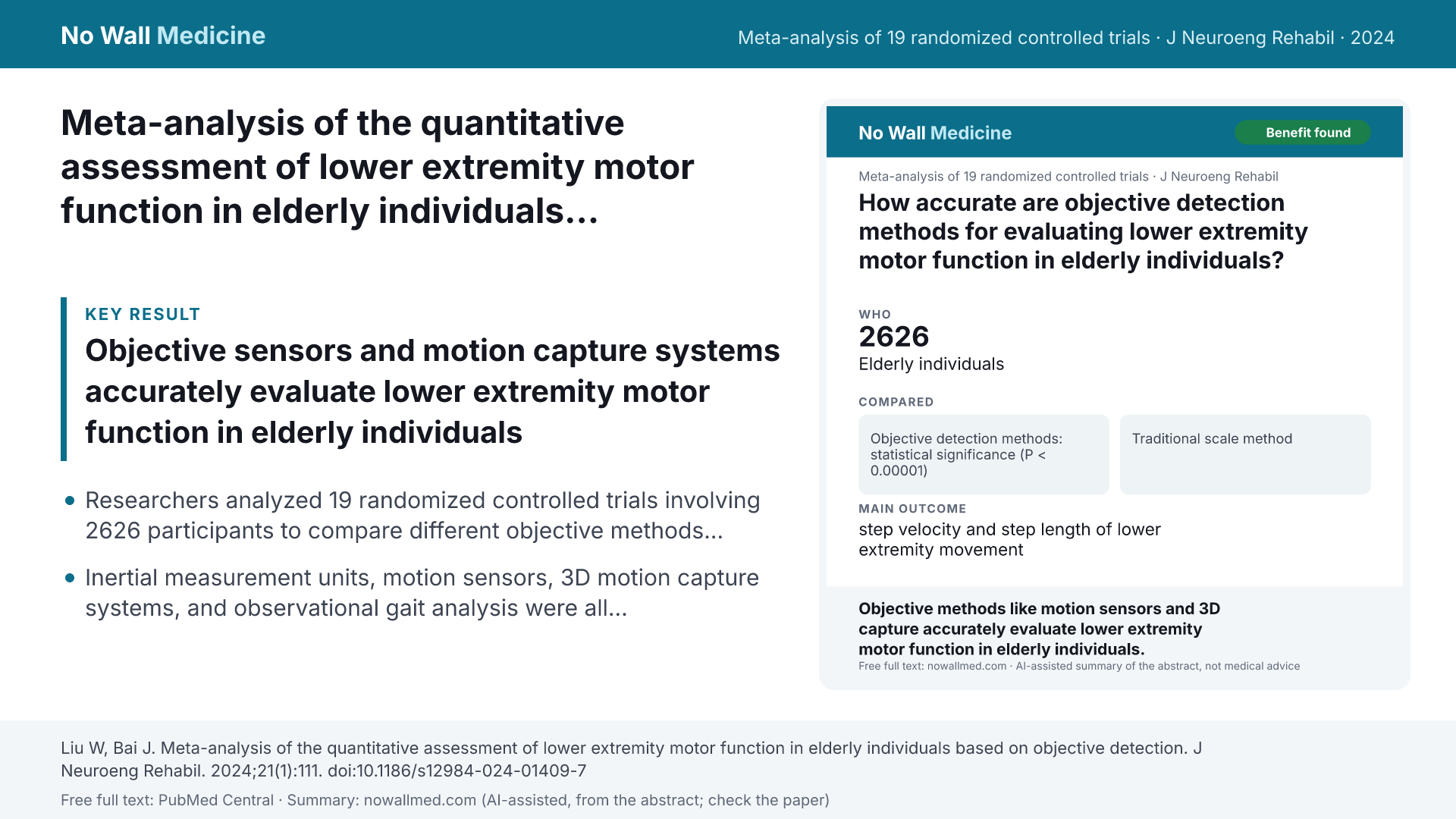
Objective sensors and motion capture systems accurately evaluate lower extremity motor function in elderly individuals
Meta-analysis of the quantitative assessment of lower extremity motor function in elderly individuals based on objective detection
Meta-analysis of 19 randomized controlled trialsBenefit found
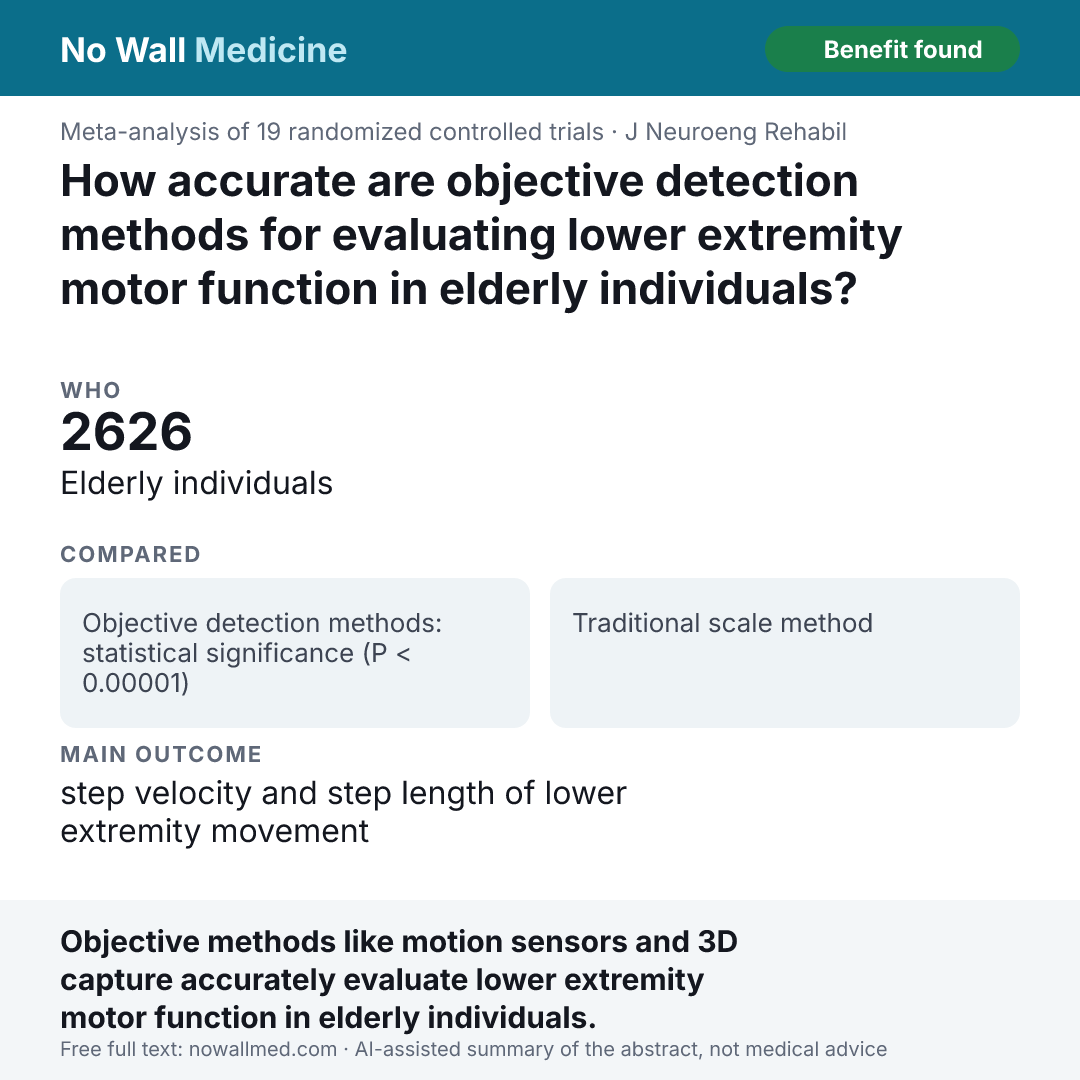
How accurate are objective detection methods for evaluating lower extremity motor function in elderly individuals?
Who
2626
Elderly individuals
Compared
Objective detection methods: statistical significance (P < 0.00001)
Traditional scale method
Main outcome
step velocity and step length of lower extremity movement
Result: SMD=-0.98, 95%CI(-1.23, -0.72) for step velocity; SMD=-1.40, 95%CI(-1.77, -1.02) for step length
Bottom line: Objective methods like motion sensors and 3D capture accurately evaluate lower extremity motor function in elderly individuals.
Limitation: High heterogeneity in observational gait analysis and inertial measurement units due to different calculation formulas.
J Neuroeng Rehabil · 2024-06-26
Why it matters: Traditional scale methods for measuring leg movement in older adults may cause deviations in assessment accuracy.
Headline and visual abstract written with AI from the paper’s abstract, with every number checked against it. Read the paper before relying on them.
Was this summary helpful?
Subject terms
Cite this article
Liu W, Bai J. Meta-analysis of the quantitative assessment of lower extremity motor function in elderly individuals based on objective detection. J Neuroeng Rehabil. 2024;21(1):111. doi:10.1186/s12984-024-01409-7
Spotted a mistake? Suggest a correction