Meta-analysis identifies consistent gut microbial patterns and species associated with obesity across 17 countries
Meta-analysis reveals obesity associated gut microbial alteration patterns and reproducible contributors of functional shift
Meta-analysis of metagenome sequencing dataBenefit found
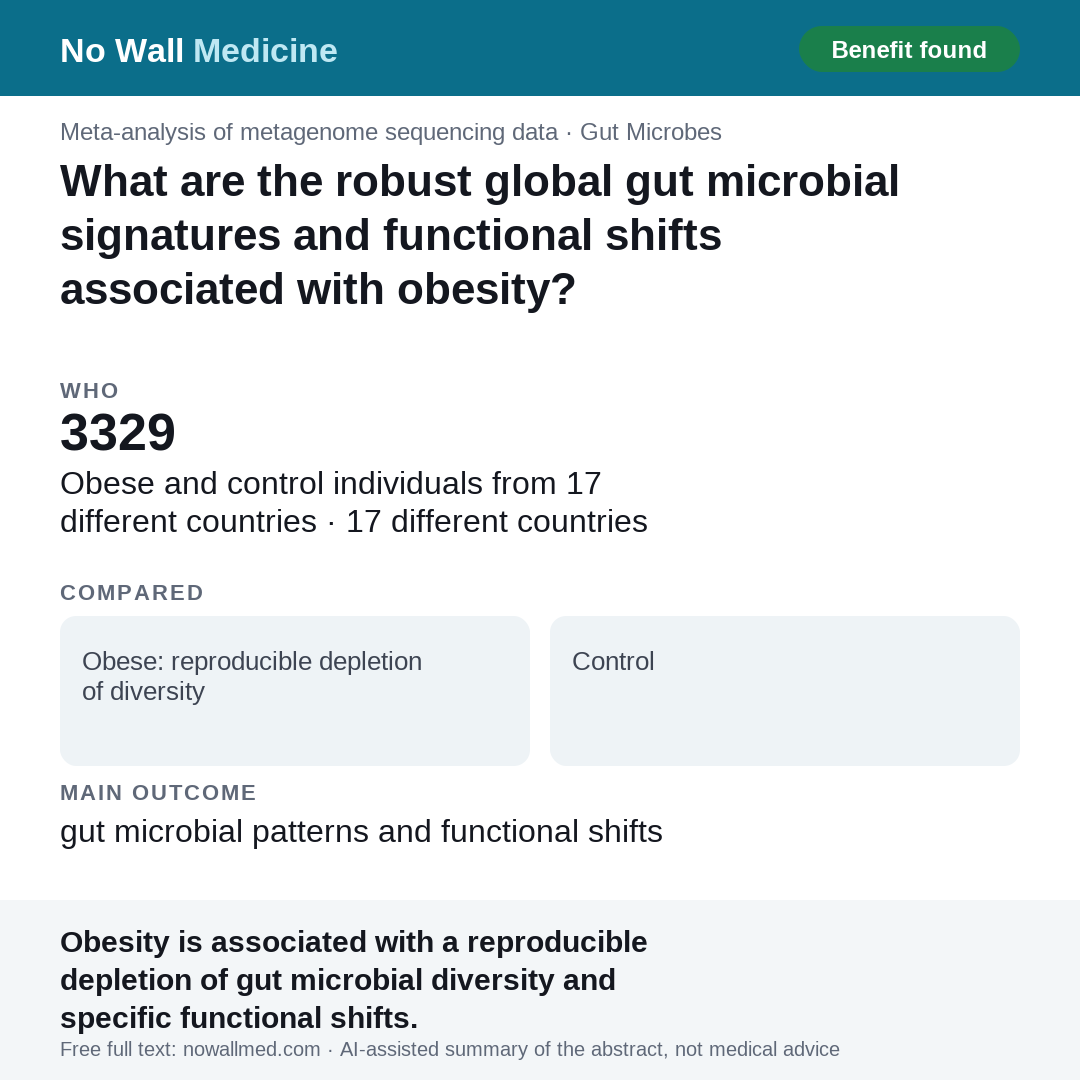
What are the robust global gut microbial signatures and functional shifts associated with obesity?
Who
3329
Obese and control individuals from 17 different countries · 17 different countries
Compared
Obese: reproducible depletion of diversity
Control
Main outcome
gut microbial patterns and functional shifts
Result: AUC, Species: 0.85, and pathway: 0.80
Bottom line: Obesity is associated with a reproducible depletion of gut microbial diversity and specific functional shifts.
Gut Microbes · 2024-01-24Download image
Clinical question: What are the robust global gut microbial signatures and functional shifts associated with obesity?
Why it matters: Previous studies linking gut microbiota to obesity often produced contradictory results, leaving the replicability of microbial signatures and the specific species driving functional shifts unknown.
Key points
- Researchers analyzed 3329 samples from 17 countries, including 1494 obese and 1835 control individuals, using machine learning to find global microbial signatures.
- The study identified 25 predictive species and 37 pathway associations, which were validated with an area under the curve of 0.85 for species and 0.80 for pathways.
- Obese guts were associated with a depletion of short-chain fatty acid producers and microbes that support gut barrier integrity, such as Akkermansia muciniphila and Bifidobacterium longum.
Headline and key points written with AI from the paper’s abstract, with every number checked against it. Read the paper before relying on them.
Topics
Cite this article
Chanda D, De D. Meta-analysis reveals obesity associated gut microbial alteration patterns and reproducible contributors of functional shift. Gut Microbes. 2024. doi:10.1080/19490976.2024.2304900
Spotted a mistake? Suggest a correction
Top studies every Monday
The week’s key trials and guidelines in your specialties, plus any topics you follow. By email, free.
Get the weekly digest