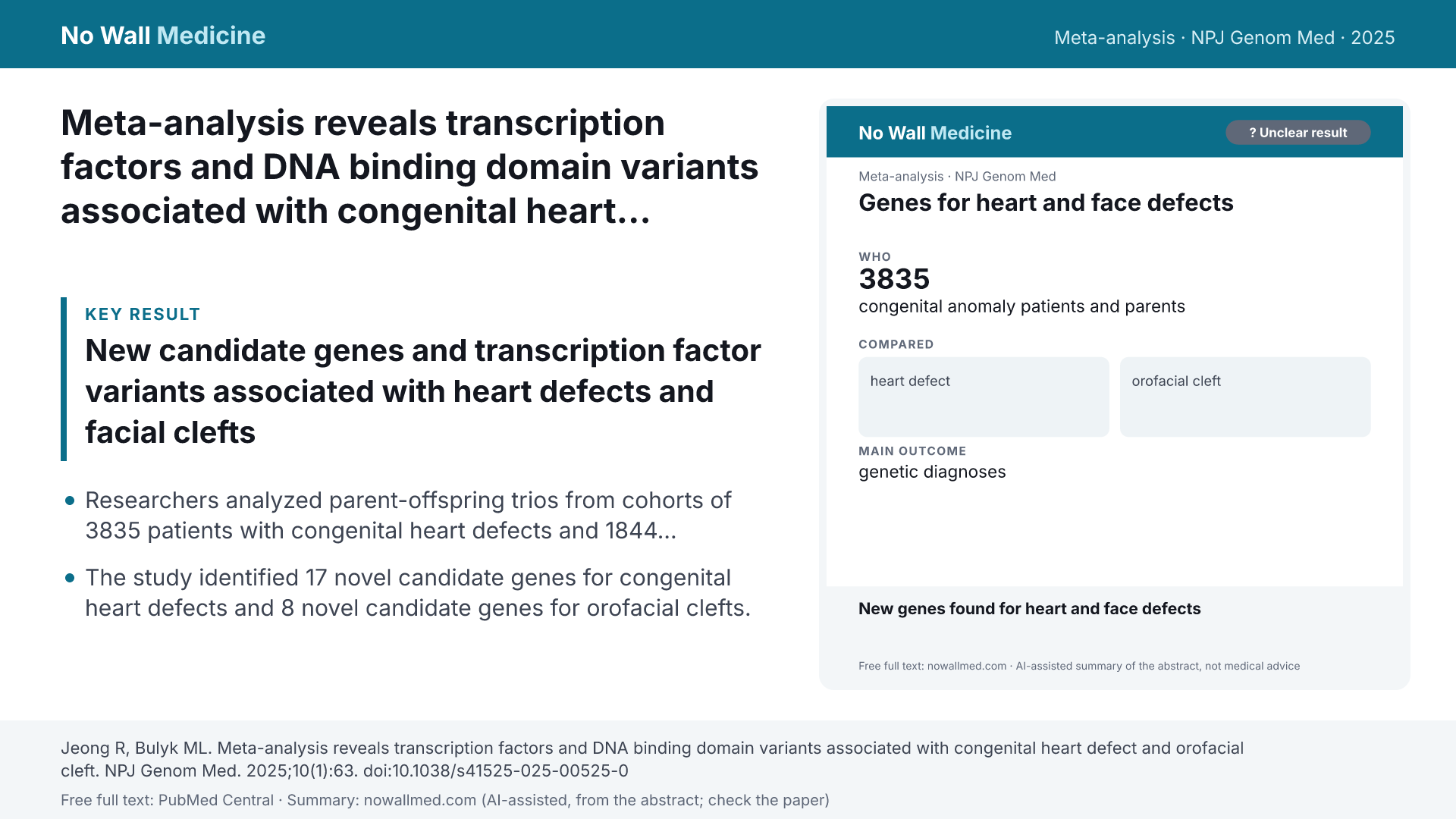
Meta-analysis reveals transcription factors and DNA binding domain variants associated with congenital heart defect and orofacial cleft
Key result: New candidate genes and transcription factor variants associated with heart defects and facial clefts
Meta-analysisUnclear result
Genes for heart and face defects
Who
3835
congenital anomaly patients and parents
Compared
heart defect
orofacial cleft
Main outcome
genetic diagnoses
Bottom line: New genes found for heart and face defects
NPJ Genom Med · 2025-09-29
Key points
- Researchers analyzed parent-offspring trios from cohorts of 3835 patients with congenital heart defects and 1844 patients with orofacial clefts.
- The study identified 17 novel candidate genes for congenital heart defects and 8 novel candidate genes for orofacial clefts.
- A total of 30 affected children had a new missense variant in a DNA binding domain of known transcription factor genes.
Why it matters: Many patients with congenital anomalies lack genetic diagnoses because many disease genes have not yet been discovered.
Discussion prompts
- Would these patients look like yours? Who was left out?
- Is the main outcome one that matters to patients?
- Is the difference large enough to change what you do?
Cite: Jeong R, Bulyk ML. Meta-analysis reveals transcription factors and DNA binding domain variants associated with congenital heart defect and orofacial cleft. NPJ Genom Med. 2025;10(1):63. doi:10.1038/s41525-025-00525-0
Free full text: PubMed Central · Summary and visual abstract: nowallmed.com/a/meta-analysis-reveals-transcription-factors-and-dna-binding-domain-1swzqoz/ (AI-assisted from the abstract; check the paper before relying on it).