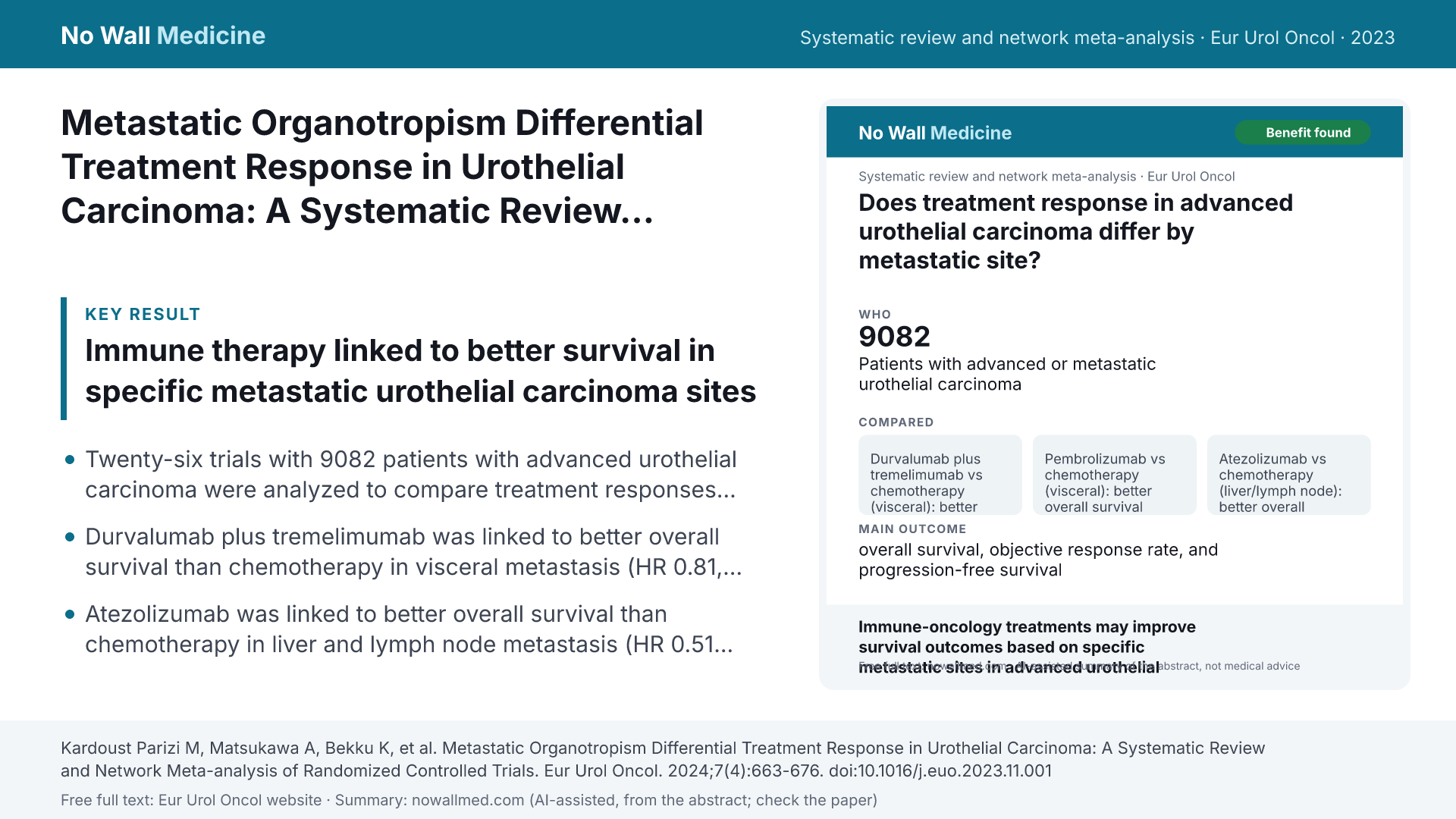
Immune therapy linked to better survival in specific metastatic urothelial carcinoma sites
Metastatic Organotropism Differential Treatment Response in Urothelial Carcinoma: A Systematic Review and Network Meta-analysis of Randomized Controlled Trials
Systematic review and network meta-analysisBenefit found
Does treatment response in advanced urothelial carcinoma differ by metastatic site?
Who
9082
Patients with advanced or metastatic urothelial carcinoma
Compared
Durvalumab plus tremelimumab vs chemotherapy (visceral): better overall survival
Pembrolizumab vs chemotherapy (visceral): better overall survival
Atezolizumab vs chemotherapy (liver/lymph node): better overall survival
Main outcome
overall survival, objective response rate, and progression-free survival
Result: hazard ratio 0.81 (95% CI 0.67-0.98)
Bottom line: Immune-oncology treatments may improve survival outcomes based on specific metastatic sites in advanced urothelial carcinoma.
Eur Urol Oncol · 2023-11-18Download image
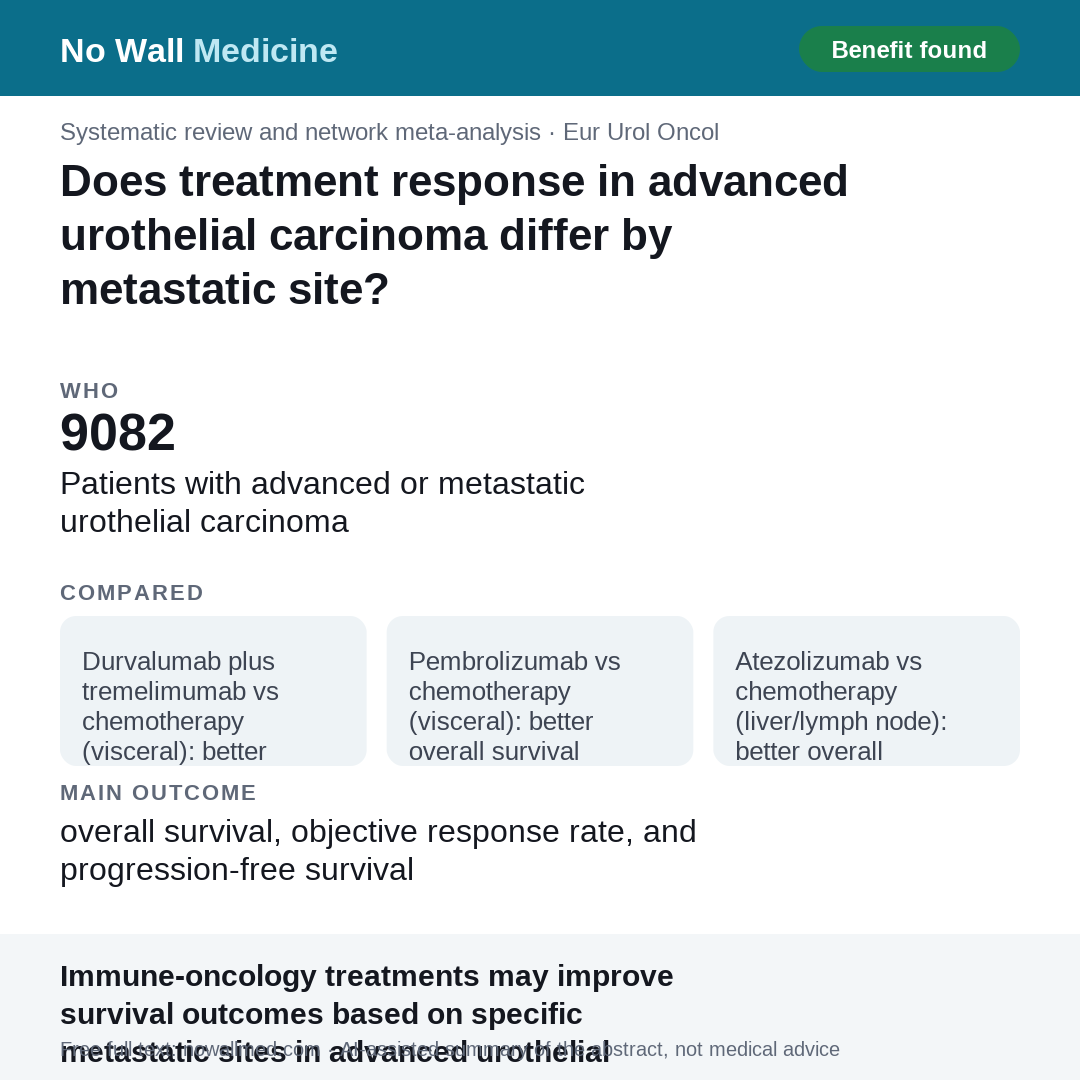
Clinical question: Does treatment response in advanced urothelial carcinoma differ by metastatic site?
Why it matters: The optimal therapeutic agent for advanced urothelial carcinoma is unclear when considering the specific sites of metastasis.
Key points
- Twenty-six trials with 9082 patients with advanced urothelial carcinoma were analyzed to compare treatment responses by metastatic site.
- Durvalumab plus tremelimumab was linked to better overall survival than chemotherapy in visceral metastasis (HR 0.81, 95% CI 0.67-0.98).
- Atezolizumab was linked to better overall survival than chemotherapy in liver and lymph node metastasis (HR 0.51 and 0.59).
Headline and key points written with AI from the paper’s abstract, with every number checked against it. Read the paper before relying on them.
Was this summary helpful?
Abstract
Context
The optimal therapeutic agent with respect to metastatic sites is unclear in advanced urothelial carcinoma (UC).Objective
To investigate the metastatic organotropism differential treatment response in patients with advanced or metastatic UC.Evidence acquisition
A systematic search and network meta-analysis (NMA) was performed according to the Preferred Reporting Items for Systematic Reviews and Meta-analyses statement. The primary endpoints of interest were the objective response rate, overall survival (OS), and progression-free survival with respect to different metastatic sites.Evidence synthesis
Twenty-six trials comprising 9082 patients met our eligibility criteria, and a formal NMA was conducted. Durvalumab plus tremelimumab as first-line systemic therapy was significantly associated with better OS than chemotherapy in visceral metastasis (hazard ratio [HR] 0.81, 95% confidence interval [CI] 0.67-0.98). Pembrolizumab as second-line systemic therapy was significantly associated with better OS than chemotherapy in patients with visceral metastasis (HR 0.75, 95% CI 0.60-0.95). Atezolizumab as second-line systemic therapy was significantly associated with better OS than chemotherapy in patients with liver metastasis (in the population of >5% of tumor-infiltrating immune cells) and lymph node metastasis (HR 0.51, 95% CI 0.28-0.96, and HR 0.59, 95% CI 0.37-0.96, respectively).Conclusions
Administration of immune-oncology treatments with respect to metastatic sites in patients with advanced or metastatic UC might have a positive impact on survival outcomes in both the first- and the second-line setting. Nevertheless, further investigations focusing on metastatic organotropism differential response with reliable oncological outcomes are needed to identify the optimal management strategy for these patients.Patient summary
Although the supporting evidence for oncological benefits of therapeutic systemic agents with respect to metastatic sites is not yet strong enough to provide a recommendation in advanced or metastatic urothelial carcinoma, clinicians may take into account tumor organotropism only in discussion with the patient fully informed on the optimal treatment decision to be taken.
Abstract reproduced under the article’s CC BY licence.
Subject terms
Cite this article
Kardoust Parizi M, Matsukawa A, Bekku K, et al. Metastatic Organotropism Differential Treatment Response in Urothelial Carcinoma: A Systematic Review and Network Meta-analysis of Randomized Controlled Trials. Eur Urol Oncol. 2023. doi:10.1016/j.euo.2023.11.001
Spotted a mistake? Suggest a correction