Metaverse-based social skills training showed potential for children with high-functioning autism
Metaverse-based social skills training programme for children with autism spectrum disorder to improve social interaction ability: an open-label, single-centre, randomised controlled pilot trial
Open-label, single-centre, randomised controlled pilot trialBenefit found
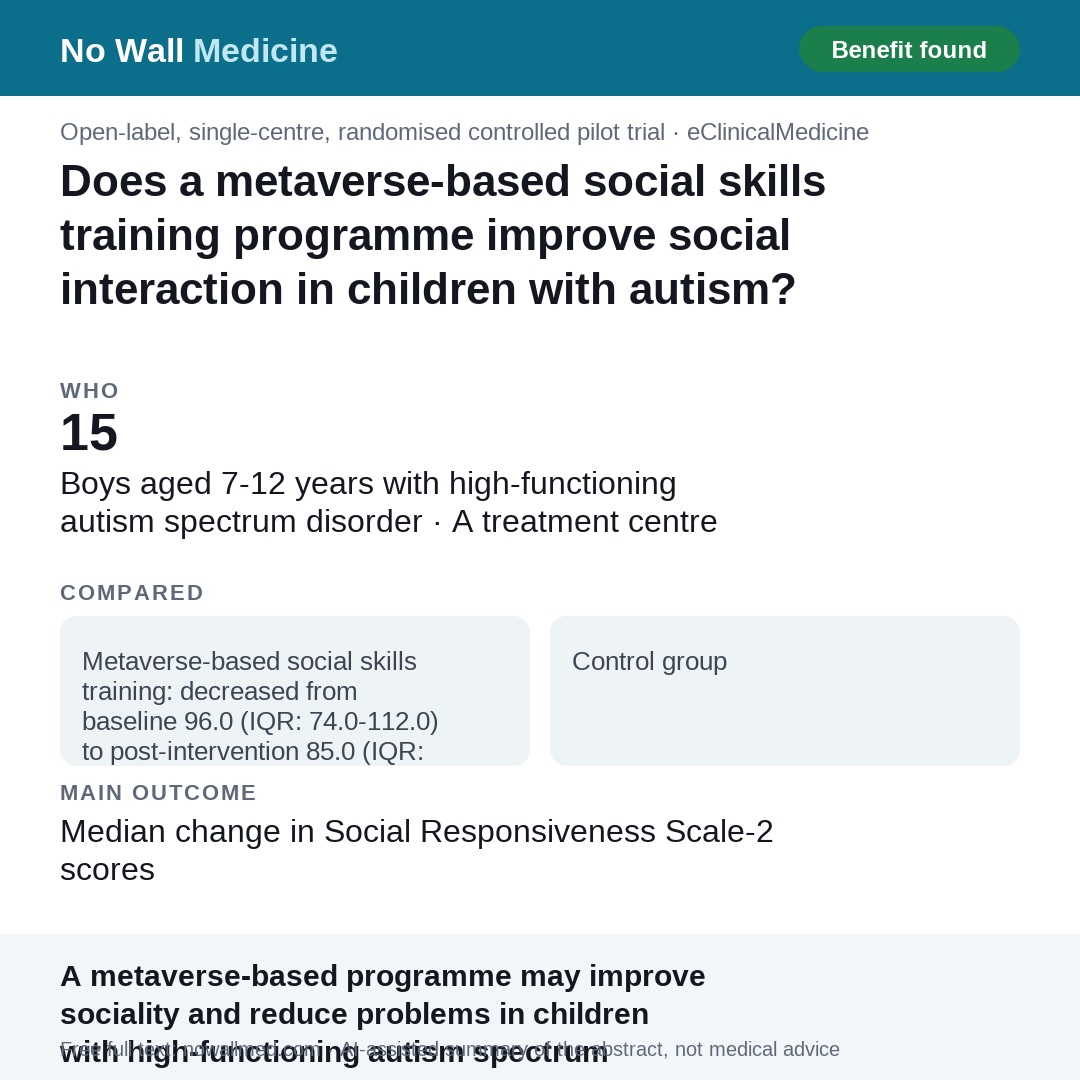
Does a metaverse-based social skills training programme improve social interaction in children with autism?
Who
15
Boys aged 7-12 years with high-functioning autism spectrum disorder · A treatment centre in Korea
Compared
Metaverse-based social skills training: decreased from baseline 96.0 (IQR: 74.0-112.0) to post-intervention 85.0 (IQR: 84.0-103.0)
Control group
Main outcome
Median change in Social Responsiveness Scale-2 scores
Result: group median difference 11.5 (95% CI: 8.5-14.0)
Bottom line: A metaverse-based programme may improve sociality and reduce problems in children with high-functioning autism spectrum disorder.
Funded by: Institute of Information & Communications Technology Planning & Evaluation
eClinicalMedicine · 2023-07-05Download image
Clinical question: Does a metaverse-based social skills training programme improve social interaction in children with autism?
Why it matters: It was unknown if a metaverse-based programme could be a feasible way to enhance social skills for children with high-functioning autism spectrum disorder.
Key points
- The pilot trial studied 15 boys aged 7-12 with high-functioning autism spectrum disorder, comparing a four-week metaverse-based programme to a control group.
- The intervention group's Social Responsiveness Scale-2 scores decreased from a median of 96.0 to 85.0, with a group median difference of 11.5 compared to the control group.
- Similar trends were observed in social cognition, social communication, and autistic mannerism scores.
Limitation the authors note: The study was an open-label, single-centre, pilot randomized controlled trial.
Headline and key points written with AI from the paper’s abstract, with every number checked against it. Read the paper before relying on them.
Was this summary helpful?
Cite this article
Lee JH, Lee TS, Yoo SY, Lee SW, Jang JH, Choi YJ. Metaverse-based social skills training programme for children with autism spectrum disorder to improve social interaction ability: an open-label, single-centre, randomised controlled pilot trial. eClinicalMedicine. 2023. doi:10.1016/j.eclinm.2023.102072
Spotted a mistake? Suggest a correction
Top studies every Monday
The week’s key trials and guidelines in your specialties, plus any topics you follow. By email, free.
Get the weekly digest