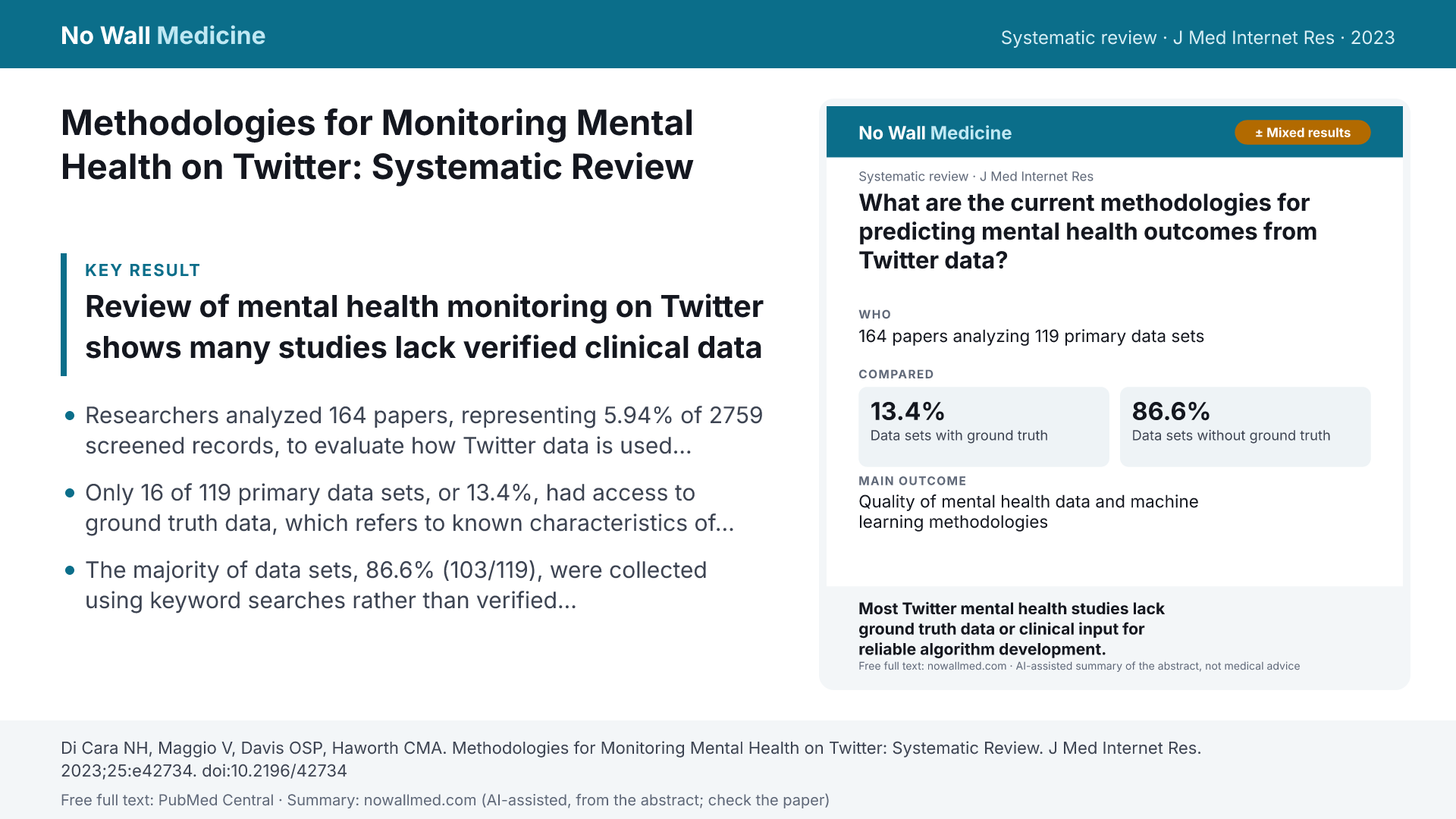
Review of mental health monitoring on Twitter shows many studies lack verified clinical data
Methodologies for Monitoring Mental Health on Twitter: Systematic Review
Systematic reviewMixed results
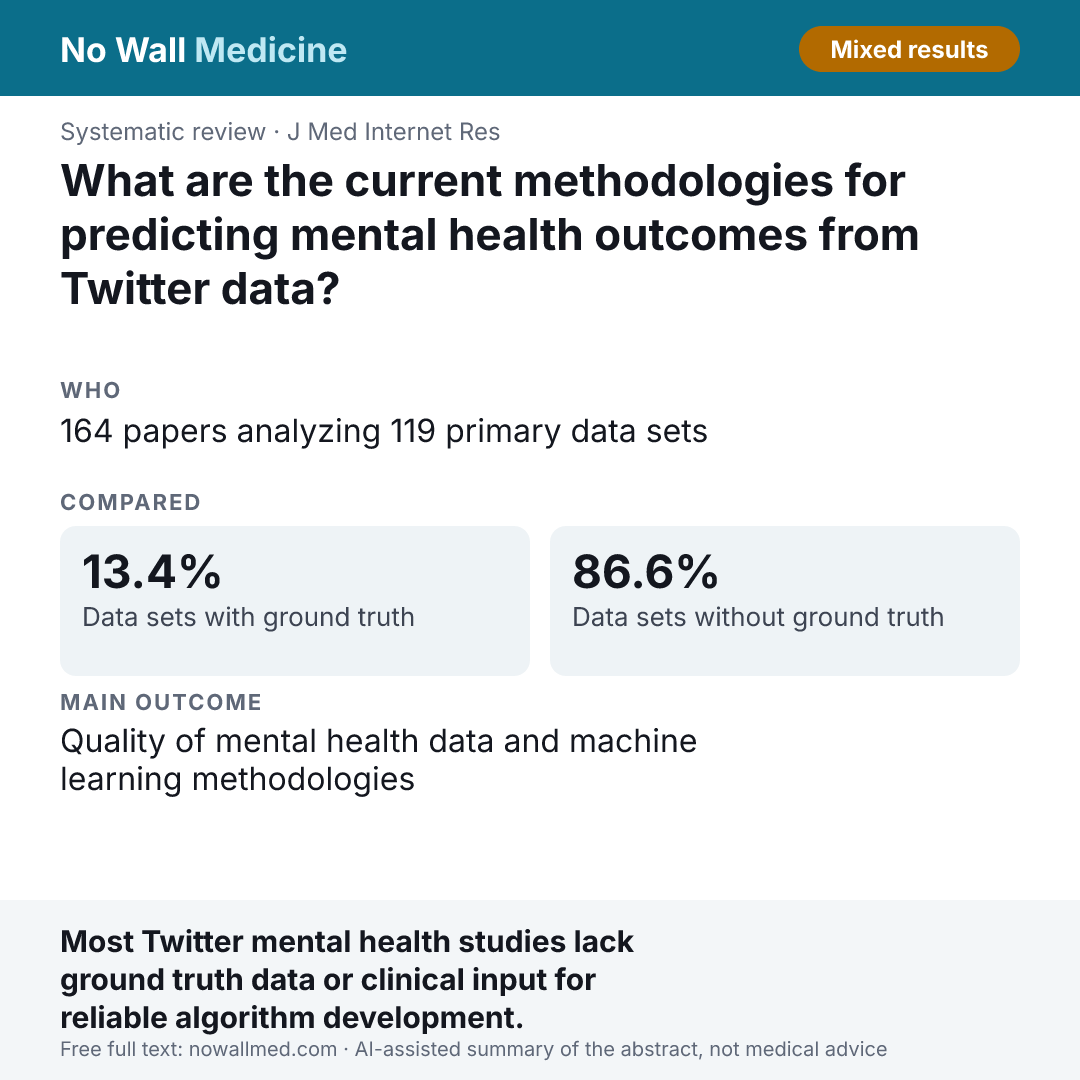
What are the current methodologies for predicting mental health outcomes from Twitter data?
Who
164 papers analyzing 119 primary data sets
Compared
13.4%Data sets with ground truth
86.6%Data sets without ground truth
Main outcome
Quality of mental health data and machine learning methodologies
Bottom line: Most Twitter mental health studies lack ground truth data or clinical input for reliable algorithm development.
Limitation: 86.6% of data sets used keyword searches which may not be representative of actual patterns.
J Med Internet Res · 2023-05-08 · Save PNG
Clinical question: What are the current methodologies for predicting mental health outcomes from Twitter data?
Key points
- Researchers analyzed 164 papers, representing 5.94% of 2759 screened records, to evaluate how Twitter data is used to predict mental health outcomes.
- Only 16 of 119 primary data sets, or 13.4%, had access to ground truth data, which refers to known characteristics of a user's mental health.
- The majority of data sets, 86.6% (103/119), were collected using keyword searches rather than verified clinical information.
Headline and key points written with AI from the paper’s abstract, with every number checked against it. Read the paper before relying on them.
Was this summary helpful?
Subject terms
Headline, design, result, key points, caveat and citation as plain text.
Cite this article
Di Cara NH, Maggio V, Davis OSP, Haworth CMA. Methodologies for Monitoring Mental Health on Twitter: Systematic Review. J Med Internet Res. 2023;25:e42734. doi:10.2196/42734
Spotted a mistake? Suggest a correction