Methodology for altering omega-3 EPA+DHA and omega-6 linoleic acid as controlled variables in a dietary trial
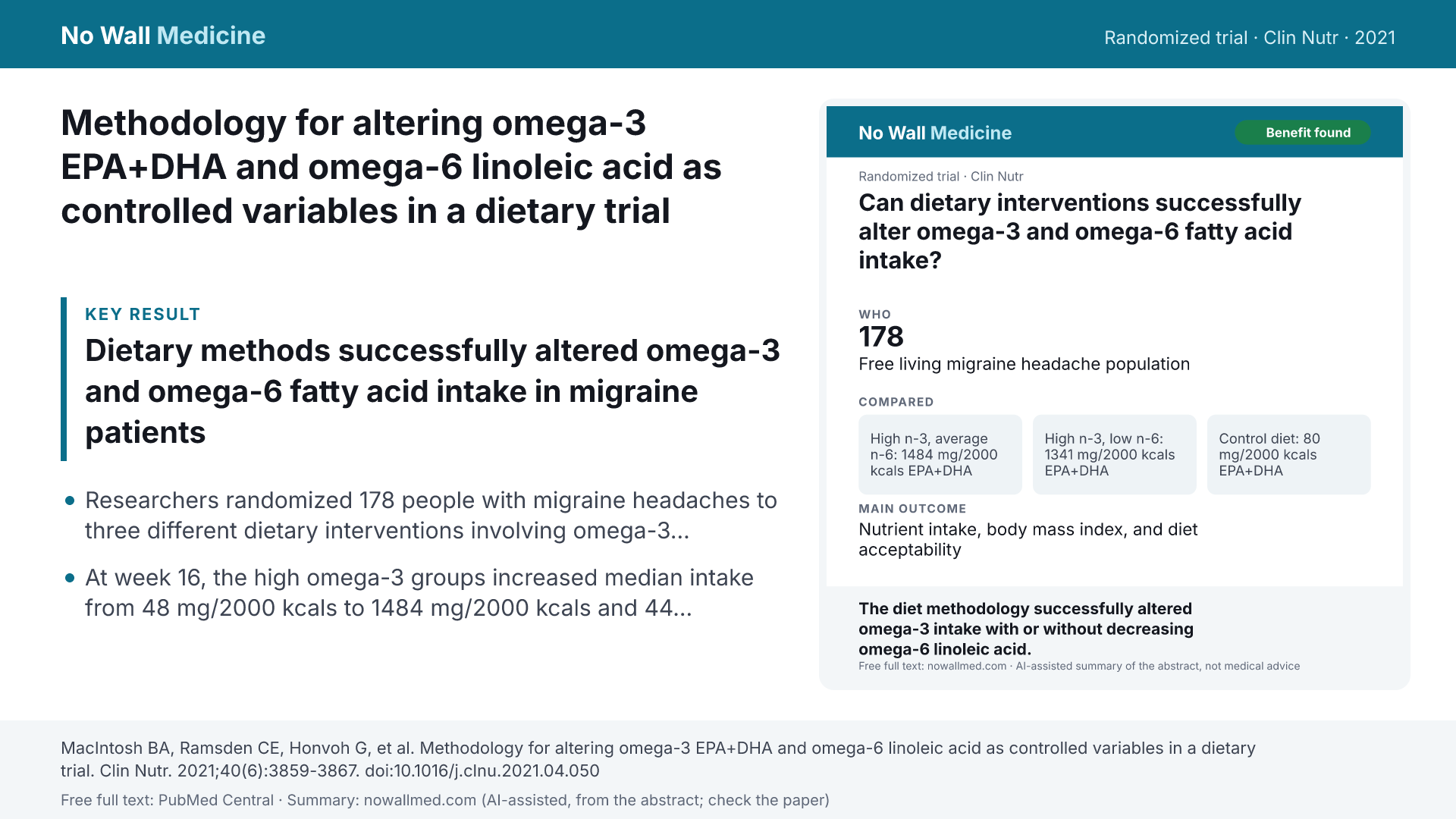
Key result: Dietary methods successfully altered omega-3 and omega-6 fatty acid intake in migraine patients
Randomized trialBenefit found
Can dietary interventions successfully alter omega-3 and omega-6 fatty acid intake?
Who
178
Free living migraine headache population
Compared
High n-3, average n-6: 1484 mg/2000 kcals EPA+DHA
High n-3, low n-6: 1341 mg/2000 kcals EPA+DHA
Control diet: 80 mg/2000 kcals EPA+DHA
Main outcome
Nutrient intake, body mass index, and diet acceptability
Bottom line: The diet methodology successfully altered omega-3 intake with or without decreasing omega-6 linoleic acid.
Clin Nutr · 2021-05-12
Key points
- Researchers randomized 178 people with migraine headaches to three different dietary interventions involving omega-3 and omega-6 fatty acids.
- At week 16, the high omega-3 groups increased median intake from 48 mg/2000 kcals to 1484 mg/2000 kcals and 44 mg/2000 kcals to 1341 mg/2000 kcals.
- The low omega-6 group saw linoleic acid decrease from 6.3 en% to 3.2 en%, while no significant changes were found in body mass index or diet acceptability.
Discussion prompts
- Would these patients look like yours? Who was left out?
- Is the main outcome one that matters to patients?
- Is the difference large enough to change what you do?
Cite: MacIntosh BA, Ramsden CE, Honvoh G, et al. Methodology for altering omega-3 EPA+DHA and omega-6 linoleic acid as controlled variables in a dietary trial. Clin Nutr. 2021;40(6):3859-3867. doi:10.1016/j.clnu.2021.04.050
Free full text: PubMed Central · Summary and visual abstract: nowallmed.com/a/methodology-for-altering-omega-3-epa-dha-and-omega-6-linoleic-acid-as-lp1rdt/ (AI-assisted from the abstract; check the paper before relying on it).