Systematic review identifies various modeling approaches used to simulate human postural control and balance
Methods for integrating postural control into biomechanical human simulations: a systematic review
Systematic literature reviewMixed results
What modeling approaches exist for integrating postural control into biomechanical human simulations?
Who
102
Biomechanical human simulation models
Compared
Reflex-based and PD controllers: show promising results
Optimal control methods: used less when model detail increases
Main outcome
Different approaches for sensory representation, integration, and control methods
Bottom line: Reflex-based and proportional-derivative controllers show promise for creating human-like motion in musculoskeletal models.
J Neuroeng Rehabil · 2023-08-21Download image
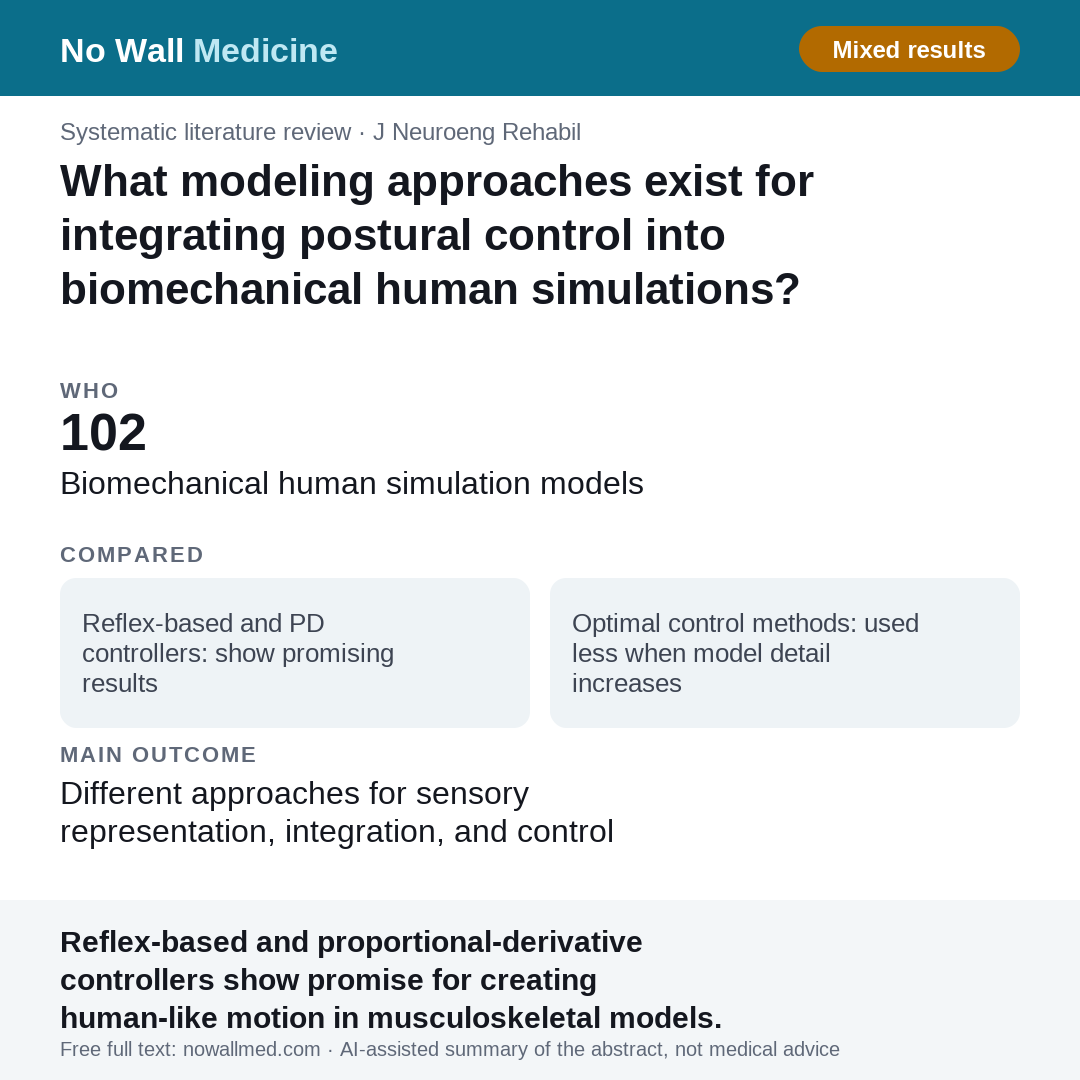
Clinical question: What modeling approaches exist for integrating postural control into biomechanical human simulations?
Why it matters: It is unknown which specific modeling approaches for sensory representation, integration, and control methods are currently used to simulate human postural control.
Key points
- Researchers scanned 1253 records and identified 102 eligible studies to categorize how different models represent sensory information and control methods.
- Reflex-based and proportional-derivative (PD) controllers are mainly used in musculoskeletal models to create human-like motion behavior.
- Optimal control methods, such as linear quadratic regulators and model predictive control, are used less frequently as model detail and nonlinearity increase.
Headline and key points written with AI from the paper’s abstract, with every number checked against it. Read the paper before relying on them.
Topics
Cite this article
Shanbhag J, Wolf A, Wechsler I, Fleischmann S, Winkler J, Leyendecker S. Methods for integrating postural control into biomechanical human simulations: a systematic review. J Neuroeng Rehabil. 2023. doi:10.1186/s12984-023-01235-3
Spotted a mistake? Suggest a correction
Top studies every Monday
The week’s key trials and guidelines in your specialties, plus any topics you follow. By email, free.
Get the weekly digest