Methods used for indirect comparisons of systemic treatments for psoriasis. A systematic review
Systematic reviewUnclear result
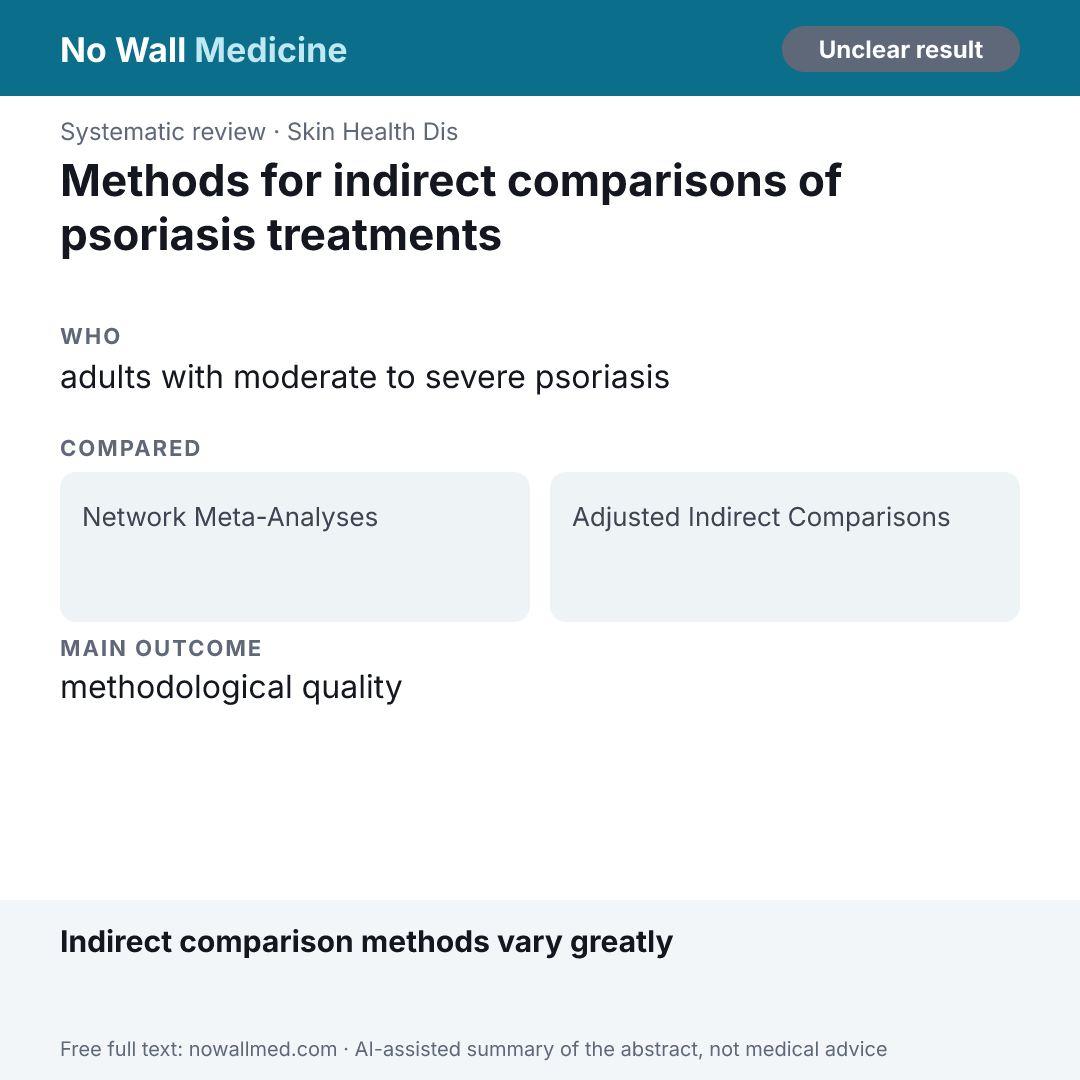
Methods for indirect comparisons of psoriasis treatments
Who
adults with moderate to severe psoriasis
Compared
Network Meta-Analyses
Adjusted Indirect Comparisons
Main outcome
methodological quality
Bottom line: Indirect comparison methods vary greatly
Limitation: small number of comparisons
Skin Health Dis · 2022-04-23 · Save PNG
Abstract
Background
Indirect comparisons (including network meta-analyses [NMAs]) allow us to compare benefits and risks of multiple interventions for the same clinical condition when head-to-head comparisons are not feasible. Objective
To provide guidance to the clinical community on better understanding indirect comparison methods to help them to interpret their results by applying two quality standards to published indirect comparisons of systemic biologics for moderate to severe psoriasis. Methods
A systematic literature review (SLR) of published indirect comparisons of biologics for the treatment of moderate to severe psoriasis in adults was conducted. Data extraction was performed using a predefined subset of NICE TSD7 (National Institute for Health and Care Excellence Technical Support Document 7) checklist questions and methods used to perform each analysis were descriptively compared. Methodological quality of the SLR underlying each indirect comparison was assessed using AMSTAR 2 (A MeaSurement Tool to Assess systematic Reviews version 2). Results
Twenty-two NMAs and four adjusted indirect comparisons (AICs) were identified. Although there were some similarities, for example, application of Bayesian random-effects models, several important methodological aspects varied considerably across NMAs identified, for example, classes of drugs, number of treatments and studies included, reporting and handling of different doses, and reporting of both checks for and investigations of inconsistency. Methodological comparisons across AICs were limited by the small number. The quality of most underlying SLRs described, assessed as overall level of confidence in the results, was 'critically low'. Conclusions
Understanding that there are different methodologies employed to answer differing research questions is key to helping clinicians to interpret the indirect evidence currently available in psoriasis.
Headline, design, result, key points, caveat and citation as plain text.
Cite this article
Nast A, Dressler C, Schuster C, Saure D, Augustin M, Reich K. Methods used for indirect comparisons of systemic treatments for psoriasis. A systematic review. Skin Health Dis. 2022. doi:10.1002/ski2.112
Spotted a mistake? Suggest a correction