Visual abstractsVisuals
Meta-analysisJournal of Pain and Symptom Management · Sep 19, 2026

Methylphenidate was associated with improved depressive symptoms in adults receiving palliative care

Methylphenidate-Based Interventions for Depressive Symptoms in Palliative Care: A Systematic Review and Meta-analysis

Huang Y, Tan C, Huang P, Li D, Ge M, Guo D, et al
Palliative CareAdult
Systematic review and meta-analysisBenefit found
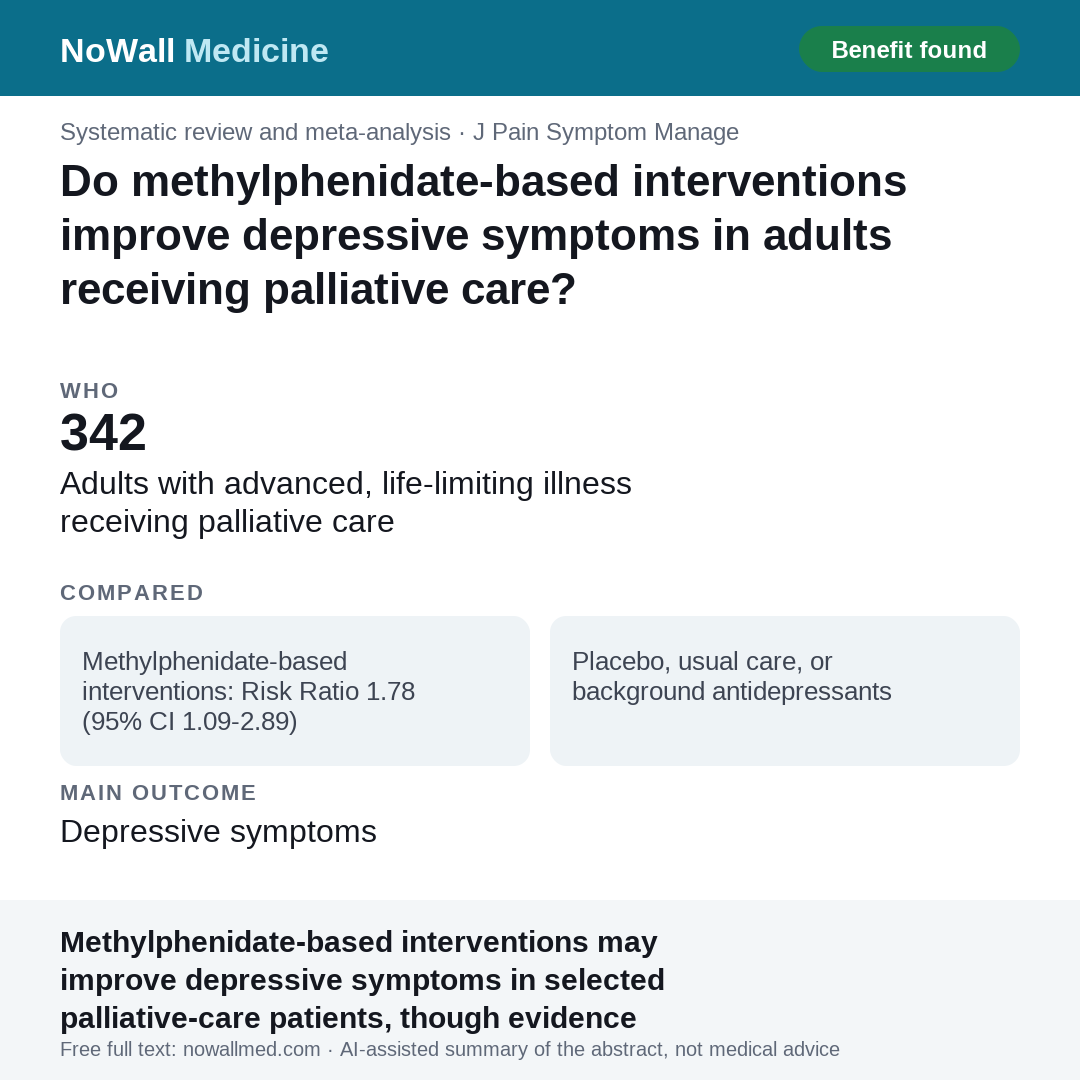
Do methylphenidate-based interventions improve depressive symptoms in adults receiving palliative care?
Who
342
Adults with advanced, life-limiting illness receiving palliative care
Compared
Methylphenidate-based interventions: Risk Ratio 1.78 (95% CI 1.09-2.89)
Placebo, usual care, or background antidepressants
Main outcome
Depressive symptoms
Result: standardized mean difference -0.47 (95% CI -0.81 to -0.13)
Bottom line: Methylphenidate-based interventions may improve depressive symptoms in selected palliative-care patients, though evidence certainty is very low to low.
Limitation: Small samples, heterogeneity, and indirectness resulted in very low to low evidence certainty.
J Pain Symptom Manage · 2026-09-19Download image

Clinical question: Do methylphenidate-based interventions improve depressive symptoms in adults receiving palliative care?

Why it matters: Conventional antidepressants for depressive symptoms in palliative care are limited by adverse effects and a delayed onset of action.

Key points

Limitation the authors note: The authors stated that evidence certainty is very low to low due to small samples, heterogeneity, and indirectness.

Headline and key points written with AI from the paper’s abstract, with every number checked against it. Read the paper before relying on them.

Read the full paper free at the publisher ↗

DOI: 10.1016/j.jpainsymman.2026.09.015 · PubMed: 42762836 · Registered: PROSPERO CRD420261277228

Spotted a mistake? Suggest a correction

More in Palliative Care

ResearchJ Pain Symptom Manage · Nov 21, 2026 · Palliative Care

Homebound cancer patients fell into two distress subgroups with differing quality of life

Psychosocial Profiles of Homebound Adults with Cancer and Poor Symptom Control: A Cluster Analysis of Meaning, Distress, and Desire for Hastened Death

ResearchPediatricJ Pain Symptom Manage · Nov 20, 2026 · Palliative Care

Family feedback loop deemed valuable in pediatric palliative care

Perceived Clinical Utility of a Routine Family Experience Feedback Loop in Pediatric Palliative Care

ResearchJ Pain Symptom Manage · Nov 19, 2026 · Palliative Care

Dementia linked to higher odds of unwanted end-of-life medical treatment

Dementia and Unwanted End-of-Life Treatment: A Retrospective Cohort Study Among Older Adults

ResearchPalliat Med · Nov 19, 2026 · Palliative Care

Eight symptoms predict survival in hospice patients at admission

Prediction of prognosis in hospice patients: Integrating symptom burden from multiple dimensions

ResearchBMC Palliat Care · Nov 18, 2026 · Palliative Care

Non-kin caregivers provide substantial support to seriously ill friends and neighbours

Beyond family ties - the role of non-kin caregivers of seriously ill friends and neighbours: quantitative findings from the NOCA study