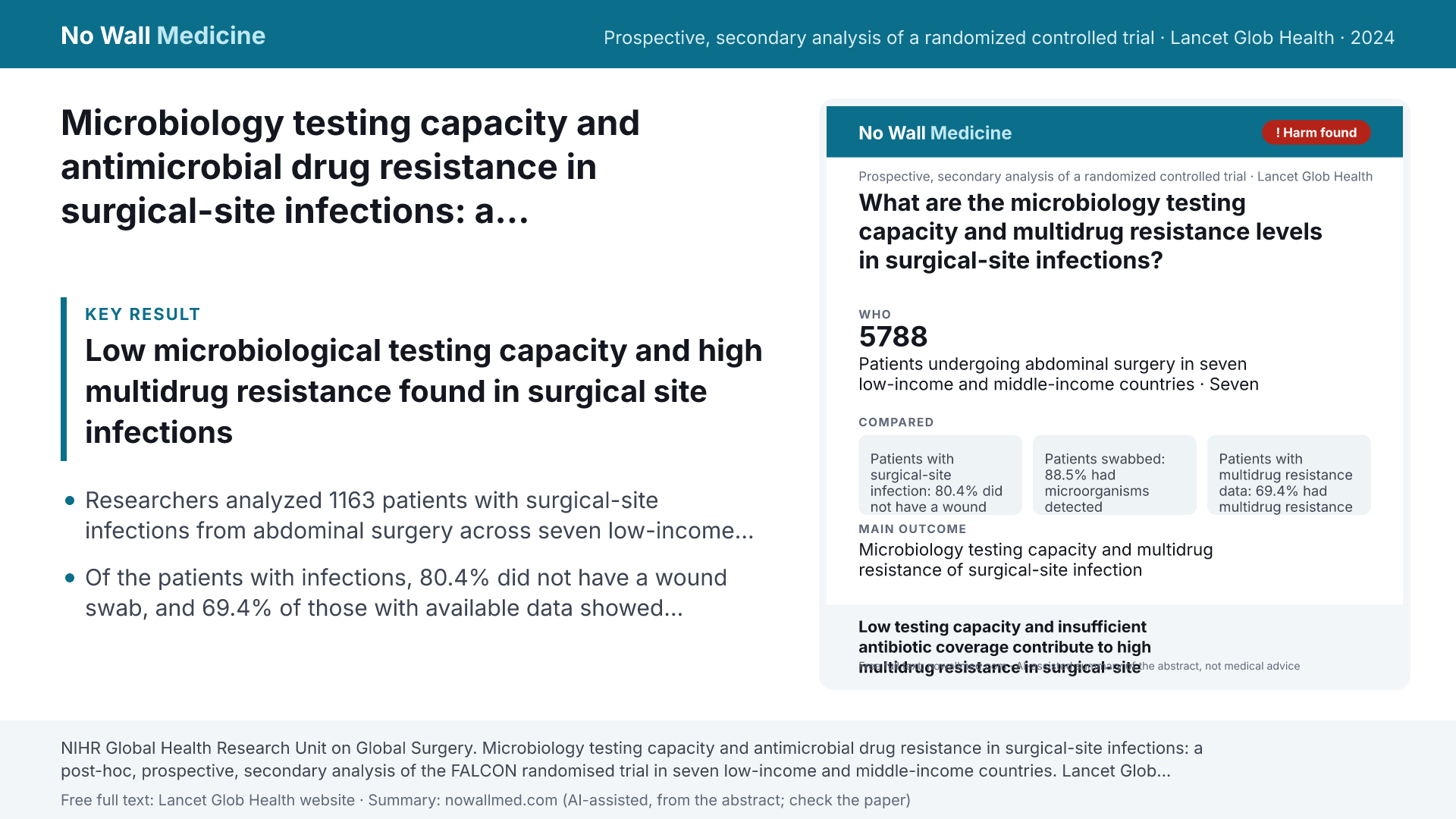
Low microbiological testing capacity and high multidrug resistance found in surgical site infections
Microbiology testing capacity and antimicrobial drug resistance in surgical-site infections: a post-hoc, prospective, secondary analysis of the FALCON randomised trial in seven low-income and middle-income countries
Prospective, secondary analysis of a randomized controlled trialHarm found
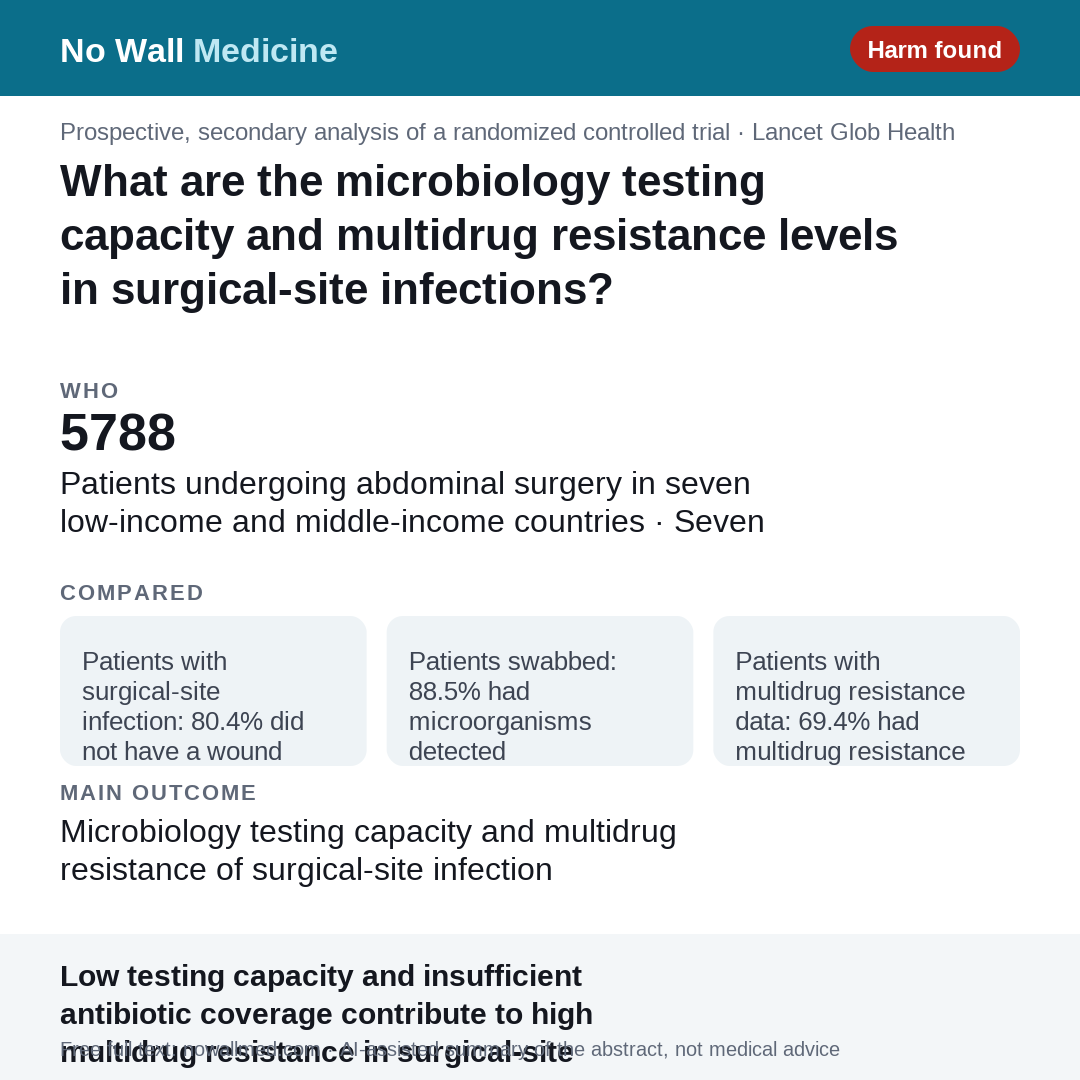
What are the microbiology testing capacity and multidrug resistance levels in surgical-site infections?
Who
5788
Patients undergoing abdominal surgery in seven low-income and middle-income countries · Seven low-income and middle-income countries
Compared
Patients with surgical-site infection: 80.4% did not have a wound swab
Patients swabbed: 88.5% had microorganisms detected
Patients with multidrug resistance data: 69.4% had multidrug resistance
Main outcome
Microbiology testing capacity and multidrug resistance of surgical-site infection microorganisms
Bottom line: Low testing capacity and insufficient antibiotic coverage contribute to high multidrug resistance in surgical-site infections in low-income countries.
Funded by: National Institute for Health and Care Research
Lancet Glob Health · 2024-09-05Download image
Clinical question: What are the microbiology testing capacity and multidrug resistance levels in surgical-site infections?
Why it matters: The extent of microbiological testing capacity and the prevalence of multidrug resistance in surgical-site infections in low-income and middle-income countries is unknown.
Key points
- Researchers analyzed 1163 patients with surgical-site infections from abdominal surgery across seven low-income and middle-income countries.
- Of the patients with infections, 80.4% did not have a wound swab, and 69.4% of those with available data showed multidrug resistance.
- Appropriate antibiotic coverage and the regular availability of infection control teams were associated with a reduction in multidrug resistance.
Headline and key points written with AI from the paper’s abstract, with every number checked against it. Read the paper before relying on them.
Was this summary helpful?
Abstract
Background
Surgical-site infection (SSI) is one of the most common health-care-associated infections, substantially contributing to antibiotic use. Targeted antibiotic prophylaxis to prevent SSIs and effective treatment are crucial to controlling antimicrobial resistance (AMR). This study aimed to describe the testing capacity and multidrug resistance (MDR) of SSI microorganisms in low-income and middle-income countries (LMICs). Methods
This analysis included patients undergoing abdominal surgery in seven LMICs (Benin, Ghana, India, Mexico, Nigeria, Rwanda, and South Africa) as part of the FALCON randomised controlled trial. Wound swabs were collected from patients diagnosed with SSI, as per US Centers for Disease Control and Prevention (CDC) definition. Data on microorganism species and MDR, as per CDC and European Centre for Disease Prevention and Control definitions, were analysed alongside hospital-level data on local microbiological practices. An adjusted analysis was performed to identify perioperative factors associated with MDR. Testing capacity was assessed by the completion of swab testing in positively diagnosed SSIs. Findings
Between Dec 10, 2018, and Sept 7, 2020, 5788 patients were recruited to the FALCON trial. 1163 patients were diagnosed with an SSI, of whom 905 (77·8%) received prophylactic antibiotics before surgery. In patients with SSIs, 935 of 1163 (80·4%) did not have a wound swab; 195 were from hospitals not performing swabs (15 hospitals) and 740 were from hospitals with capacity but no swab performed (35 hospitals). Of 228 patients swabbed, 200 (88·5%) had microorganisms detected. Escherichia coli (89 of 200, 37·9%) was the most common microorganism and 116 of 200 (58·0%) patients were not covered by the perioperative prophylactic antibiotic. MDR was found in 102 of 147 (69·4%) patients for whom data were available to determine MDR status. Adjusted analysis found that appropriate prophylactic antibiotic coverage (adjusted odds ratio 0·43, 95% CI 0·19-0·96) and regular availability of infection control teams (0·32, 0·11-0·93) were associated with a significant reduction in MDR. Interpretation
Targeted perioperative antibiotic prophylaxis during contaminated abdominal surgery is insufficient in LMICs, with very few SSI organisms undergoing formal diagnosis. Expansion of testing capacity, development of local guidelines, and implementation of infection control teams could support the prevention of SSI through directed antibiotic prophylaxis, subsequently reducing the burden of MDR. Funding
National Institute for Health and Care Research. Translations
For the French and Spanish translations of the abstract see Supplementary Materials section.
Abstract reproduced under the article’s CC BY licence.
Subject terms
Cite this article
NIHR Global Health Research Unit on Global Surgery. Microbiology testing capacity and antimicrobial drug resistance in surgical-site infections: a post-hoc, prospective, secondary analysis of the FALCON randomised trial in seven low-income and middle-income countries. Lancet Glob Health. 2024. doi:10.1016/S2214-109X(24)00330-9
Spotted a mistake? Suggest a correction