Alternate-day fasting was associated with the greatest cognitive improvements in people with obesity
Microbiota fasting-related changes ameliorate cognitive decline in obesity and boost ex vivo microglial function through the gut-brain axis
Randomized trialBenefit found
How do different dietary interventions influence cognitive function and microbiota in obesity?
Who
96
Participants with obesity
Compared
Mediterranean diet
alternate-day fasting: improved most notably
ketogenic diet
Main outcome
Cognitive performance and microbiota composition
Bottom line: Alternate-day fasting most effectively improved cognitive performance and enhanced microglial function in individuals with obesity.
Gut · 2025-10-08Download image
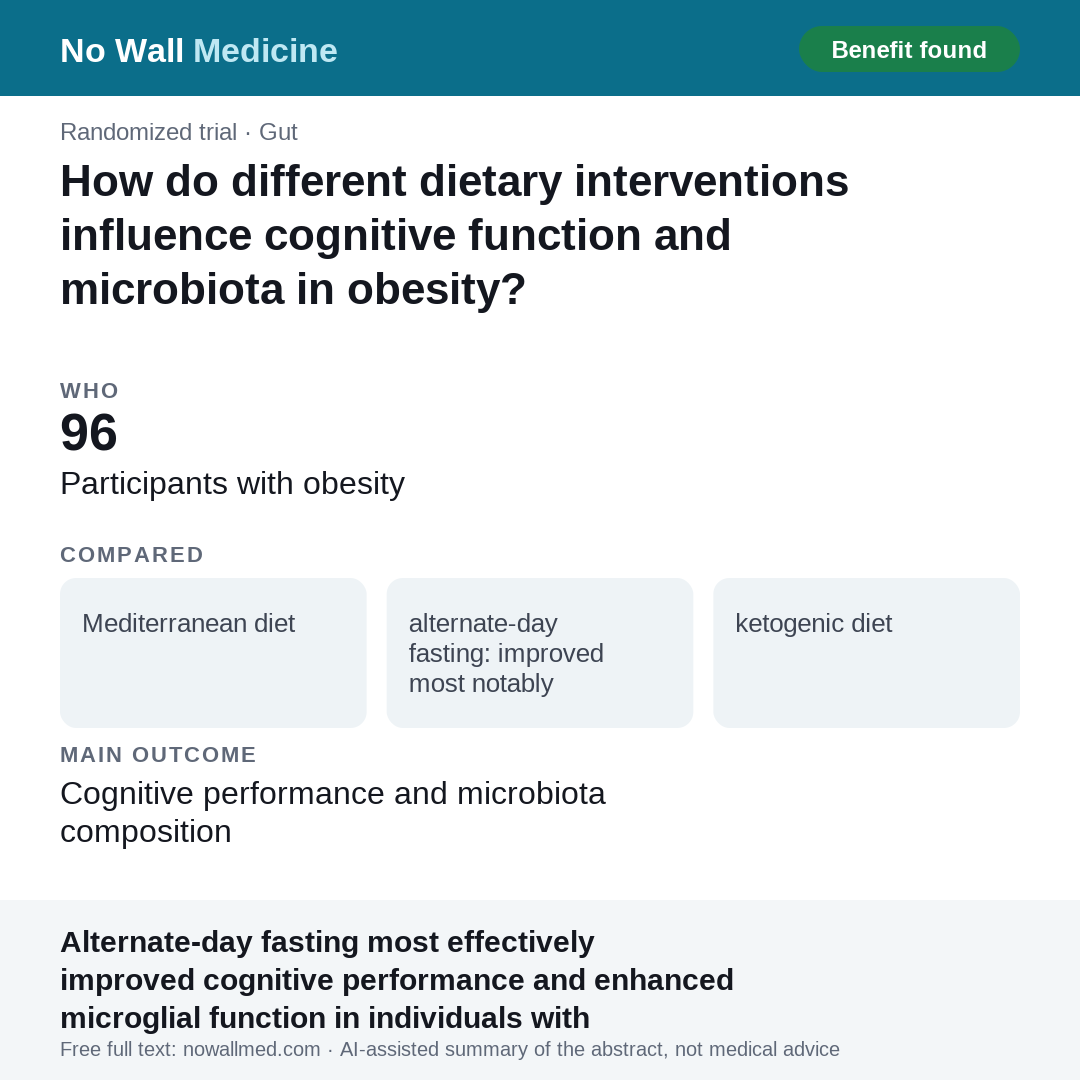
Clinical question: How do different dietary interventions influence cognitive function and microbiota in obesity?
Why it matters: The role of microglial cells, which are the brain's resident immune cells, in the relationship between gut microbiota and obesity-related cognitive decline is underexplored.
Key points
- Researchers studied 96 participants with obesity who were randomized into Mediterranean diet, alternate-day fasting, or ketogenic diet groups.
- The alternate-day fasting group showed the most notable improvement in cognitive performance, which was associated with reduced inflammation.
- In mouse models, the benefits of alternate-day fasting were linked to enhanced microglial phagocytic capacity, which is the ability of immune cells to clear debris.
Headline and key points written with AI from the paper’s abstract, with every number checked against it. Read the paper before relying on them.
Abstract
Background
Obesity-related cognitive decline is linked to gut microbiota dysbiosis, with emerging evidence suggesting that dietary interventions may ameliorate cognitive impairment via gut-brain axis modulation. The role of microglial cells in this process remains underexplored. Objective
To investigate how diet-induced changes in gut microbiota influence cognitive function in individuals with obesity and their microglial activity, and to determine the impact of specific dietary interventions. Design
This study included 96 participants with obesity who were randomised into three dietary intervention groups: Mediterranean diet (Med), alternate-day fasting (ADF) and ketogenic diet (Keto). Cognitive performance and microbiota composition were assessed pre-intervention and post-intervention. The effects of microbiota-related changes on microglial function were further evaluated in mice models through faecal transplantation and in vitro model with microbiota exosome treatment. Results
Both the Keto and ADF groups demonstrated significant weight loss, but cognitive performance improved most notably in the ADF group, in association with reduced inflammation. Diet-related microbiota composition was correlated with the cognitive outcomes in the human study. Mice models confirmed that the cognitive benefits of ADF were microbiota-dependent and linked to enhanced microglial phagocytic capacity and reduced inflammation, accompanied by changes in microglia morphology. Conclusion
Fasting-induced modifications in gut microbiota contribute to cognitive improvement in individuals with obesity, with microglial cells playing a crucial mediatory role. Among the interventions, ADF most effectively enhanced microglial function and cognitive performance, suggesting its potential as a therapeutic strategy for obesity-related cognitive decline. Further studies are required to fully elucidate the underlying mechanisms. Trial registration number
NCT04453150.
Abstract reproduced under the article’s CC BY NC licence.
Topics
Cite this article
Mela V, Heras V, Iesmantaite M, García-Martín ML, Bernal M, Posligua-García JD. Microbiota fasting-related changes ameliorate cognitive decline in obesity and boost ex vivo microglial function through the gut-brain axis. Gut. 2025. doi:10.1136/gutjnl-2025-335353
Spotted a mistake? Suggest a correction