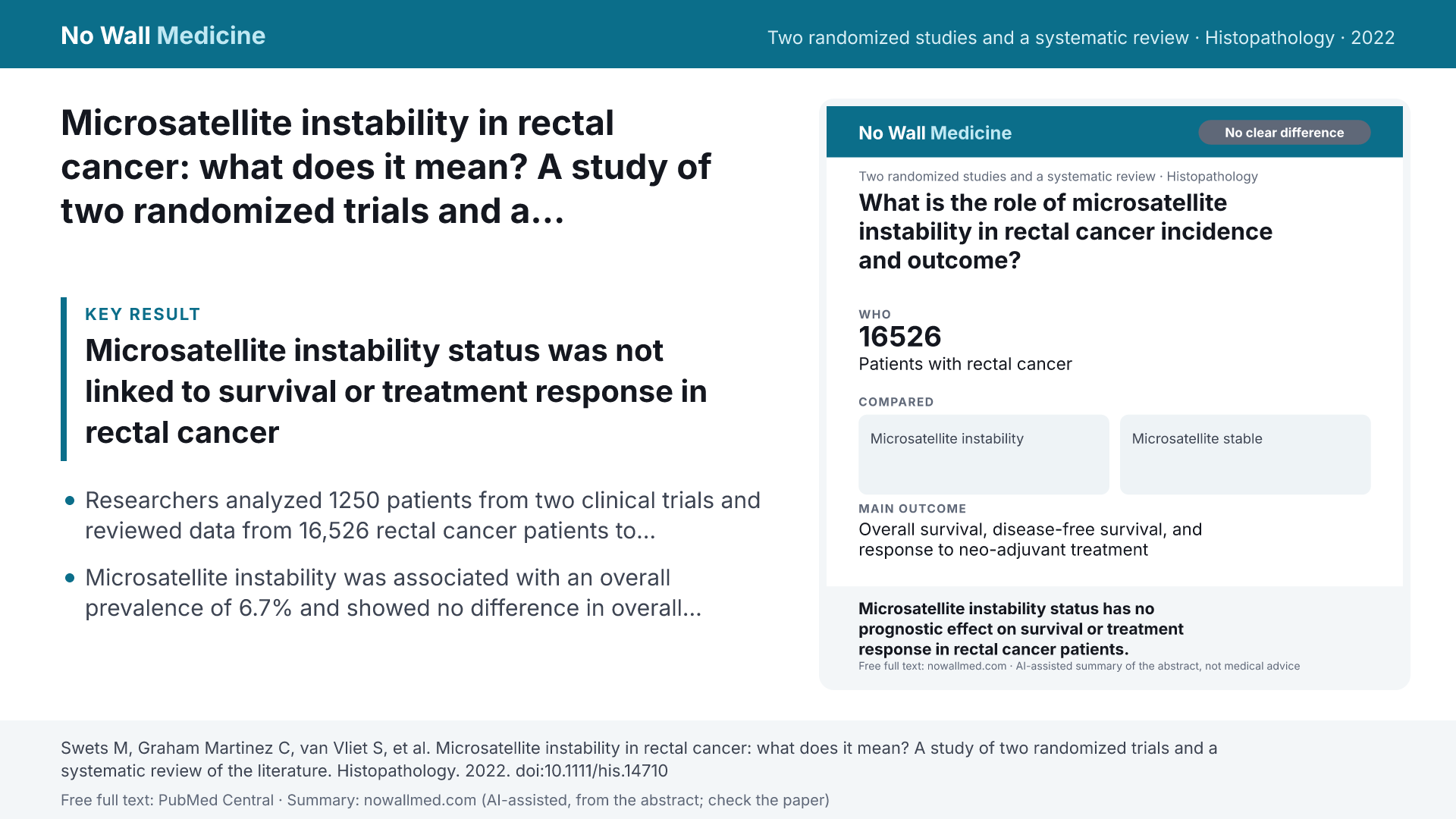
Microsatellite instability status was not linked to survival or treatment response in rectal cancer
Microsatellite instability in rectal cancer: what does it mean? A study of two randomized trials and a systematic review of the literature
Two randomized studies and a systematic reviewNo clear difference
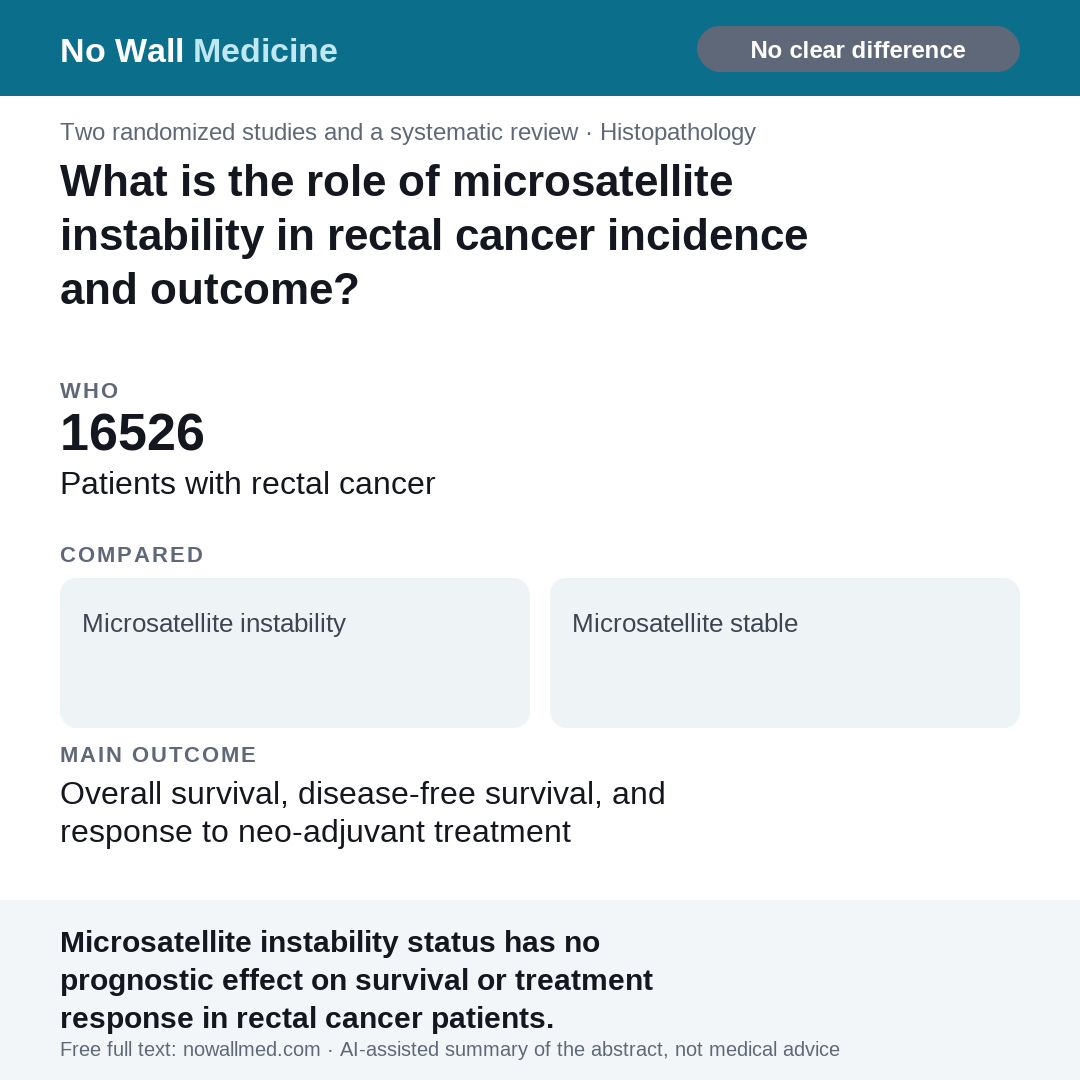
What is the role of microsatellite instability in rectal cancer incidence and outcome?
Who
16526
Patients with rectal cancer
Compared
Microsatellite instability
Microsatellite stable
Main outcome
Overall survival, disease-free survival, and response to neo-adjuvant treatment
Result: hazard ratio 1.00 (95% CI 0.69-1.47)
Bottom line: Microsatellite instability status has no prognostic effect on survival or treatment response in rectal cancer patients.
Histopathology · 2022-07-14Download image
Clinical question: What is the role of microsatellite instability in rectal cancer incidence and outcome?
Why it matters: The implications of microsatellite instability regarding incidence and outcomes in patients specifically with rectal cancer remain undefined.
Key points
- Researchers analyzed 1250 patients from two clinical trials and reviewed data from 16,526 rectal cancer patients to evaluate microsatellite instability, a genetic marker.
- Microsatellite instability was associated with an overall prevalence of 6.7% and showed no difference in overall survival (HR 1.00, 95% CI 0.69-1.47) or disease-free survival (HR 1.00, 95% CI 0.68-1.45).
- The genetic marker was not linked to the likelihood of downstaging or achieving a pathological complete response, which is the disappearance of all tumor cells after treatment.
Headline and key points written with AI from the paper’s abstract, with every number checked against it. Read the paper before relying on them.
Was this summary helpful?
Subject terms
Headline, design, result, key points, caveat and citation as plain text.
Cite this article
Swets M, Graham Martinez C, van Vliet S, et al. Microsatellite instability in rectal cancer: what does it mean? A study of two randomized trials and a systematic review of the literature. Histopathology. 2022. doi:10.1111/his.14710
Spotted a mistake? Suggest a correction