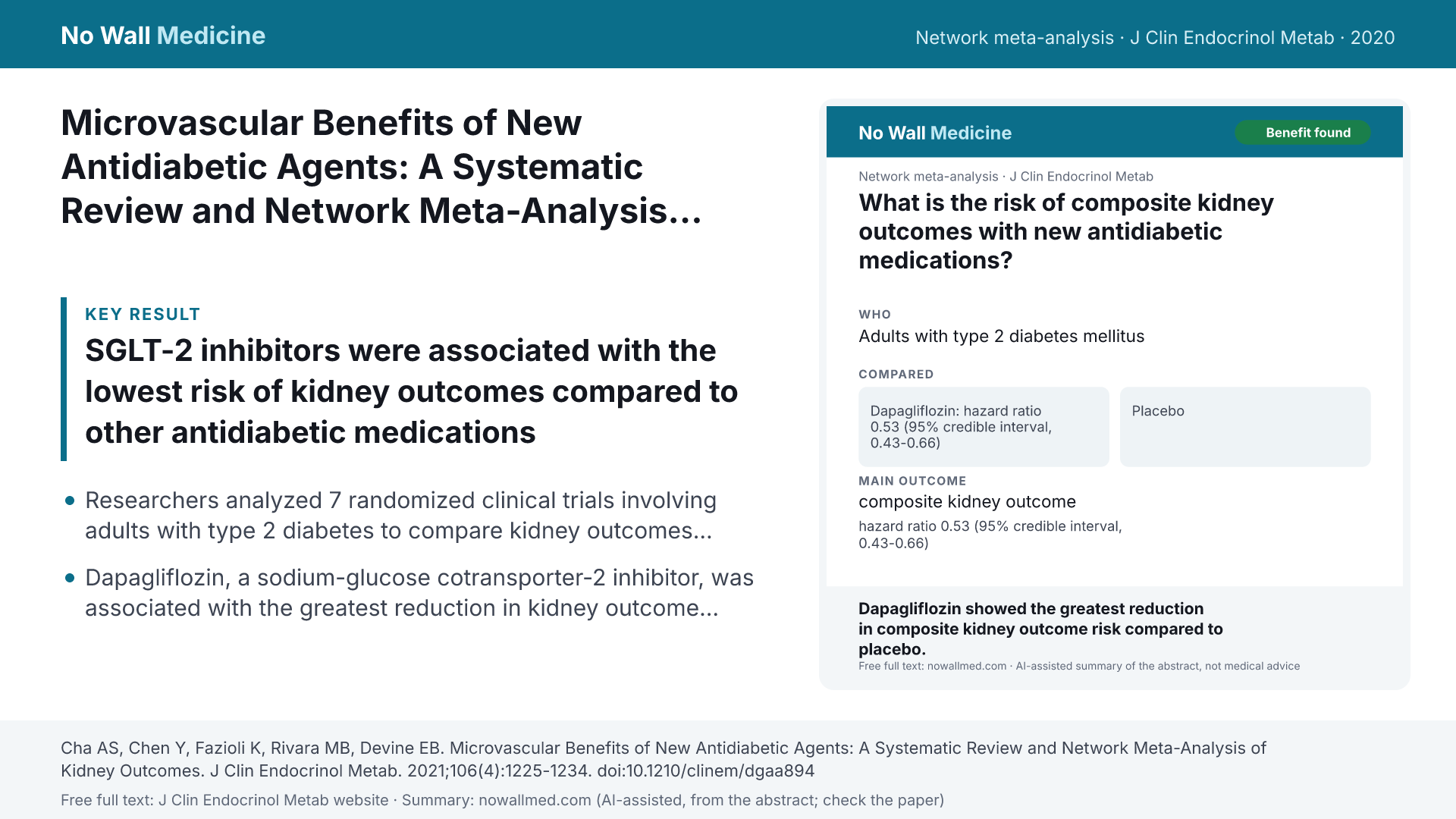
SGLT-2 inhibitors were associated with the lowest risk of kidney outcomes compared to other antidiabetic medications
Microvascular Benefits of New Antidiabetic Agents: A Systematic Review and Network Meta-Analysis of Kidney Outcomes
Network meta-analysisBenefit found
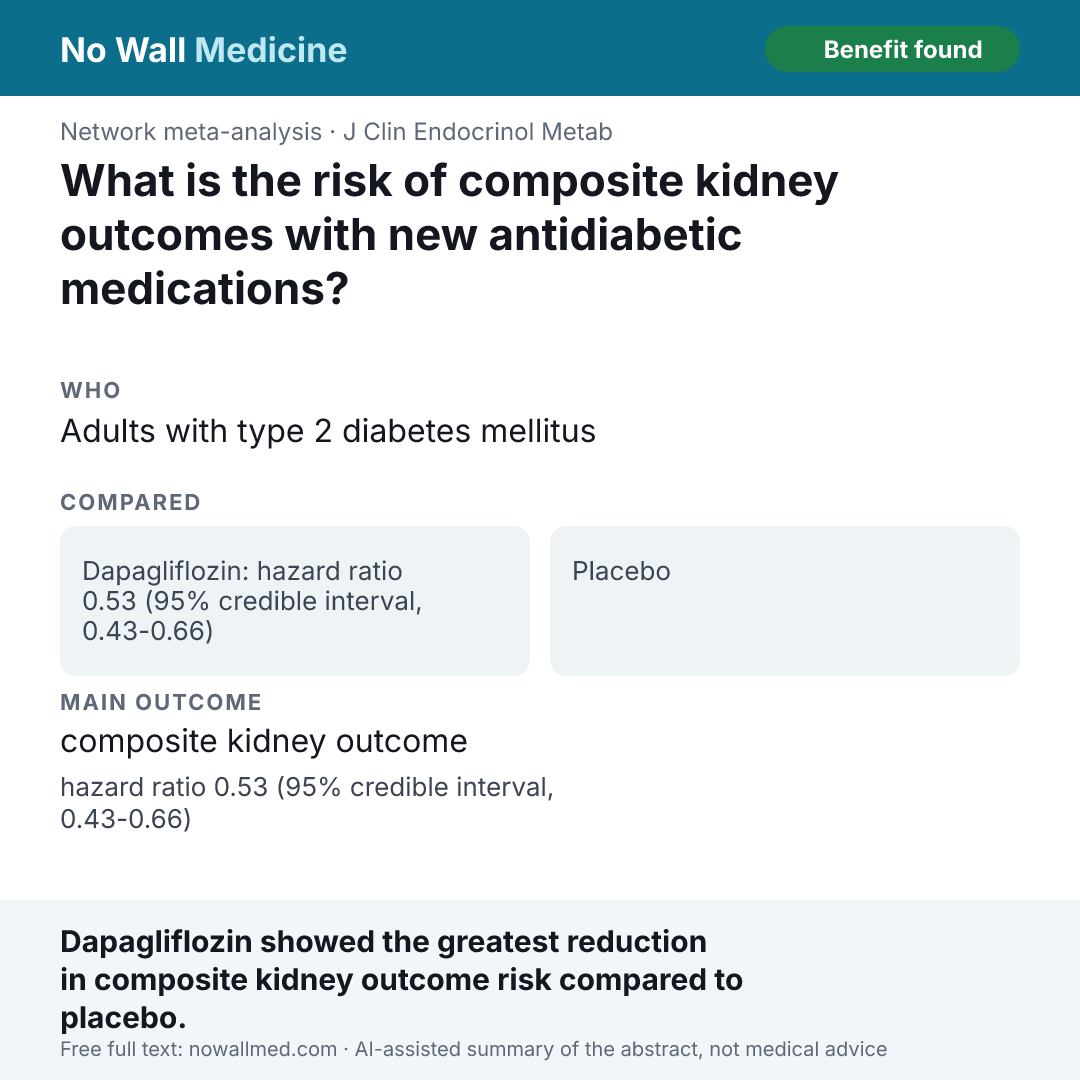
What is the risk of composite kidney outcomes with new antidiabetic medications?
Who
Adults with type 2 diabetes mellitus
Compared
Dapagliflozin: hazard ratio 0.53 (95% credible interval, 0.43-0.66)
Placebo
Main outcome
composite kidney outcome
Result: hazard ratio 0.53 (95% credible interval, 0.43-0.66)
Bottom line: Dapagliflozin showed the greatest reduction in composite kidney outcome risk compared to placebo.
Limitation: Scarcity of data for kidney safety endpoints in large, randomized clinical trials.
J Clin Endocrinol Metab · 2020-11-29 · Save PNG
Clinical question: What is the risk of composite kidney outcomes with new antidiabetic medications?
Why it matters: The risk of developing kidney complications among patients using different classes of new antidiabetic medications was not clearly characterized.
Key points
- Researchers analyzed 7 randomized clinical trials involving adults with type 2 diabetes to compare kidney outcomes across three drug classes.
- Dapagliflozin, a sodium-glucose cotransporter-2 inhibitor, was associated with the greatest reduction in kidney outcome risk with a hazard ratio of 0.53.
- Empagliflozin, canagliflozin, semaglutide, and liraglutide also showed reduced risks, while linagliptin, a dipeptidyl peptidase-4 inhibitor, did not show a significant reduction.
Limitation the authors note: The analysis was limited by a scarcity of data for kidney safety endpoints in large, randomized clinical trials.
Headline and key points written with AI from the paper’s abstract, with every number checked against it. Read the paper before relying on them.
Was this summary helpful?
Subject terms
Headline, design, result, key points, caveat and citation as plain text.
Cite this article
Cha AS, Chen Y, Fazioli K, Rivara MB, Devine EB. Microvascular Benefits of New Antidiabetic Agents: A Systematic Review and Network Meta-Analysis of Kidney Outcomes. J Clin Endocrinol Metab. 2021;106(4):1225-1234. doi:10.1210/clinem/dgaa894
Spotted a mistake? Suggest a correction