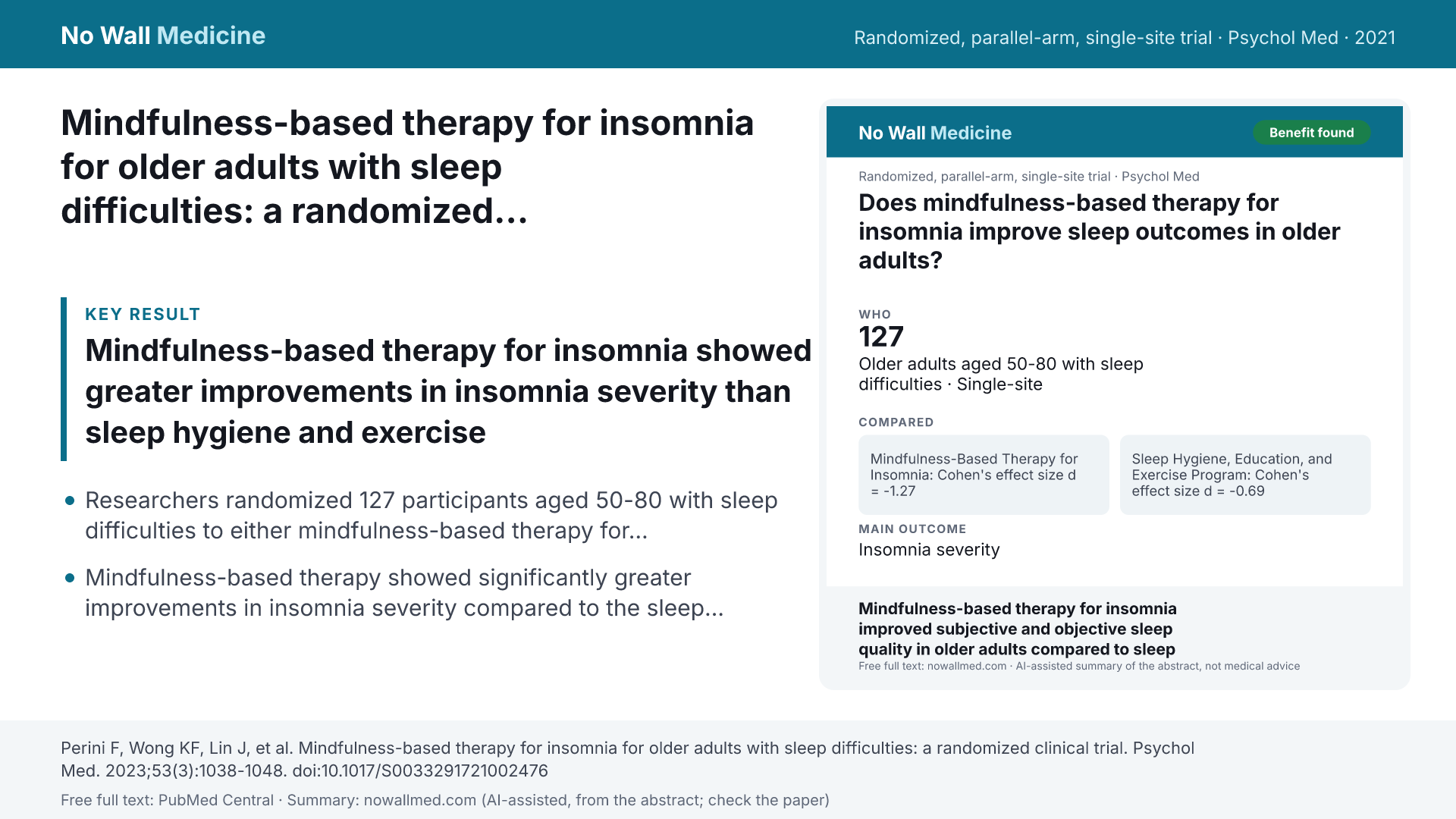
Mindfulness-based therapy for insomnia showed greater improvements in insomnia severity than sleep hygiene and exercise
Mindfulness-based therapy for insomnia for older adults with sleep difficulties: a randomized clinical trial
Randomized, parallel-arm, single-site trialBenefit found
Does mindfulness-based therapy for insomnia improve sleep outcomes in older adults?
Who
127
Older adults aged 50-80 with sleep difficulties · Single-site
Compared
Mindfulness-Based Therapy for Insomnia: Cohen's effect size d = -1.27
Sleep Hygiene, Education, and Exercise Program: Cohen's effect size d = -0.69
Main outcome
Insomnia severity
Bottom line: Mindfulness-based therapy for insomnia improved subjective and objective sleep quality in older adults compared to sleep hygiene, education, and exercise.
Psychol Med · 2021-07-01Download image
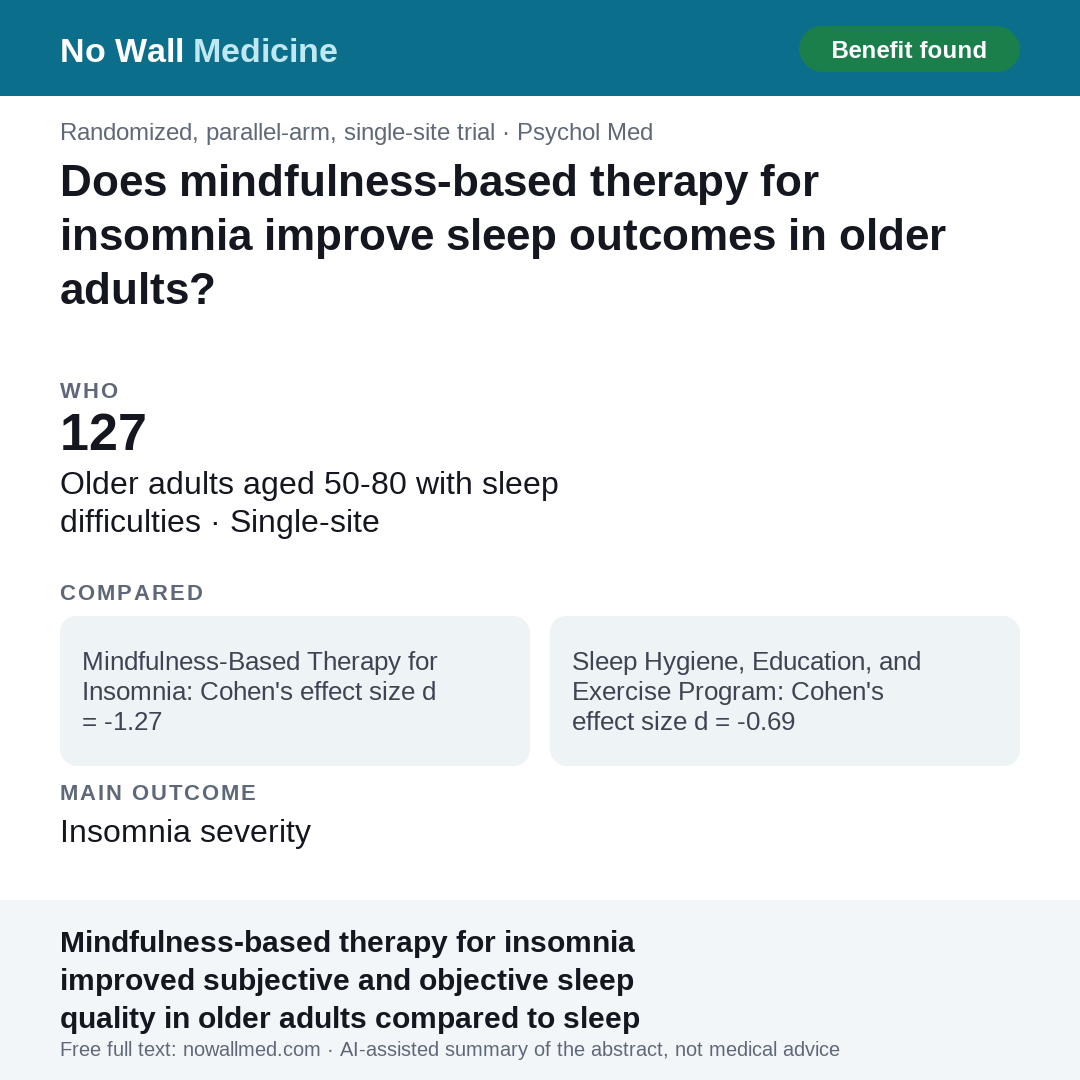
Clinical question: Does mindfulness-based therapy for insomnia improve sleep outcomes in older adults?
Why it matters: Frontline treatments for insomnia have limitations, leaving it unknown if mindfulness-based therapy is an effective alternative for older adults with sleep difficulties.
Key points
- Researchers randomized 127 participants aged 50-80 with sleep difficulties to either mindfulness-based therapy for insomnia or a sleep hygiene, education, and exercise program.
- Mindfulness-based therapy showed significantly greater improvements in insomnia severity compared to the sleep hygiene program, with a Cohen's effect size of d = -1.27 versus d = -0.69.
- Mindfulness-based therapy was associated with reduced wake after sleep onset and sleep onset latency measured by actigraphy, but no significant interaction effects were observed in objective sleep measures.
Headline and key points written with AI from the paper’s abstract, with every number checked against it. Read the paper before relying on them.
Was this summary helpful?
Subject terms
Cite this article
Perini F, Wong KF, Lin J, Hassirim Z, Ong JL, Lo J. Mindfulness-based therapy for insomnia for older adults with sleep difficulties: a randomized clinical trial. Psychol Med. 2021. doi:10.1017/S0033291721002476
Spotted a mistake? Suggest a correction
Top studies every Monday
The week’s key trials and guidelines in your specialties, plus any topics you follow. By email, free.
Get the weekly digest